| Author |
 Replies: 10 / Views: 1,332 Replies: 10 / Views: 1,332 |
|
|
New Member
United Kingdom
4 Posts |
Hey all, My family and I found this coin while out on one of our regular walks. It was about 6 inches underground the area is known to have roman connections. The coin itself is 17 grams and 31 mm, its uneven and quite thick on one side. I guess its copper or bronze due to the green? We have no idea to be honest as this is the first coin we have ever found. 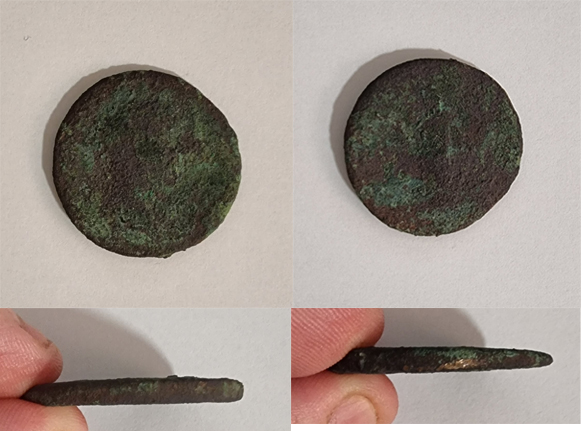 |
|
|
|
Pillar of the Community
United States
7066 Posts |
Welcome, and congrats on the find.
Yes, almost certainly a Roman Imperial bronze coin. I think it's too far gone (worn and corroded) to definitively ID. It has a right-facing male bust, likely laureate, for the obverse, and a standing figure reverse. With the weight and dimensions that may seem to narrow it down some, but there are still so many possibilities.
|
|
New Member
 United Kingdom
4 Posts |
Thanks for the reply Bob.
The area we found it is known for having very acidic soil which might be the cause of most of the corrosion.
I'm guessing Imperial Rome is 31 BC - AD 476 from a quick google, which is amazing.
I just wish I could see more of the detail to really narrow it down.
|
|
Moderator
 United States
23731 Posts |
 to the community. I agree it's does appear to be Roman. |
|
Pillar of the Community
United States
1046 Posts |
Most likely a 2nd or 3rd-century Sestertius. Could also be a provincial coin.
|
|
Pillar of the Community
United States
3402 Posts |
Hats off to my colleagues with better eyesight...I can make out a right facing head and maybe a standing figure on the other side.
KK
|
|
Moderator
United States
194586 Posts |
to the Community! |
|
Moderator
Australia
16963 Posts |
If found in the ground in Britain, it's likely to be a "proper Roman" coin, rather than Roman Provincial. Bronze coins rarely travelled far from the city of issue, and Britain never issued "Provincial coins". My best guess for a date for this piece is somewhere around 120-170 AD, possibly into the early 200s.
Don't say "infinitely" when you mean "very"; otherwise, you'll have no word left when you want to talk about something really infinite. - C. S. Lewis
|
|
Moderator
Australia
16963 Posts |
As for what it's made from, it could be bronze, or it could be "orichalcum", an ancient type of brass. The small spot on the edge where it's been scraped does look brassy in colour. Meanwhile, those of us "living in the colonies" are jealous of people living in a land where somebody walking along can stumble upon an 1800 year old Roman coin just sitting there buried in the ground. We think finding a coin that's 100 years old is special.   Don't say "infinitely" when you mean "very"; otherwise, you'll have no word left when you want to talk about something really infinite. - C. S. Lewis
|
|
New Member
United Kingdom
4 Posts |
Thanks all for replies, I find it so very interesting and utterly amazing. You won't believe it though!! I found another one near the same spot, I just need to clean it up. I'll do another post for it tomorrow. I also found this round metal ball nearby I'm guessing a musket ball or something? 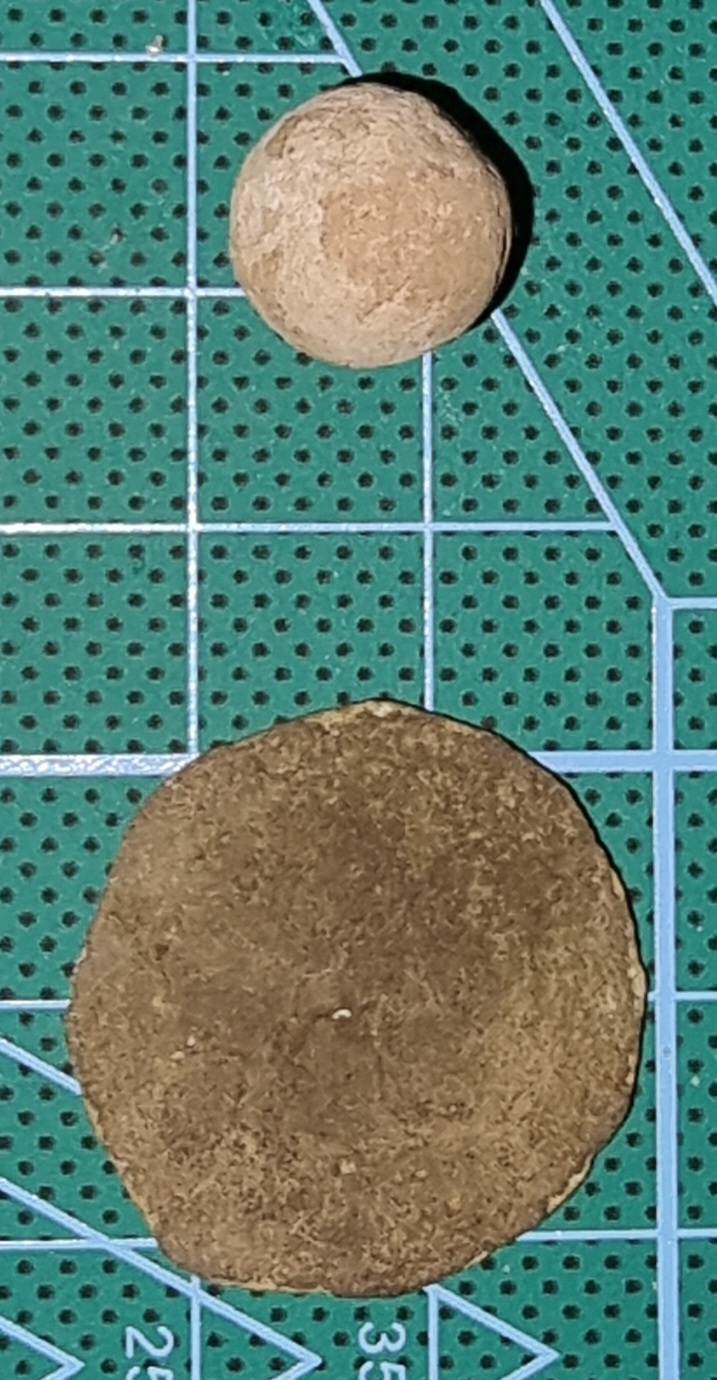 |
|
Valued Member
United States
66 Posts |
This may be a stretch, but the coin pictured below the round metal ball looks like a crusty MAGNUS MAXIMUS (383-388AD) I have in the collection.
|
| |
Replies: 10 / Views: 1,332 |
|










 Posted 07/31/2022 1:19 pm


