| Author |
 Replies: 35 / Views: 5,067 Replies: 35 / Views: 5,067 |
|
|
|
New Member
 United States
42 Posts |
I would say, maybe, they were popular in those grades. Maybe not, idk, I know that there are limited early slabs like, Maya Angelou MS69 and Sally Ride MS69 that fetched decent auction prices. Also in lower grades certain mint marks that had top pop fetched decent auctions. I guess we both can find examples to prove a point. I buy coins without early designations, I just see future value in the early slabs simply because of the cutoff dates. It is fairly new to this market and I expect some push back for sure. I could be way off, but something needs to intrigue newcomers.
|
|
Bedrock of the Community
Australia
21792 Posts |
1.
Doesn't matter if the coins are certified slab graded or not.
The common coins stay common, the truly rare coins are what go in in value, over time.
2.
It's just the fact the owners of the rarer coins have a preference to be slabbed / certified graded coins for protection, and to have a specified more widely accepted, when it come to dispersing an estate, after the owner has kicked the bucket. In most cases, the beneficiaries know less about the numismatics of the collection than the owner did. Point 1 still applies.
|
|
Pillar of the Community
 United States
8060 Posts |
Quote:
Obviously, I am new, but I've notice on the PCGS price guide chart that values of coins seem to mostly lose value over time. I am looking at the overall chart. Please provide your evidence for this statement. (As a work colleague used to say ... "In God we trust. All others provide data.") Maybe I am missing something, but if I go to the PCGS site, here is the graph I see for the PCGS 3000 index in the last 3 years: 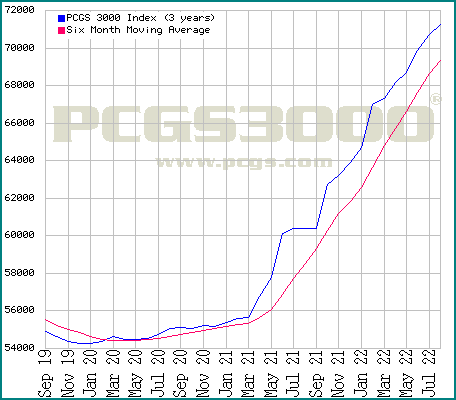 If we look at longer term data, the trend changes. Please let us know what data you are working from. |
|
Pillar of the Community
United States
1648 Posts |
 Actually, it should be noted the PCGS3000 is a general rare coin price index which does support that certain mostly classic coin prices/categories included are generally on the upswing for the OP https://www.PCGS.com/prices/PCGS3000 ... but the replies that when the populations go up at a rate faster than the number of collectors that are willing to buy at that high cost and participate in high end registry sets, the price can decrease for these high end coins over time in those cases as well when population increases for modern top pop these prices can also decrease also is accurate. So it depends on what the OP and other posters are looking at to see a increase/decrease potential over time. "Particular coins being offered for sale may not have been included within particular indexes, and if included, may not have experienced the same market movements as the index as a whole. Therefore, the PCGS3000® should only be used as one guide to rare coin prices and historical price movements, and not as the sole source for determining the value or market history of a particular coin" Edited by datadragon
12/18/2022 8:50 pm
|
|
New Member
United States
42 Posts |
Quote:
Please provide your evidence for this statement.
(As a work colleague used to say ... "In God we trust. All others provide data.") I guess I brought up the topic because almost every coin I ever looked up values on were trending down. I don't know if there is exact data to support what I am saying for the entire market, it is bits of evidence, kind of like polling to get a gist of what's going on. I am not knocking PCGS or faulting them for the falling prices, I know Auctions often determine values. I have learned a lot on here, though I don't always agree, I certainly appreciate everyone who took the time to discuss this topic. Edited by coinstocollect
12/19/2022 01:08 am
|
|
Pillar of the Community
United States
8060 Posts |
Which types have you looked up? (for example U.S. minors, U.S. silver? Gold?)
Some types are influenced by (or at least correlate with) movement of precious metal prices. So, if you were looking at gold coins during a time of downward movement of gold prices, that could be part of an explanation.
|
|
Bedrock of the Community
United States
18935 Posts |
i agree with CarrsCoins. its all about supply and demand just like any other commodity. there are two types of collectors. one are collectors and the other are investors or a combination of the two. if you're a collector you are buying coins to fill a hole in your collection most of which are common. with the decline in generational interest common coins are going to be common coins pretty much forever and the prices will reflect that. rarer coins are going to be purchased more so by investors. folks that may be collectors but purchase these coins to increase in value over time. rarer coins in higher grades are always going to be in demand, however, prices of these can exceed what they typical collector can pay so this limits demand and in turn holds down the prices. however, if you look at the prices of lets say MS65 morgans you will see that that over the last couple years they have increased considerably but when you get to that level and prices investors want to ensure that the coin itself is in fact that grade so they for the most part avoid buying them raw and you can see this in demand for slabbed high grade coins.
bottom line...if you want to see increases in values in your coins over time buy high grade slabbed rarer coins.
|
|
Pillar of the Community
United States
1316 Posts |
To add to the supply / demand notes, what series does the OP think will have demand outpace supply over the next 10/20/30 years? As the current generation of demand dies (Boomers that are a lot of the market) or is distracted to something else (Fads come and go), what is going to matter to an equal or greater number of the upcoming generation?
I think this is what makes modern stuff kinda risky. While the mint sometimes tries to select stuff of historic or cultural relevancy, what is relevant evolves quick and often for many things. However there are often 10s or 100s of thousands if not millions of supply. What series will have that many buyers down the road?
Classic stuff can hold a little better because supply might already be down to dozens or hundreds, maybe a thousand or two. Its a lot easier to find an equilibrium or positive demand when it only needs a few thousand folks who care to hold pricing. Plus it's had 1-200 years old lore and fame stoking the fire. What modern stuff will go down as the stuff of legend?
Edited by Collects82
12/19/2022 10:19 am
|
|
Pillar of the Community
United States
756 Posts |
what constitutes rare and high grade is relative. for early copper (and many other coins) rarity is discusses using R#s. R-8 is 1-3 copies known. R-7 is 4-12. R-6 is 13-30. R-5 is 31-75. R-4 is 76-200, R-3 is 201-600 R-2 is 601-2,000 R-1 is more than 2,000 coins that many people consider rare like the 1916-D dime or the 1909-S vdb cent would be listed as R-1 in this scale and labeled as common. their supply is outstripped by the massive demand for those coins. they demand a significant premium. on the flip side there are quite a few large cent variations that are R-4 and R-5 and carry no significant premium. there arent 200 people collecting them by variety. there is more supply than demand even though they are quite a bit rarer than those 20th century key dates. if 500 people start seriously collecting large cents by variety all of the R-3 coins start commanding premiums. if half the current sets are sold and nobody replaces that demand then some of R-6 coins wont be much more expensive than common coins. condition can be relative too. my avatar picture is of an 1800 Half Dime. it is a unique die combination (the LM-5 die marriage) and the only known version of that coin. its worn slick and has a hole in it. it is the finest known example of that coin. its also the worst known. it takes one coin surfacing for that coin to no longer be top pop. |
|
New Member
United States
42 Posts |
Quote:
Which types have you looked up? (for example U.S. minors, U.S. silver? Gold?) I looked up probably thousands since I started collect PCGS stabbed coins, I tend to look up modern silver dollars, half dollars, quarters, dimes and sometimes eagles. I have looked up Mercury dimes ms67 and up...also Peace dollars. I love the older coins, just a little out of my reach. Oh and key date nickels. I'm sure I am missing a bunch. Going back to 1998 til today there is a big differece in prices, State Quarters were at ridiculous prices and so were many other coins. It must have been an exciting time. If I had to guess, PCGS probably set the prices back then to entice people to buy stabbed coins?! Maybe not, idk, the market could have been booming. |
|
Pillar of the Community
United States
5302 Posts |
Quote:
it is hard to find any coin shows in the state of Maine I am not sure how far away you are from the border with New Hampshire, but it might be worthwhile for you to check out the New Hampshire Coin & Currency Expo, https://nhcoinexpo.com/Next one is April 7-8, 2023. |
|
Pillar of the Community
United States
1648 Posts |
This is a great discussion with much input. I would add that PCGS also posts pricing changes, here for example are the 1-10 year, 3 month and less changes for some of the Washington quarters (mint state - they also of course have proof etc) and as usual, some go up, some go down, so its probably going to be very hard to generalize too much except using specific examples for data if you really want to know whats changed use that, and also just added some general reasons why top pop or expensive coins might lessen due to having too few collectors at that level vs a population increasing faster. https://www.PCGS.com/prices/pricech...arter/112/msEdited by datadragon
12/19/2022 1:41 pm
|
|
Pillar of the Community
United States
5302 Posts |
Quote:
Maybe I am missing something, but if I go to the PCGS site, here is the graph I see for the PCGS 3000 index in the last 3 years: And here is the one from 1970. 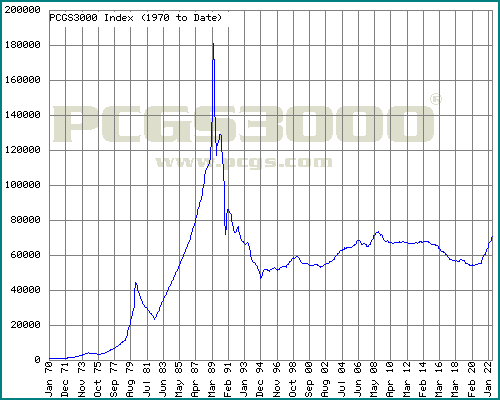 Had you bought in 1970, you would be doing ok. However, had you bought in 1989 you would be totally underwater. |
|
Pillar of the Community
United States
3540 Posts |
Population report for each grade.
Slab companies have helped and hurt. Probably more help in the long run, as long as the grading standards are consistent (which is another conversation).
Don't forget, there is also a grading company that grades slabbed coins! Company will apply green sticker (acceptable at grade), gold sticker (designates an undergraded slabbed coin), or, NO sticker (coin is not graded or market acceptable in encapsulated grade.
There are also two unique buyers of slabbed coins. Collectors and investors. Do not know the percentage, but, at least SOME collectors are also investors. They will buy a coin, because of their knowledge or using a crystal ball that the coin will increase in value, and the collector will trade/sell the coin for something for their collection (or another "prospecting" coin).
|
|
Pillar of the Community
United States
1648 Posts |
Quote:
@acloco Don't forget, there is also a grading company that grades slabbed coins! Company will apply green sticker (acceptable at grade), gold sticker (designates an undergraded slabbed coin), or, NO sticker (coin is not graded or market acceptable in encapsulated grade. Certified coins of the same grade can be of varying quality. Many of today's collectors want coins that are solid or premium quality for their assigned grade and CAC will verify previously graded coins to be a solid/high quality example for that grade. There are many coins that are certified accurately for their grade. Unfortunately, it is an inescapable reality that many are at the lower end of the quality range for the assigned grade. CAC's rejection of a coin does not necessarily mean that CAC believes the coin has been over-graded. It simply means that there are other coins with CAC stickers that are of higher quality for the grade. CAC will eventually reject tens of thousands of accurately graded coins. The CAC green sticker also adds to the value and demand. And now they are doing their own full grading in slabs. @NumisEd Yes that info would be helpful if someone perhaps is collecting quite a large batch of those classic coins that make up the index which I posted a link to earlier. Otherwise I guess you can visit specific price changes (for PCGS coins only) over time by cllicking the price changes link. I mentioned one for quarters earlier but below is where to find it on a PCGS price page. A person who mainly was buying say modern top pop coins and holding for example wouldnt get much data out of that index and further may have done poorly investment wise since those are among the coins that have the biggest chance to drop quite alot over time. 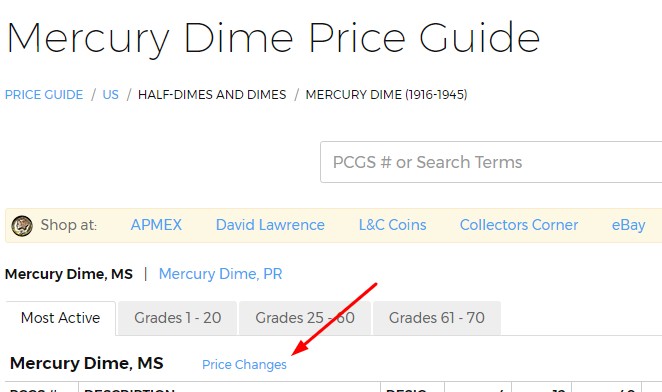 Edited by datadragon
12/19/2022 10:08 pm
|
| |
Replies: 35 / Views: 5,067 |






 First Page


 Posted 12/18/2022 6:05 pm


