| Author |
 Replies: 10 / Views: 1,691 Replies: 10 / Views: 1,691 |
|
|
Pillar of the Community
 United States
732 Posts |
|
|
|
|
Pillar of the Community
United States
756 Posts |
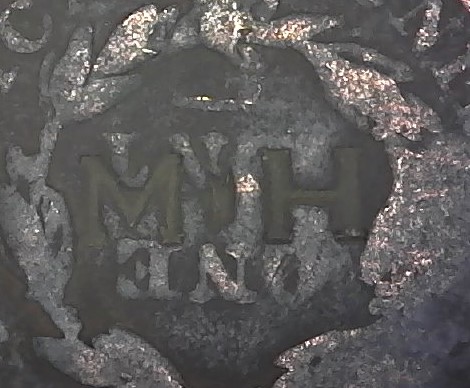
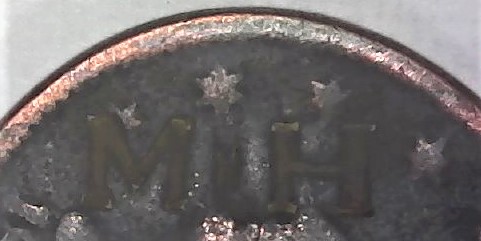
with most counterstamped letter pairs it is impossible to know. its probably someones initials. maybe something like (M + H) or (H + W) like what a couple would carve into a tree.
there is a book that catalogs these. its by a guy named Gregory Brunk. its online somewhere but I cant find it at the moment.
its probably worth a touch more with the stamp than it would be without.
|
|
Moderator
 United States
34575 Posts |
@moo, as you probably know, identifying these so-called mavericks is exceedingly difficult. I'm hoping that @exoguy sees this thread and can offer some identifying help.
"If you climb a good tree, you get a push."
-----Ghanaian proverb
"The danger we all now face is distinguishing between what is authentic and what is performed."
-----King Adz
|
|
Bedrock of the Community
United States
94367 Posts |
Interesting, thanks for sharing.
|
|
Pillar of the Community
United States
4433 Posts |
Hi Spence ....  CarrsCoins summed this one up well, and I can't add anything on this specific piece. In general, initials' stamps that are recessed within a rectangle, circle, scroll or other shape do stand a fair chance of being attributed to a particular silversmith or other metalsmith. It's then simply a matter of matching the coin's stamp with that on a product, say a silver spoon, for example. On very rare occasions, initials' marks have been accompanied by a full name stamp(s) on a coin. Then, a maverick initials' stamp on another coin can be compared to known piece. An aside on initials' counterstamps at large ....A few years ago, there was a counterstamp article published in the ANA journal. The subject piece was an early half dollar or dollar, as I recall, that was stamped W.E.G. The writers mused that it was stamped by the famous statesman, William E. Gladstone .... pure poppycock!  The authors offered not one shred of evidence. From my perspective, the ANA's upholding material like this undermines and mocks the serious study and attribution of counterstamps. It's sad enough that many a seller of counterstamps attaches a bogus story simply to make a sale. Now, we have the country's top numismatic organization using the same ploy to peddle their journal. |
|
Moderator
United States
34575 Posts |
Thx for weighing in @exoguy! To be clear, I wasn't trying to throw shade on @carrs though. You are just my go-to for these things.
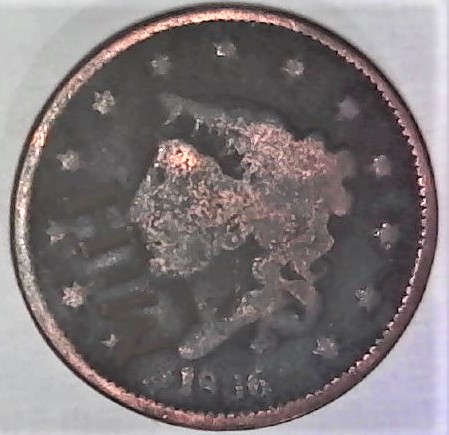
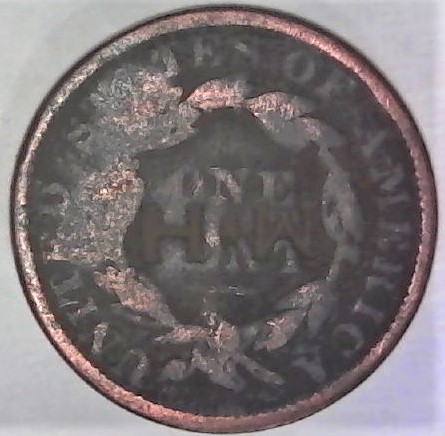
I do have one question about this counterstamp. It looks to me like it was applied to both sides. Is there any particular meaning in that (vis-a-vis counterstamping only on one side)?
"If you climb a good tree, you get a push."
-----Ghanaian proverb
"The danger we all now face is distinguishing between what is authentic and what is performed."
-----King Adz
|
|
Pillar of the Community
United States
756 Posts |
i felt no shade. exoguy knows this stuff better than me. its nice to have my thoughts corroborated.
|
|
Pillar of the Community
United States
4233 Posts |
I perceive a short vertical bar separating M and H, not another letter or symbol. M | H
Not that it helps anything.
|
|
Rest in Peace
United States
632 Posts |
Have you checked for it in Brunke or Rulau?
|
|
Pillar of the Community
United States
4433 Posts |
Quote:
I do have one question about this counterstamp. It looks to me like it was applied to both sides. Is there any particular meaning in that (vis-a-vis counterstamping only on one side)? Good observation & question, Spence. My thought on our OP's piece is that "MH" was intended to be seen, so the coin could well have been a pocket-piece. Then, when pulled from a pocket to show a fellow Mason or whoever, either heads or tails, the stamp showed. Members of fraternal organizations often carried personal "cards" like this as a method of greeting and bonding with others; conversation starters, when traveling. Many surviving 19th century coins bear a masonic symbol. More often than not, counterstamps were applied to obverses over reverses. One reason for this, it seems, is that most coins tend to have a larger field area on the obverse. The positioning of stamps often makes a statement of sorts. Beyond my thought of visibility, I'm at a loss to deduce why MH is stamped on both sides of this cent. There could be another intent, of course?  Speculating about the intent behind c/s's can be fun ....  |
|
Pillar of the Community
United States
4433 Posts |
Quote:
Have you checked for it in Brunke or Rulau? Because you asked, I did check Brunk. As I suspected, there's no listing. If Brunk and Rulau had catalogued all simple initials' c/s's like our OP's piece, their books would easily be ten times larger and convey very little info beyond the existence of all the mavericks. These authors tended to focus upon initials' c/s's that stood a fair chance of being attributed. That said, they were often "pressed" to oblige contributors, and this resulted in many erroneous listings over the years. Here's a link to Brunk's updated listings, circa 2006 .... https://archive.org/details/2006mer...145/mode/1up |
| |
Replies: 10 / Views: 1,691 |
|









 Posted 12/30/2022 6:27 pm


