| Author |
 Replies: 10 / Views: 1,555 Replies: 10 / Views: 1,555 |
|
|
Valued Member
United States
319 Posts |
This coin is another from my 'Top Ten' of 2022. It was a very new acquisition at that time, so I'd yet to give it a singular post. Time to remedy that. The Republican denarius is the only silver in my collection and the sole denarii. Why break with form, you might ask. It isn't a large coin...and the portrait doesn't depict a living being! All valid points, but in truth I have routinely looked at these coins of the early Republic. I guess...waiting for one to stand out and demand further attention. This baby did just that. 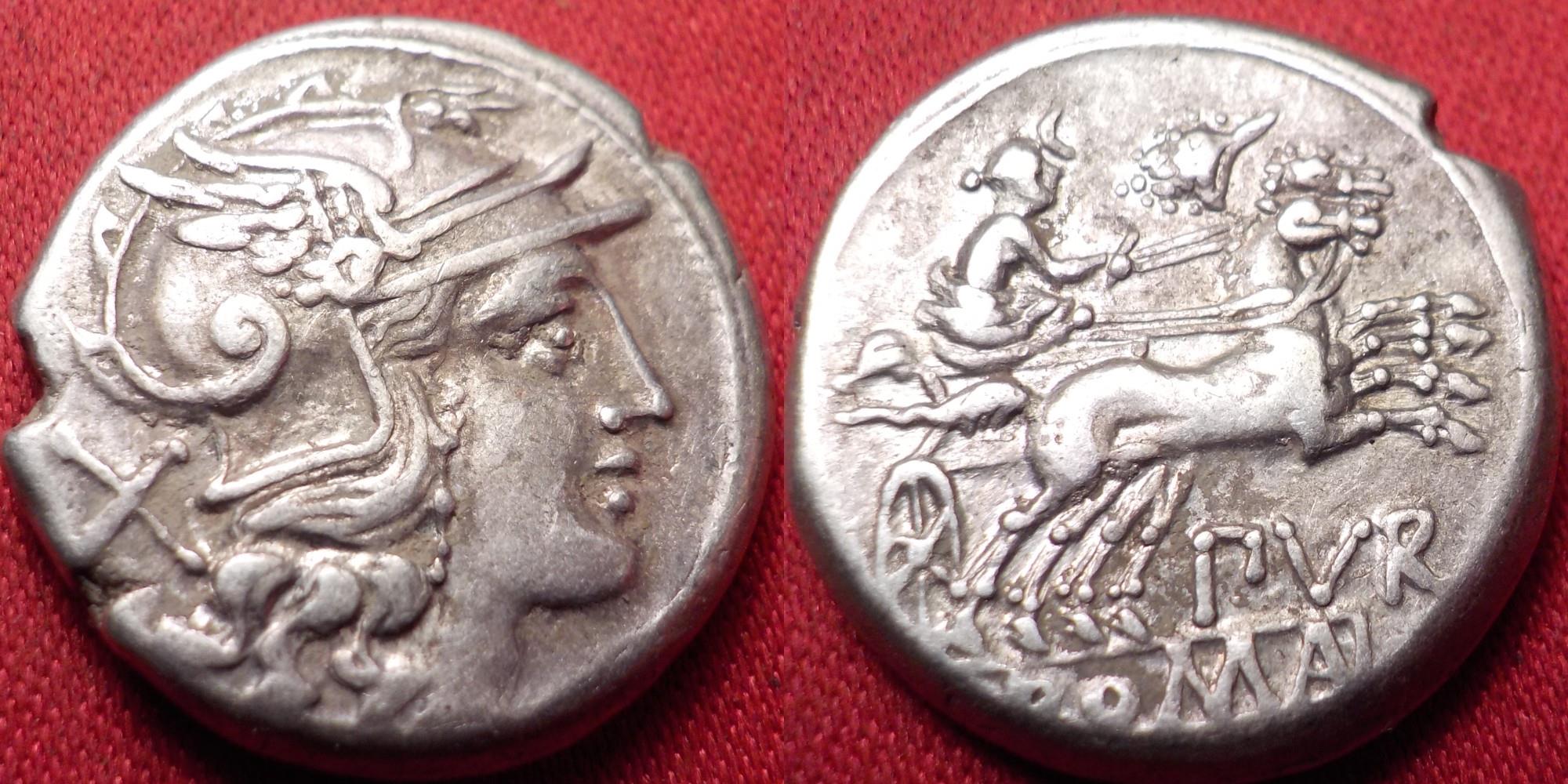 The depiction of the very personification of Rome itself, Roma is an obverse standard of this variety, and the quality of the portrait varies widely. The essential qualities of this particular portrait stood out to me. Fine, sharp features with a fullness that seems to be lacking in most examples of this coinage. Wonderful details in the helmet. Unless I am mistaken, the 'X' to the left refers to the die number. Wonderful stuff! In the end I was finally swayed by the story told on the reverse. The identity of the moneyer or "tresviri aere argento auro flando feriundo" (literally "three men for striking [and] casting bronze, silver, [and] gold coins") was a man named Furius Purpurio (probably one the most fabulous ancient names I've ever heard), represented on the coin as 'PVR'. Aside from apparently employing the best die-cutters, Furius had a great sense of humor. Above the horses on the reverse, he included a representation of the murex shell from which was derived the valuable purple dye used in the creation of senatorial togas. A wordplay on his own name. Brilliant! Surely I cannot be blamed for straying off the path with this one. C FURIUS PURPURIO AR silver denarius. Rome, 169-158 BC. Helmeted head of Roma right, X behind. Reverse - Luna in a biga right, PVR below horses, murex shell above, ROMA within linear frame. 17.5mm, 4.3grams |
|
|
|
Pillar of the Community
 Spain
2752 Posts |
Another beautiful coin Mike!
I can quite understand the draw towards the republican coinage with their interesting reverses...Trigas, bigas,quadrigas etc pulled by not only horse's but also lions, stags, goats, elephants, snakes and even cupids to name a few...
One thing that has always appealed to me is the decorative helmet of Roma with that lovely griffin laying on the ball of the helmet with its tail curled...
Great Coin!
Edited by Palouche
02/17/2023 4:00 pm
|
|
Pillar of the Community
United States
7066 Posts |
A very nice example. Thanks for sharing - enjoyed the write-up.
|
|
Valued Member
 United States
319 Posts |
That's just the way it has been with me lately, guys. Wandering eyes...straying from the path. *long breath* Just can't help myself sometimes. Maybe I should seek professional help.
Naawwwww! Stewarding beauties like this makes the adventure worthwhile!
|
|
Pillar of the Community
 United States
954 Posts |
The X is a mark of value-- 10 asses. Denarius comes from the word deni; which translates as "containing ten"
|
|
Moderator
United States
34530 Posts |
Quote:
Maybe I should seek professional help. Isn't that us?  Super coin by the way. "If you climb a good tree, you get a push."
-----Ghanaian proverb
"The danger we all now face is distinguishing between what is authentic and what is performed."
-----King Adz
|
|
Valued Member
United States
319 Posts |
Ahhh, Spence. You are so right! Y'all are the best Numistherapists anyone could ask for. And all it takes is a little coin!
|
|
Valued Member
United States
319 Posts |
Victor's informative response-post regarding the Roman numeral 'X' seen on the obverse of this Purpurio denarius really got me thinking. A quick search for information about the symbol certainly supports Victor's statement. So I asked myself "Where did I get the idea that the 'X' was in any way related to the numbering of the die?" I may be imaginative and excitable, but I certainly didn't pull that out of thin air. I searched on and soon found a familar blog post by Gareth Harney entitled 'Another Publius Satrienus Denarius - Insights into the Roman Mint', dated October 17, 2021. In the article, Mr. Garney states: "As with a number of other Republican issues, the coin type is notable for its employment of control marks, numbers or symbols designating the precise dies used to strike obverse and reverse, possibly as a means of quality control adding a level of accountability to the die engraving process or as just a systematic method in which to keep track of large coin issues. Control marks are of great interest to the numismatist as they can provide valuable evidence for many of the most interesting questions around the coin minting process: How many coins were struck within a series? How long did a coin die last before wearing out or breaking? In coin striking, did the obverse or reverse die wear out more rapidly? How many engravers were employed at the mint and how much variation was allowed between their individual artistic approaches? While control marks often take the form of small pictograms with fascinating representations of everyday objects from the ancient world, the Satrienus denarius instead uses a simple numerical system. Each obverse die is designated with a clear Roman numeral behind the head of Roma. When that particular die wore down to an unacceptable degree or indeed broke completely, the next number die awaited. Experimental archaeology has come up with varying estimates of how many coins a single Roman die might realistically strike with most in the number of multiple thousands."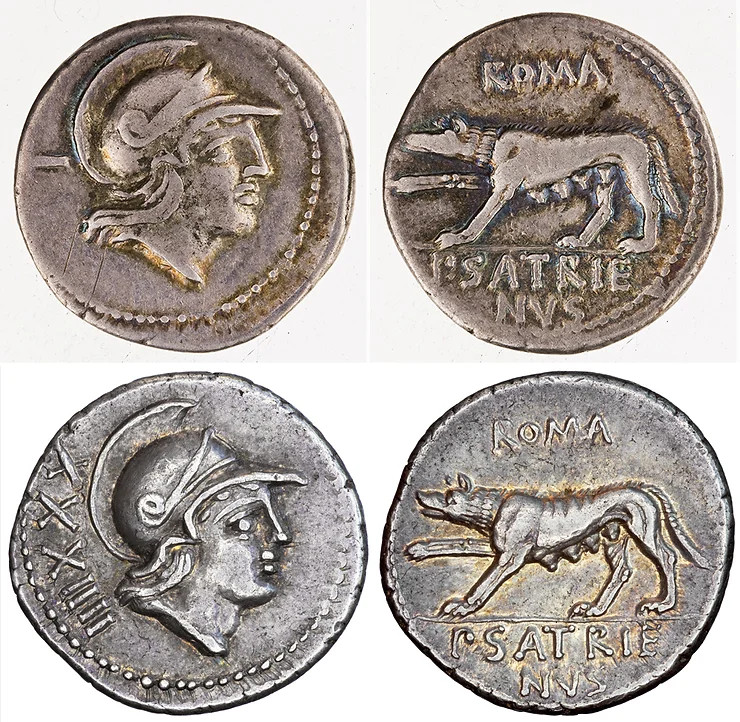 "Top: Example using the obverse die numbered 'I'. Bottom: Example from my collection numbered 'XXXIIII'." "Top: Example using the obverse die numbered 'I'. Bottom: Example from my collection numbered 'XXXIIII'."This is clearly where I got the idea that Republican denarii bore numerical die indicators. I do not doubt that Mr. Harney is quite correct, but...his article is focused specifically on the coins of one moneyer: Satrienus. Could it be that such a numbering system was employed only by Satrienus? Or perhaps a particular group of moneyers at a particular time in the minting of Republican coinage? Further study is required! I have included a link to the original post in case anyone wishes to read it in its entirety. https://www.harneycoins.com/post/an...e-roman-mint |
|
Pillar of the Community
Australia
2577 Posts |
Thanks for the link cm120. An interesting article.
The Ox moves slowly, but the Earth is patient.
|
|
Pillar of the Community
United Kingdom
1168 Posts |
Another super coin, Mike. I enjoyed the very interesting write-up, thanks.  |
|
Valued Member
United States
319 Posts |
It is a marvelous coin indeed, Jim. Really liked the fullness of the portrait of Roma, with all the great details of the helmet. That, however, was not enough. The inspiration to acquire this denarius lies firmly in the story it told about its own creation. Absolutely fascinating!
I found the Harney blog post to be both informative and intriguing. I'm glad others have given it a read. Let's see what else we can find in regards to the numerical markings on this type of coinage. Could be interesting!
|
| |
Replies: 10 / Views: 1,555 |
|





 Posted 02/17/2023 4:04 pm





