| Author |
 Replies: 13 / Views: 1,778 Replies: 13 / Views: 1,778 |
|
|
Valued Member
United States
51 Posts |
Hi CC  I know from a previous thread that the mints stopped sharing dies in the 50's but this looks like a D over an S to me. It isn't... so any idea what it might be? Thank you for any feedback  *** Edited by Staff to Add Year / Mintmark / Denomination to Title. It's very important to have in the title. *** *** Edited by Staff to Add Year / Mintmark / Denomination to Title. It's very important to have in the title. ***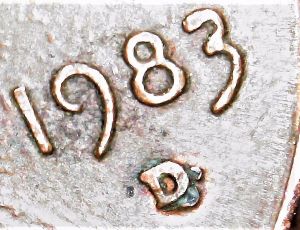 |
|
|
|
Pillar of the Community
United States
603 Posts |
I would guess it started as a small plating bubble that split or some other damage and then zinc rot set in.
|
|
Valued Member
 United States
51 Posts |
So that is what the grey color is? Zink rot? I never heard of that but I see it a lot...
|
|
Bedrock of the Community
United States
10065 Posts |
 ...and it coincidentally resembles a D/S |
|
Pillar of the Community
United States
4233 Posts |
Where did you get the idea that the branch mints were sharing dies? Prior to 1996 Philadelphia controlled all aspects of die making, as far as I know including punching the mint marks on working dies. It doesn't make sense that they would be exchanging dies with mint marks from another mint on them. Regardless, as said it appears to be damage that happens to look like an S.
|
|
Moderator
 United States
56855 Posts |
1955 is the last year for OMM's. As to die sharing, I would like to read what Mike has to say. John1  |
|
Moderator
United States
15941 Posts |
it's simply plating damage that Pareidolia has us 'seeing' an S. Take a look at my other hobby ... http://www.jk-dk.art |
|
Bedrock of the Community
United States
94367 Posts |
 to the CCF! |
|
Valued Member
United States
51 Posts |
I read a discussion thread in this forum that talked about the sharing of dies between mints. I tried to reply directly to that ongoing discussion but it was too old so I had to start a new topic...even though it was apparently an old topic. If you do a search I am sure you can find it.
|
|
Pillar of the Community
United States
4233 Posts |
Is this the thread you're referring to? http://goccf.com/t/384571If so, I think that bit about the branch mints sharing dies amongst themselves is just wrong, and I'd want to see evidence. The branch mints had no die making capabilities until Denver opened its die making shop in 1996 (source Wexler). As far as I know, they did not have any ability to anneal or harden the dies, which would have been required to repunch their own mint mark, nor to my knowledge did they have any of their own punches. Philadelphia exclusively controlled all die making, and it was tightly controlled. As you might imagine - you don't want coin dies passing around willy-nilly and getting "lost." What did happen is that some dies returned to Philadelphia (or never shipped) were reused (mint mark polished off, repunched), or mistakes with the mint marks were corrected by punching over them. If I'm wrong about any of this I'm open to factual sources to correct my understanding. |
|
Moderator
United States
107650 Posts |
Well, while it looks like a D over a rotated S, it is not. This looks more like split plating and resulting zinc blister that broke open.
|
|
Pillar of the Community
United States
1648 Posts |
Zinc rot is like the equivalent of a zombie, dead but not as its still spendable. In 1982 when the rising cost of copper made the cent more expensive to produce than its face value, a new composition of copper-plated zinc was adopted for the cent. These cents had a core composed of 99.2% zinc and 0.8% copper, with a plating of pure copper. It is a very unstable combination. Often around the mintmark, small breaks of the plating occur as the coin is struck. That spot is a prime target area for corrosion to begin under the copper plating. The splitting of the copper plating on post 1981 Lincoln cents usually led to an exposed zinc core which in turn formed this protective layer of zinc bloom or Hydrozincite (zinc carbonate) that you see which has formed over a split in the platting. If that coin went into circulation, the normal use would cause that protective layer to be removed and a process of reformation would begin anew. The continuous handling of the coin would have a recurrence of these events, but with an increasing size of the affected area See: https://www.error-ref.com/zinc-dete...ncoln-cents/Edited by datadragon
02/19/2023 4:35 pm
|
|
Pillar of the Community
United States
7174 Posts |
I will admit that with all the D over S and S over Ds we've seen, this one is the most believable. But not posable.
|
|
Valued Member
United States
51 Posts |
Thanks for all of the feedback!!!
|
| |
Replies: 13 / Views: 1,778 |
|





 Posted 02/18/2023 9:59 pm





