As part of the
America the Beautiful Quarters Program, two World War II related parks in the South Pacific were recognized: the War in the Pacific National Historical Park on Guam and the American Memorial Park on Saipan, Northern Mariana Islands.
The War in the Pacific National Historical Park on Guam was established in 1978 to recognize those who served in the Pacific Theater of World War II. The Park is administered/managed by the US National Park Service.
2019 War in the Pacific National Historical Park ATB Quarter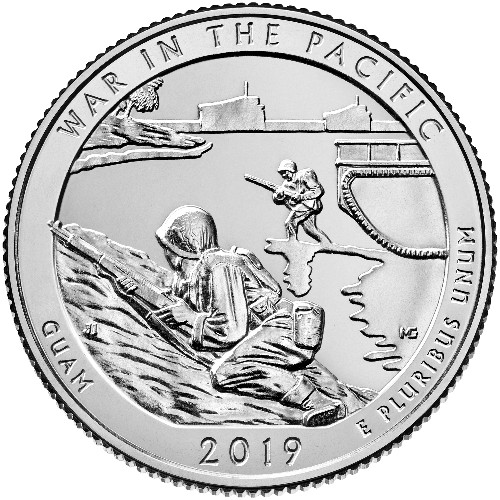 (Image Credit: US Mint Media Image.)
The American Memorial Park on Saipan, Northern Mariana Islands was also established in 1978. It honors the American military personnel and local Marianas people who fought and died in the Marianas Campaign of World War II; the Marianas Campaign pitted US forces and local islanders (Chamorro and Carolinian) against the Japanese Imperial Army in a battle that lasted from June 1944 into November 1944. The Memorial is owned by the Commonwealth of the Northern Marianas Islands and managed jointly with the US National Park Service.
2019 American Memorial Park ATB Quarter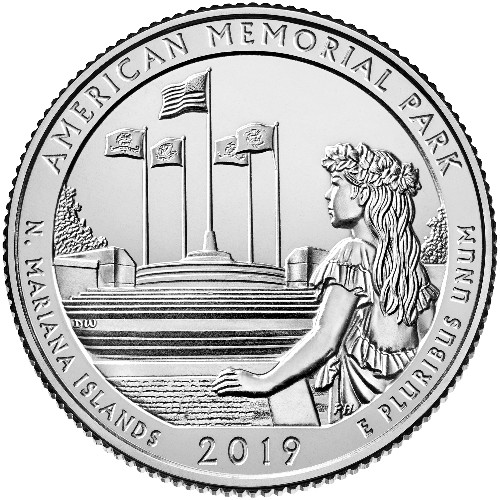 (Image Credit: US Mint Media Image.)
Back in 1993, the two parks were included in a commemorative silver dollar proposal introduced in the House of Representatives by Robert A. Underwood (D-Guam Delegate) for himself and 13 of his colleagues. The bill sought coins "in commemoration of the 50th Anniversary of the Liberation of Guam and the Northern Mariana Islands." Upon its introduction, the bill was referred to the Committee on Banking, Finance and Urban Affairs.
Underwood's bill called for 1.5 million silver dollars (0.900 fine). The sales price of each was to include a $10 surcharge, with collected funds to be distributed to the Secretary of the Interior to be used for the construction of a museum at the War in the Pacific Historical Park on Guam and a museum and visitors center at the American Memorial Park on Saipan, Northern Mariana Islands. The coins were to carry a dual "1944-1994" date and feature designs "emblematic of the heroism of the American forces that liberated Guam and the Northern Mariana Islands in World War II."
In support of the bill, Representative Underwood took to the House floor and made an impassioned plea for the bill's passage. His remarks included:
"While some students of history will note that Alaska's Aleutian Islands were also captured by Japan, the Native Aleutian islanders were evacuated prior by the United States military in anticipation of hostilities. While the Aleutian Islands were also captured, only Guam has the distinction of having its population subjected to an occupation by the enemy.
The distinction of Guam's status was not lost on the occupiers. Guam suffered an especially brutal occupation due to the loyalty of the people of Guam to America. Executions, beheadings, forced labor, forced marches, and internment in concentration camps marked the 30 months of Guam's occu- pation. The people of Guam suffered, but remarkably endured those trying times.
The Marianas campaign was a militarily significant battle. In the aftermath of the huge Japanese defeat, Prime Minister Tojo's government resigned. The Marianas gave the Allied forces the ability to reach Japan in bombing raids with long-range bombers. The momentum of the Pacific war changed with the Allied attacks on the Japanese homeland from airfields on Guam, Saipan, and Tinian. And, of course, the atomic bombs that ended the war were delivered from bombers taking off from Tinian in the Northern Mariana Islands.
Guam and the Commonwealth of the Northern Mariana Islands share this distinct history with a sense of the tremendous human toll that brought them freedom. The battle for Saipan was bitter, costing 3,426 American lives. The battle for Guam cost 2,124 American lives. The 50th anniversary commemorations will focus on the deep gratitude that the people of the Marianas still feel for these American sacrifices."
Side Note 1: Guam was the only inhabited American Territory to be occupied by an enemy during World War II. See reference to Alaska's Aleutian Islands above.Side Note 2: The Northern Mariana Islands provided the US with bases/airfields from which its planes/bombers could reach the Japanese main island - as noted by Underwood, this helped change the momentum of the WWII in the Pacific.The Committee on Banking, Finance and Urban Affairs further referred the bill to its Subcommittee on Consumer Credit and Insurance. The bill was never reported out of the Subcommittee, however, and thus never acted upon by Congress. While the bill did attract 225 co-sponsors, without a well-financed private sponsor lobbying for it, the bill couldn't generate the needed tangible backing for passage.
I would have supported this one. I do not blindly back all military-themed commemorative coins, but when they are meant to recall and honor those that made the ultimate sacrifice for their country's continued freedom, I can be counted on for support.
Side Note 3: Though the coin bill failed, the referenced museums and visitor center at each park/memorial were eventually funded and constructed - they are open today and tell the story of war in the Pacific.For more of my topics on commemorative coins and medals, including many more What If? stories, see:
Commems Collection.







 Posted 03/08/2023 3:22 pm





