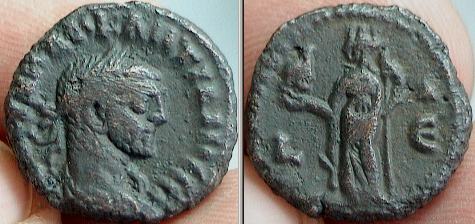
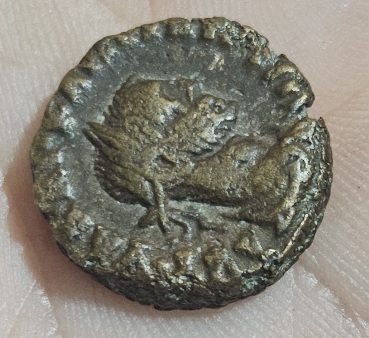
It is a "Roman provincial" coin, from Egypt.
Under Roman rule, up until the coinage reform of Diocletian, Egypt was treated differently to the other Roman provinces. Rather than being under the jurisdiction of the Roman Senate or the Roman military, Egypt was the personal property of the Emperor himself. As such, it had a "closed economy", not entirely unlike the situation in Communist countries during the Cold War: anyone wishing to do business in Egypt needed a permit, normal Roman money was not valid in Egypt, and Egyptian money could not be taken out of the province.
This coin is a "tetradrachm", nominally equivalent to a Roman denarius; though thicker and heavier, it was more dilute in silver content, thus had the same amount of silver in it as a denarius. Of course, this is a very Late-period tetradrachm; the amount of silver present is miniscule and it is effectively made of a lead-brass alloy.
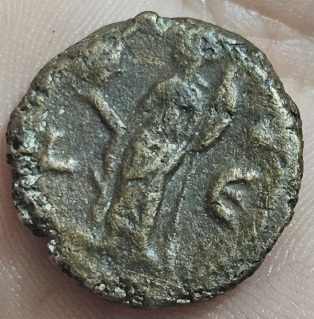
Unlike Roman coins from the same time period, Romano-Egyptian coins usually bear a date, which is visible on your coin: the "L"-shaped symbol means "this is a year", and the letter E is the Greek numeral for "5". Thus, "LE" means "Year 5". Year 1 for Emperor Diocletian was AD 284-285 (Egyptian New Year was in August, so Egyptian dates are always split across two AD years), so Year 5 was AD 288-289.
As to authenticity, I'm not really seeing any sings this coin is fake. It is currently illegal for tourists to take ancient coins out of Egypt, but people have been souveniring ancient Egyptian coins for hundreds of years. It might have been souvenired by a soldier, stationed in Egypt during either the first or second world wars.
As to value, it's surprisingly cheap. People are often surprised that 1700 year old Roman coins can be so cheap, but the Roman economy was suffering from severe inflation a tthe time, and their answer was to churn out vast amounts of heavily debased coins. Unidentified Late Roman coins are bought for just a dollar or two each; identified and identifiable coins, like this one, less than $50.
Don't say "infinitely" when you mean "very"; otherwise, you'll have no word left when you want to talk about something really infinite. - C. S. Lewis






 Posted 03/19/2023 10:25 am