| Author |
 Replies: 13 / Views: 2,087 Replies: 13 / Views: 2,087 |
|
|
Pillar of the Community
Canada
1160 Posts |
Been going through my USA stash of 1 cent coins and its not hard to find Massive Zinc Rot on there coins from 1983 to currant times. Lets keep this to only Canadian coins but I want to add a sample how there Zinc coins are rotting internally. Question for all you Canadian coin searchers is, has anyone come across this yet in our Zinc 1 cent coins. Its a scary topic because there even rotting in PCGS holders. For alot of us Canadian collectors you should read up on this topic. Did the RCM doing any thing to prevent this? A couple pics of a USA 1994D as a sample were the D rotted and fell in the crater. Enjoy the pics!! Keep it Canadian please.   |
|
|
|
Valued Member
United States
218 Posts |
As an American, I'm also interested in the answer to this. I haven't seen zinc rot on a Canadian cent personally, but I'm also on the wrong side of the border to say if it can happen for sure.
|
|
Bedrock of the Community
United States
94367 Posts |
That's a good question!  |
|
Pillar of the Community
Canada
1984 Posts |
I have certainly seen zinc rot in Canadian cents that have been subjected to harsh environments. I have found lots of coins in the streets with horrific rot. My guess is that if anything pierces the plating (a scratch, ding, or external corrosion), rot will set in quickly in a moist environment and eventually in all but the most arid environments. My guess is that well handled MS coins will be safe for a long time.
|
|
Pillar of the Community
 Canada
1160 Posts |
I think for the Canadian 1 cents is, to watch the first production years from 1997, 1998 and 1999 if the Minting prosses was done right. All those bubbly surfaces are the concerns. If the bubbles break its because of the rot. Maybe 2012 if the Mint got sloppy getting out of production year. Time will tell. I still have a bunch more Canadian 1 cents to go through one day and if I ever come across any I for sure will post them in the future.
|
|
Pillar of the Community
Canada
1018 Posts |
I've looked at a lot of cents and come across many zinc core cents with rot/corrosion, I don't keep them they get turned into the banks. The ones I have kept so far have not shown signs of rot while in storage. As a side I have found that steel core cents have much nicer plated surfaces than the zinc plated cents. For instance 2010 cents I've seen have a lot more black dots and spotting.
|
|
Pillar of the Community
Canada
1984 Posts |
Denny....totally agree on the steel vs zinc cents. Very often the zinc cents have ripply surfaces. Poorer strikes also.
|
|
Pillar of the Community
Canada
1018 Posts |
Yes I don't think I've seen a steel core cent with the rippled surfaces like zincs have. I've looked at so many modern cents I'm pretty sure I can tell core by looking at the surface now.
|
|
Pillar of the Community
Canada
1984 Posts |
I cobbled together the PCGS pop reports. In most years tteel is clearly creating higher grade coins 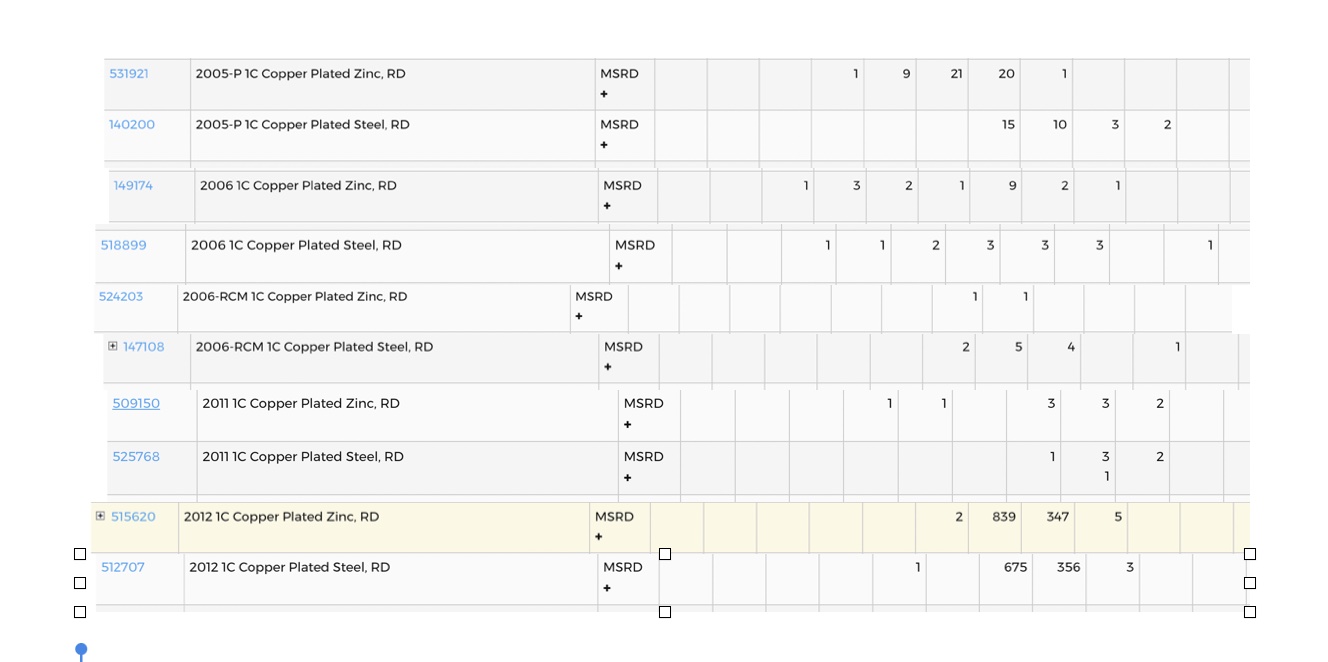 |
|
Pillar of the Community
United States
1648 Posts |
Yes, in general If the zinc core is exposed to the atmosphere (carbon dioxide), it quickly tarnishes and forms a protective layer of zinc bloom or hydrozincite (zinc carbonate) over any plating splits and helps prevent any further deterioration of the zinc. This is a powdery, white, opaque substance that you are seeing on your coin. It is just that if such a coin were to go back into circulation for example, the protective layer typically gets removed from usage and unable to stay put to protect the exposed zinc which leads to further deterioration (called zinc rot). Its not something like the milk spotting issue, but involves breaks in the plating layer after the fact. What I mentioned elsewhere is as long as you keep it in a 2x2 and left alone and dry it will be fine. I have seen cents with breaks in the plating, lots of exposed zinc around the lettering and devices, and only the same white layer is present but no further deterioration happened over 20 years even with the split plating on those that were left alone rather than cleaned or had further wear and tear. Dont clean away the protective layer or you will cause further zinc rot. https://www.error-ref.com/zinc-dete...ncoln-cents/Edited by datadragon
04/07/2023 9:54 pm
|
|
Pillar of the Community
Canada
1160 Posts |
Thank you very much datadragon for joining in with expertise on this topic. I'v been studying the USA cents lately and Zinc Rot always come up. I was inspired by all the work that the US collectors did on this topic and to make my Canadian collectors aware of this coin problem. This posts intent was for education purpose, even myself I'm going to read that link you gave us, looks interesting.
|
|
Pillar of the Community
United States
1648 Posts |
As far as education for all of us, yes the topic of zinc rot comes up frequently and It is going to happen to any cents with the zinc core exposed such as from damage after minting. That powdery, white, opaque substance can be from a protective layer of zinc bloom or Hydrozincite that has formed over a original split in the plating especially on the newer 1982+ Lincoln cents and around the mint mark as mentioned, but I'll add that it can be caused from the minting process not yet being optimal and this can be improved over time, such as the problems happened more for 1982-1986 cents initially than later on (for the US MINT) as from this NGC article about conservation: It took a lot of trial and error to consistently produce coins whose brass plating adhered to the zinc base properly. Many of the 1982-83 cents showed raised bumps from gas trapped between the layers. When compressed during the coining process, these gas occlusions formed tiny pimples that were unsightly and hinted at bigger problems. These soon manifested themselves when the coins entered circulation, as they quickly formed dark swirls on the brass surface. More seriously, the striking process sometimes flattened the brass plating so much that the underlying zinc was exposed. Since zinc is a very reactive metal when exposed to finger oils and other environmental triggers, corrosion became a highly visible problem. This was especially true at the coins' peripheries and edges. Frequently seen today are zinc cents placed within albums or folders that have corroded from their rims inward, leaving their central areas bright and coppery. So pervasive was the problem of zinc exposure in these early plated cents that the Mint double plates its proof cents, because the greater pressure used to bring up details in a proof coin easily breaks through single plating. The problem of trapped gas causing raised lumps and streaks continued in ever-diminishing numbers as late as 1986, and cents made since that time are seldom seen with this effect. Nevertheless, they are still susceptible to corrosion from their reactive zinc centers, and this becomes a very real concern for collectors attempting to preserve them in gem condition. The most simple step to take in assuring their long term preservation is to control the environment in which they are stored. Exposure to extremes of temperature and humidity is harmful to all coins, but it is quite a serious problem for brass-plated zinc cents and particularly so for the earliest issues. https://www.ngccoin.com/news/articl...-1982-cents/Edited by datadragon
04/08/2023 11:28 am
|
|
Pillar of the Community
Canada
1160 Posts |
|
|
Pillar of the Community
United States
4233 Posts |
Quote:
More seriously, the striking process sometimes flattened the brass plating so much that the underlying zinc was exposed. In my observation a similar effect around the date and mint mark is often mistaken for doubling by novice collectors. |
| |
Replies: 13 / Views: 2,087 |
|







 Posted 04/07/2023 09:04 am





