| Author |
 Replies: 13 / Views: 2,194 Replies: 13 / Views: 2,194 |
|
|
New Member
Canada
21 Posts |
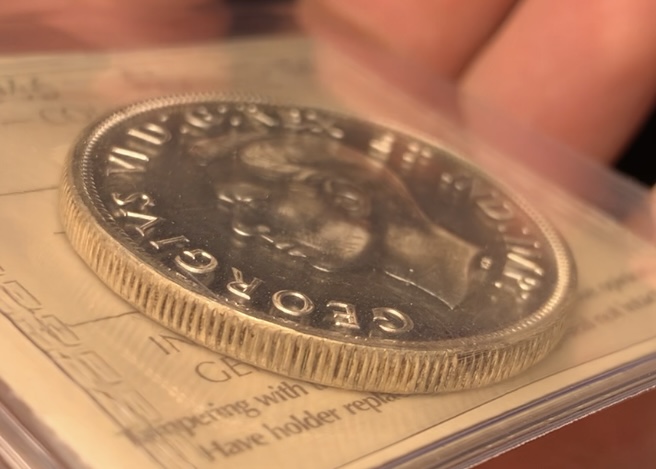
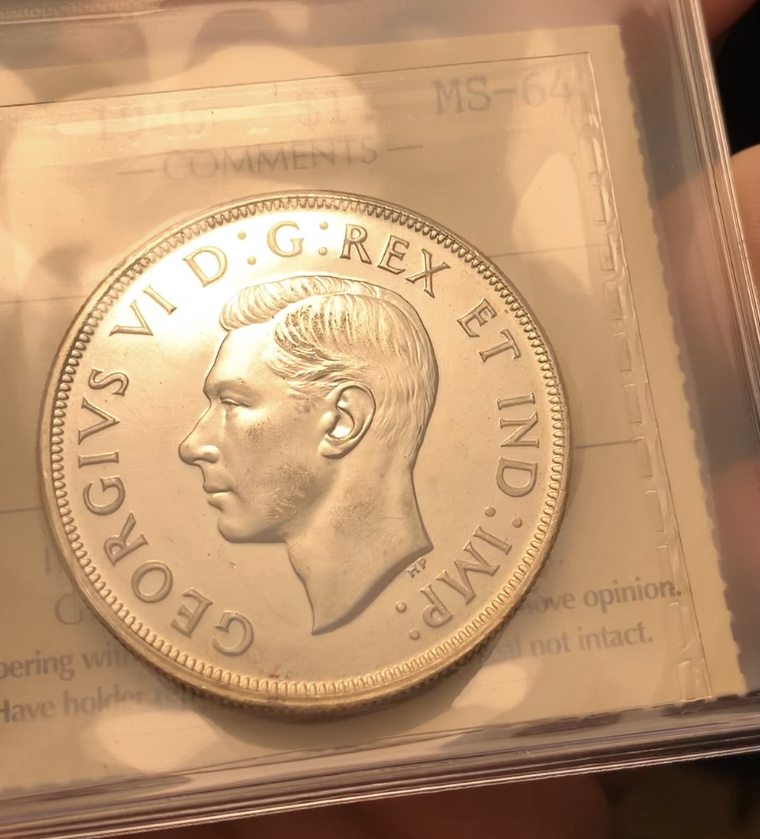
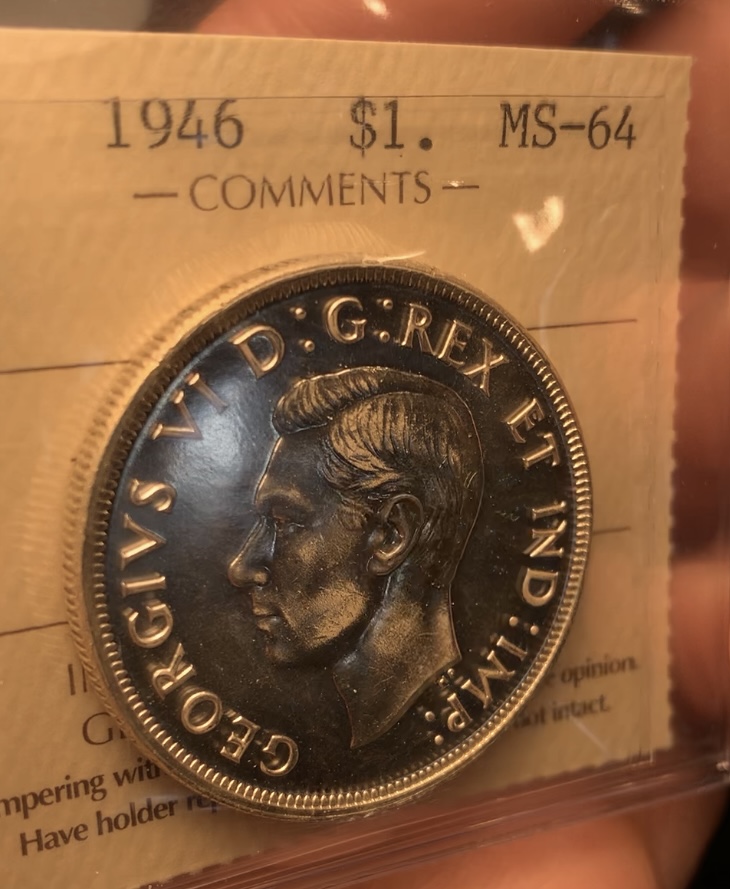
Hi everyone, I thought I would post this coin here as I'm hoping someone might be able to provide some additional background information about it. It's currently graded MS-64 by ICCS but has specimen-like characteristics (the strike is incredibly strong, and the rims are sharp and well defined). The coin was purchased in a 1973 J. E. Charlton auction... curious to see if there is any way to find the original auction listing for this piece. 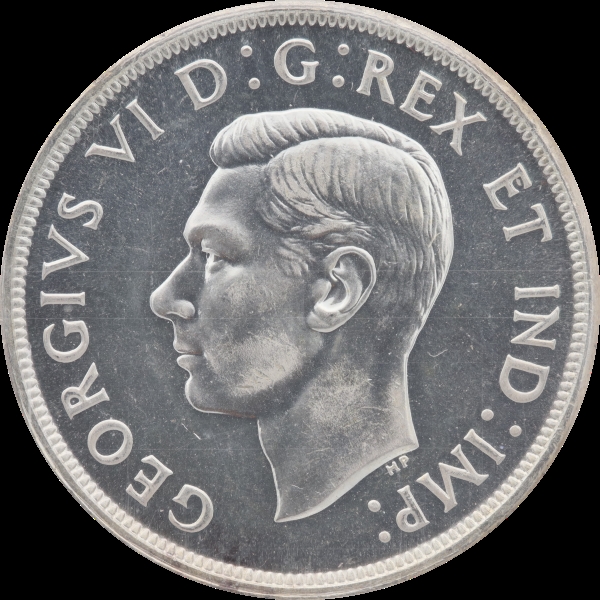 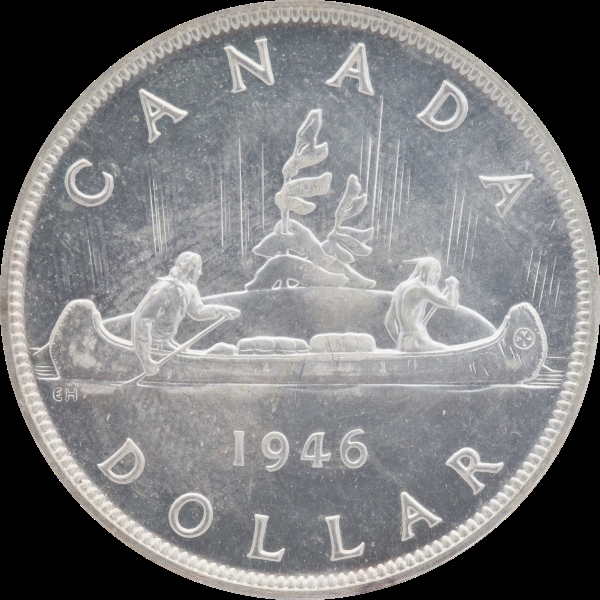 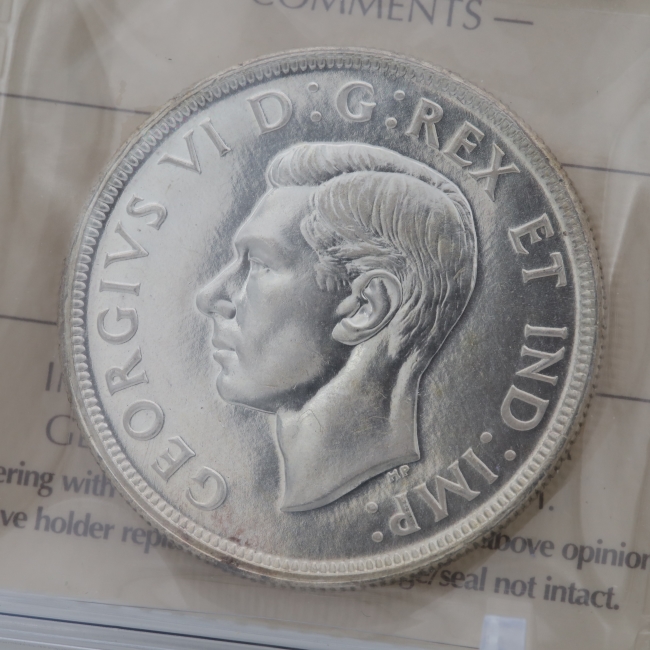 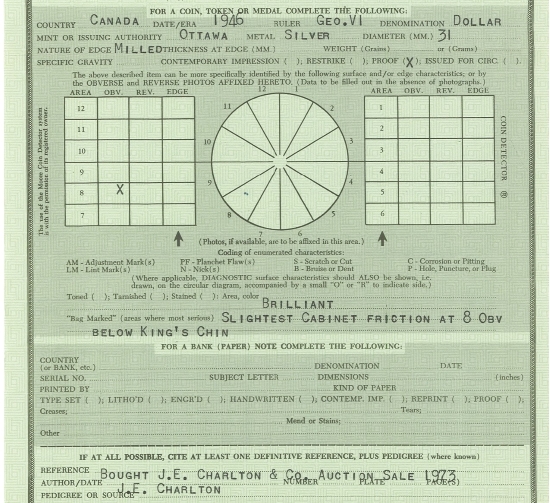 |
|
|
|
Pillar of the Community
Canada
1984 Posts |
I am no expert on dollar grading, but if I owned this I would be resubmitting this to either/both of ICCS and PCGS hoping for an MS65/SP65 or better. I suspect one will grade it higher. The uptick in value is big and definitely worth the cost given the odds.
|
|
Bedrock of the Community
United States
94367 Posts |
  to the CCF! |
|
Moderator
 United States
16014 Posts |
to the CCF |
|
Pillar of the Community
 Canada
9913 Posts |
I agree with smallcentguy. The ROI could be huge.
I'm on the fence as far as SP vs MS.
Looks MS in the last pic yet the certificate calls it Proof.
Hopefully dollarman will give his opinion.
"Dipping" is not considered cleaning...
-from PCGS website
|
|
Pillar of the Community
Canada
1808 Posts |
Nice coin either way. DBM is right, dollarman will let you know. "We are poor little lambs...who have lost our way...Baa...Baa...Baa"
In memory of those members who left us too soon...
In memory of Tootallious March 31, 1964 - April 15, 2020
In memory of crazyb0 July 27 2020. RIP.
In memory of T-BOP Oct. 12, 1949 - Jan. 19, 2024
Edited by loonielewy
06/14/2023 4:52 pm
|
|
Pillar of the Community
Canada
4916 Posts |
I've been discussing this one with the poster for a while now..
Initially I was on the fence, and at one point called it a really nice mint state, but upon comparing it to images of other coins, I'm leaning heavily towards specimen.
1946 specimen dollars are a tricky animal, many of them come with a less proof-y finish than other years.. The Pittman sale mentions this exact problem a couple times.
There are one or two specimens in the Pittman sale described like this, as having a satiny nearly unc look..thede Pittman examples likely originated from a mint employee named Maurice Lafortune, so there would be no doubt as to their strike type.
When I last looked through Heritage archives, I came across several uncirculated coins with proof like qualities, as well as several specimens.. the coin posted here matches with the specimens much better than it does with the mint state coins I saw.
The coin posted here has a very interesting finish to the fields..very deep in reflectivity and a hammered appearance in the detail. The canoe detail is also impeccable. On top of this, The rims are quite thick and well struck.. what seals the deal for me here though, is the pattern of die burn on the king is virtually identical to most known specimen strikes for this issue, as well as other issues in the specimen dollar series. Less lustrous 1946 circulation strike dollars appear to have good cameo and more mirrored fields than the posted coin.. But lack specimen characteristics, they also tend to have less die burn than specimens.
I'll also note the pebbled texture of the fields is similar to a 1946 specimen dollar I once owned, which was off of different dies, but had a similar overall look, but perhaps was a bit more reflective.
Luckily I've been able to see videos of this coin, It has some minor hairlines on the reverse, as well as some minor disturbances in the field on the obverse.. with that said, it lacks any high point friction or bag marks, or rim dings...all of which you'd expect on a circulation strike, even in 64.
The quality of the coin's preservation reminds me of a specimen that likely spent time in an original mint case with the rest of the set, and acquired a touch of contact and some hairlines from other pieces in the set shifting around once or twice. This would also explain the fingerprint on the reverse, as the coin was probably dipped in its lifetime with the fingerprint being left after the toning from the specimen box was removed.
Whoever owned the coin back in the day with that certificate probably also had much better insight to its origins, so I trust the specimen Attribution.
For this coin to be a circulation strike, look like that, and have virtually no contact associated with the type of storage and handling a circulation strike would get..just feels too unlikely to me.
Feel free to call me Will.
|
|
Pillar of the Community
United States
4233 Posts |
I'm curious how you would distinguish a specimen coin from one of the first circulation strikes that reused a specimen die. I've demonstrated on here that the 1947ML dollars reused a reverse die that was also used for specimens, and I believe it's known that the 1947 Dot dollars used the same die for both specimen and circulation. So I'm wondering how you could tell the difference. I've been looking for a smoking gun that RCM reused dollar dies in 1946 as well, but haven't concluded anything yet. The specimens were struck twice though, right? Perhaps that's the key. My MS62 1946 has really obvious pebbled texture, especially evident on the reverse. So I'm not sure if it's a relevant criteria. OP coin certainly looks like a specimen to me though. |
|
Pillar of the Community
United States
1380 Posts |
IMHO, specimen. Caveat, photos are sometimes not accurate indicators.
http://www.victoriancent.com2011 & 2025 Fred Bowman Literary Award, 2025 Guy Potter Literary Award, 2022 Paul Fiocca Award, & 2020 J. Douglas Ferguson Award. Life Member of RCNA.
Edited by bosox
06/16/2023 01:08 am
|
|
Pillar of the Community
United States
4233 Posts |
Quote:
I'll also note the pebbled texture of the fields is similar to a 1946 specimen dollar I once owned @thedollarman, is this what you're talking about? This is my MS62. When I first saw this years ago, I was afraid some sort of ED was causing the surface to bubble up. 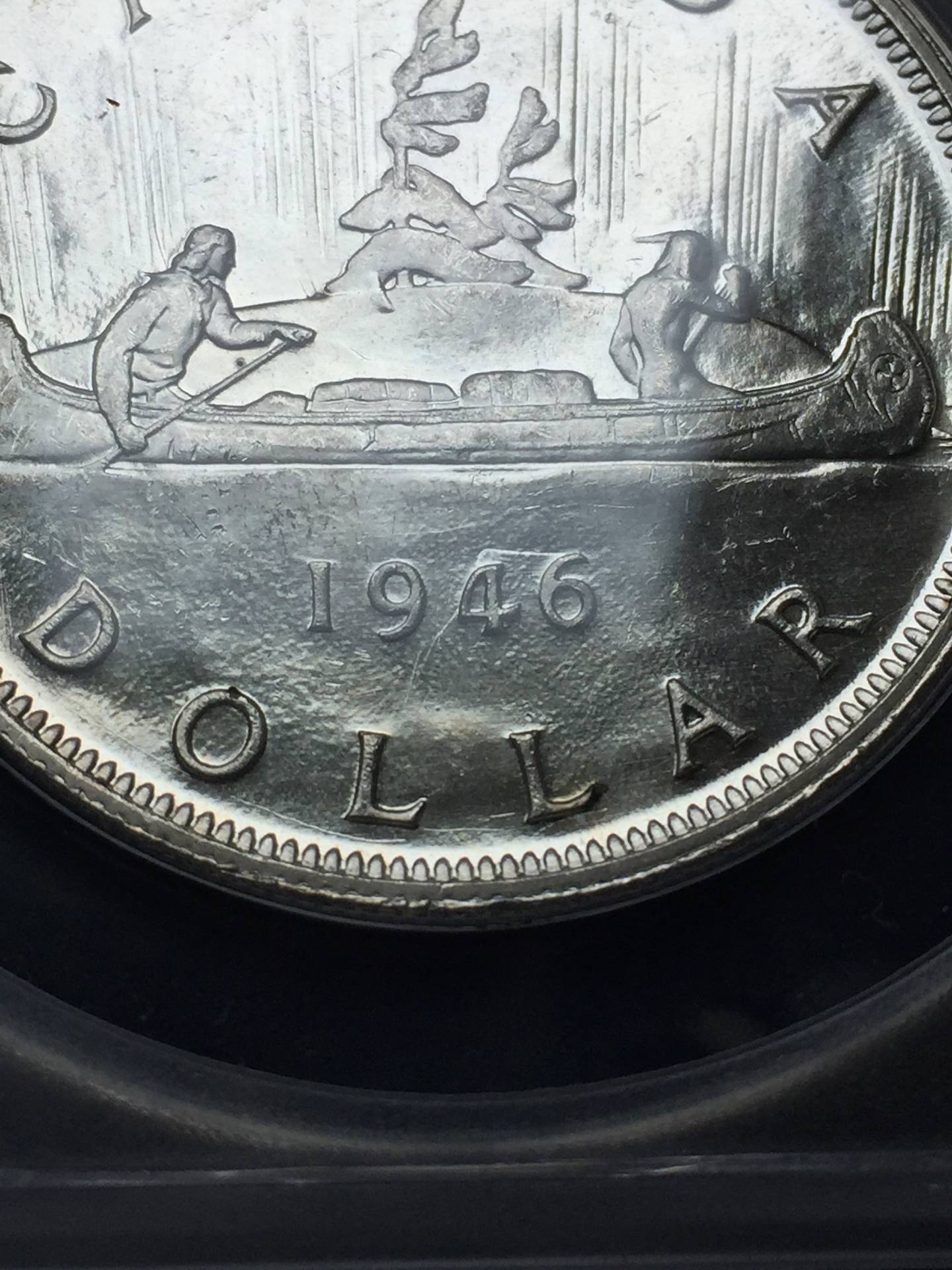 |
|
Pillar of the Community
Canada
5423 Posts |
I am leaning towards a superb Early mint state business strike . There is a real possibility that the piece WAS struck from a Refurbished obverse specimen die. The reverse appears to have a very minor weak strike issue at the centre of the Canoe . The pebble like surface (coin #2) does show up on 1946 Dollars fairly often. Years ago a prominent Canadian Dealer had two 1946 Dollars graded as MS64 in old 2 Letter ICCS Holders . They were very similar in appearance to the OP coin . A theory that might be plausible , the above coin was struck and caught by hand , thus the minimal amount of marks. Back in the day it was not unheard of to let a visitor or dignitary to the RCM to hand strike and catch a coin that was then either presented or purchased . That said , sure is a beautiful 1946 Dollar in this post! |
|
New Member
 Canada
21 Posts |
A lot of interesting information to take in...
Pacificcoin; you mentioned something that perked my interest:
"Years ago a prominent Canadian Dealer had two 1946 Dollars
graded as MS64 in old 2 Letter ICCS Holders . They were very similar
in appearance to the OP coin ."
Further down on the PNG certificate, it mentions that this dollar was purchased by dealer Al Rosen (Toronto Coin Centre) in the 1973 Charlton auction; interested in knowing if this was the same dealer & if there is any more information surrounding those two dollars (I don't believe this to be one of them, just curious to know as much as possible about any history that might lead to more answers!).
|
|
New Member
Canada
21 Posts |
|
|
Pillar of the Community
United States
4233 Posts |
I suppose you could check for die polish, particularly around the date, and compare to known examples. It won't rule out a specimen die used for circulation if it matches, but if yours doesn't match any known SP it could be evidence against yours being one. Below are a Cook collection SP64 and an NGC MS62. This could be proof that a 1946 SP die was used for circulation. I highlighted a few matching polish lines. There might be a "dot" in common as well (circled) but it's difficult to determine on many of the Heritage images (lots of dots on these coins!). 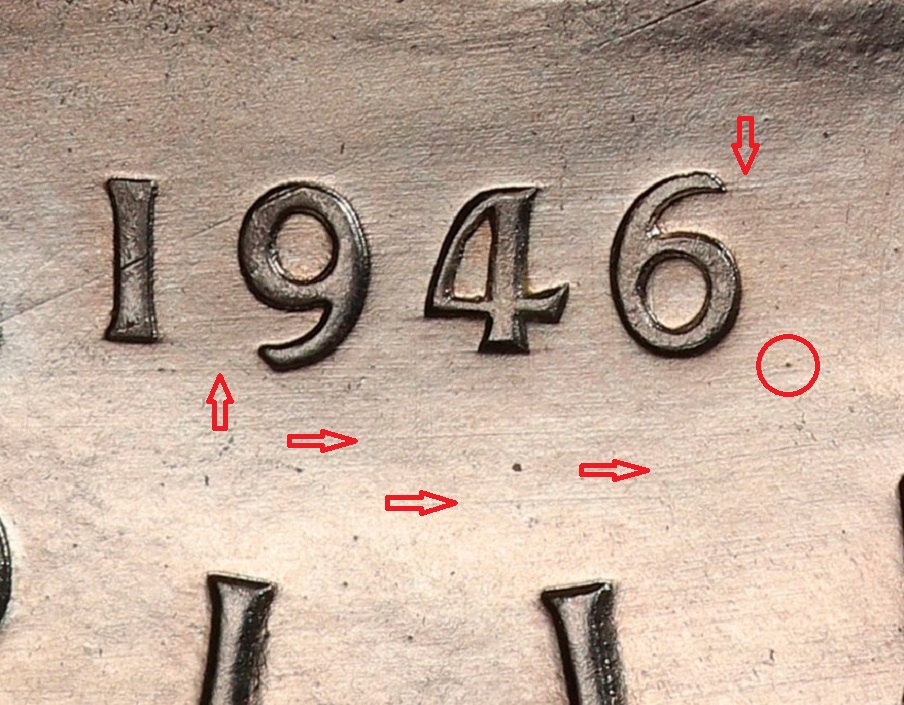 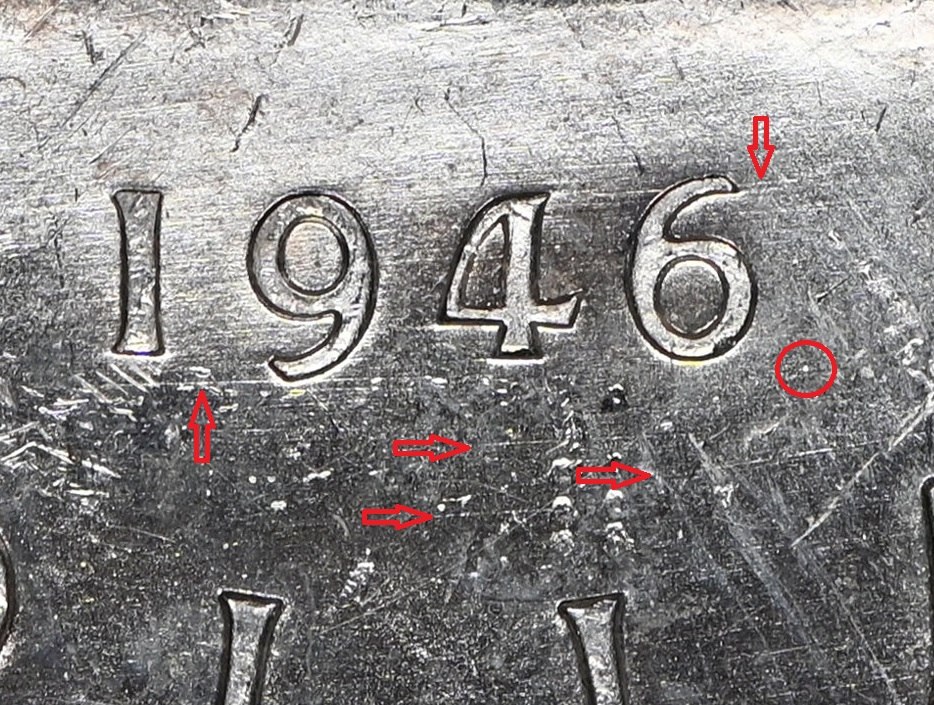 |
| |
Replies: 13 / Views: 2,194 |
|




 Posted 06/14/2023 1:23 pm