| Author |
 Replies: 15 / Views: 1,395 Replies: 15 / Views: 1,395 |
|
|
CCF Master Historian of Commemorative Coins
 United States
12626 Posts |
In early September 1965, John Waldemar Wydler (R-NY) introduced an amendment to the Coinage Act of 1965 in the House of Representatives that called for the placement of "a likeness of the late General of the Army Douglas MacArthur on one side." MacArthur's quote "Duty, Honor, Country" (originally spoken at a 1962 speech given by MacArthur at West Point when he was accepting the Academy's Thayer Award) was to be included. A parallel amendment proposal was introduced by Representative John Irving Whalley (R-PA) approximately two weeks later. Each amendment was referred to the House Committee on Banking and Currency. General Douglas MacArthur had died a year+ earlier on April 5, 1964 at Walter Reed Army Medical Center; he was being treated for biliary cirrhosis (a condition which destroys the bile ducts in the liver and thus allows bile to build up in the liver to a toxic level). MacArthur was 84 at the time; he was born in Little Rock, Arkansas on January 26, 1880. MacArthur graduated from the US Military Academy at West Point in 1903 - he was first in his class. His first military commission was with the US Army Corps of Engineers as a Second Lieutenant; his first assignment took him to the Philippines - at the time, a Territory of the US. (The Philippines would play a significant role in MacArthur's military life.) MacArthur had a distinguished military career, serving in leaderships positions during World War I, World War II and in Korea. During his career, he earned two Distinguished Service Crosses (WWI), a Distinguished Service Medal (WWI), seven Silver Stars (WWI) and two Purple Hearts (awarded in 1932) for two separate mustard gas attacks he survived during WWI. In World War II, he received the Medal of Honor - the highest military award of the United States - for his actions in defense of the Philippines. He also was promoted to the rank of Five-Star General in 1944 after liberating the Philippines from the Japanese - he returned to the islands to make good on a promise he made in 1942 when he was forced to leave the Philippines in advance of the invading Japanese. (Note: MacArthur is just one of five to achieve the rank of Five-Star General of the Army.) Following MacArthur's death, a 50-member Commemorative Coin for MacArthur Committee formed and worked to secure signatures on a petition that called for a MacArthur coin. The Committee was spearheaded by Stewart Smith of Baldwin New York; he helped gather ~4,000 signatures on the Committee's petition. Representative Wydler remarked that is was the work of Smith and the Committee that inspired him to introduce his Coinage Act amendment. During his Extended Remarks on his coinage proposal, Wydler argued that MacArthur's popularity would be a boon to the public's acceptance of the new "cupri-nickel" coinage at a time when it was generally believed that the new silverless coinage would be spurned by the general public. Neither of the two amendments was ever reported out of Committee or considered further - George Washington made the transition from silver to copper-nickel clad and continues in place to the present! At the time, MacArthur had previously been recognized numismatically via a Gold Congressional Medal (in 1962). 1962 Congressional Medal for General Douglas MacArthur - Bronze Copy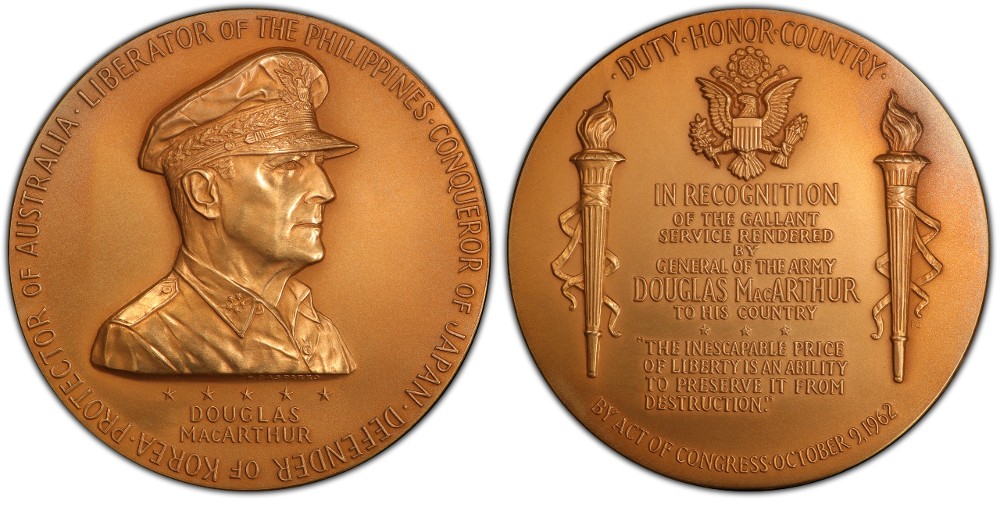 (Image Credit: PCGS CoinFacts. Fair use, education.) (Image Credit: PCGS CoinFacts. Fair use, education.)At the time, the Mint struck full-size and small bronze replicas of the medal for public sale. The small version of the medal was struck again by the Mint recently for inclusion in the 2013 5-Star Generals Profile Collection. For other of my posts about commemorative coins and medals, see: Commems Collection. Collecting history one coin or medal at a time! (c) commems. All rights reserved.
|
|
|
|
Bedrock of the Community
United States
94367 Posts |
Good read. The medal is most impressive!
|
|
Pillar of the Community
United States
883 Posts |
During the Russo-Japanese War of 1905, the military attaches in Tokyo of the Western powers (whose lives were reportedly a dull lot) mostly requested, and were granted, permission to accompany the Japanese military forces. Unfortunately, even though almost everything (with the exception of aerial warfare) that was to happen 10 years later in Europe happened in Korea and Manchuria, the home governments took no heed. The US attache was an officer named Arthur MacArthur, whose aide-de-camp was his son, young Douglas.
If you look at General MacArthur's campaign during the Korean War of the 1950s, it was almost step-by-step a duplicate of the campaign of 1905. The landing place of Chemulpo had been re-named Incheon, but the strategy was the same. This helps to explain why he made to cross the Yalu River into Manchuria, despite orders to remain within Korean territory : he knew that the movement of war materiel could best be stopped by seizing the Chinese Eastern Railway junction at Mukden.
Edited by publius
06/19/2023 09:57 am
|
|
Pillar of the Community
 United States
4623 Posts |
I realize 1965 was a kindler, gentler time than today, but can you imagine the kerfuffle - in snippy letters to the editor in weekly coin magazines - about replacing General Washington's SILVER coins with this MacArthur CLAD coinage?
-----Burton 50+ year / Life / Emeritus ANA member (joined 12/1/1973) Life member: Numismatics International, CONECA Member: TNA, FtWCC, NETCC, EveryCountry (online) coin club Owned by three cats and a wife of 40+ years (joined 1983) Author: 3rd Edition of the Sample Slabs book, https://www.sampleslabs.info/ |
|
CCF Master Historian of Commemorative Coins
 United States
12626 Posts |
Quote:
...replacing General Washington's SILVER coins with this MacArthur CLAD coinage? It's important to remember that Clad coinage was already authorized and a reality at the time of Wydler's proposal. Representative Wydler believed that changing the quarter's portrait to that of the immensely popular MacArthur, the clad coin would be better accepted by a large segment of the population. There will always be opposition to change, however. Collecting history one coin or medal at a time! (c) commems. All rights reserved.
|
|
Bedrock of the Community
United States
27514 Posts |
Thank you for this insightful historical summary, commems.
Inordinately fascinated by bits of metal with strange markings and figures
|
|
Moderator
United States
109575 Posts |
MacArthur: who's dat? Did he ever do anything great?
|
|
Pillar of the Community
United States
1538 Posts |
@Dearborn — Guess the Navy didn't teach you about the Army lol.
|
|
Moderator
United States
197600 Posts |
Very interesting!  I have that medal as part of the 2013 5-Star Generals Profile Collection I purchased from the Mint in 2013.  |
|
Moderator
United States
109575 Posts |
Quote:
@Dearborn — Guess the Navy didn't teach you about the Army lol. Army? you mean there is more that just the NAVY?!?  |
|
Moderator
United States
109575 Posts |
Lets not forget that the Island hopping ground fighters were mostly Army (with only a small Marine Corps effort) all caught rides from the US Navy.. Quote:
Army General Douglas MacArthur and Navy Admiral Chester Nimitz along with Admiral William "Bull" Halsey devised a plan unique in the annuls of military history. They would orchestrate a series of complex maneuvers that has come to be known as "island hopping". Source: https://sites.wp.odu.edu/primary-so...the-pacific/ |
|
Pillar of the Community
United States
1080 Posts |
Very impressive medal, commems...you didn't get the gold?
Quote:
Dearborn asked: "MacArthur: who's dat? Did he ever do anything great?"
He did indeed! MacArthur signed one of my Dad's short snorters somewhere over the Phillipines in 1945.
Unfortunately I sold it on ebay about 18-20 years ago. Not sure if MacArthur's autograph was a bigger draw than Joe E. Brown's or Jerry Colonna's, but the main reason the group of bills brought a tidy sum was certainly because Bob Hope distinctively signed "from the Solomon Islands!"
(As a sad but not atypical sidelight for WWII, my Dad was a LT and pilot based out of Alameda NAS who spent the entire war "island-hopping" -- flying large transport aircraft -- or as he downplayed it once, "driving taxicabs and hearses all over the Pacific.")
"If everything seems to be under control, you're just not going fast enough."
--- Mario Andretti
|
|
Pillar of the Community
United States
1538 Posts |
In all seriousness, @Dearborn, thank you (and so many others) for your service!
|
|
Moderator
United States
109575 Posts |
Quote:
In all seriousness, @Dearborn, thank you (and so many others) for your service! Thanks, (I do hope the others above know that I'm just playing around here) We all well know that Mac helped to throw back the Germans and save Bastogne!  |
|
Moderator
United States
15997 Posts |
Fantastic read - thank you @commems for sharing your scholarship.
Take a look at my other hobby ... http://www.jk-dk.art |
|
Pillar of the Community
United States
3857 Posts |
Great read, commems, thanks!
|
| |
Replies: 15 / Views: 1,395 |
|







 Posted 06/19/2023 09:55 am


