| Author |
 Replies: 21 / Views: 2,521 Replies: 21 / Views: 2,521 |
|
Valued Member
United States
164 Posts |
Several years ago I was given the item pictured below. It was a prop from a display in a clothing store that was closing for good; they were literally getting rid of everything, so the manager let me have it. For that reason (along with its thinness, as mentioned below), I've always assumed it was a replica. Am I correct in that assumption? It's about 23mm in diameter, the same as real Chinese coin I have (a common one from Qianlong, c.1740-70), but not much more than half its thickness, less than 1mm. It doesn't stick to a magnet. What do you think? Assuming it is a replica, what actual Chinese coin (if any) does it look like? 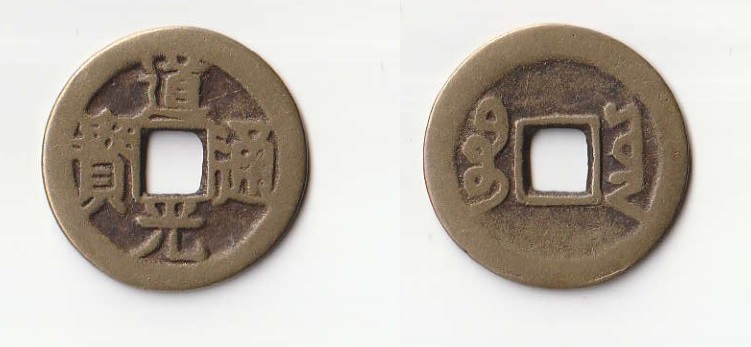 Edited by SquareCircle
06/22/2023 12:21 pm
|
|
|
|
Valued Member
 United States
164 Posts |
A comparison between the thickness of the known Chinese coin (top) and the questioned item: 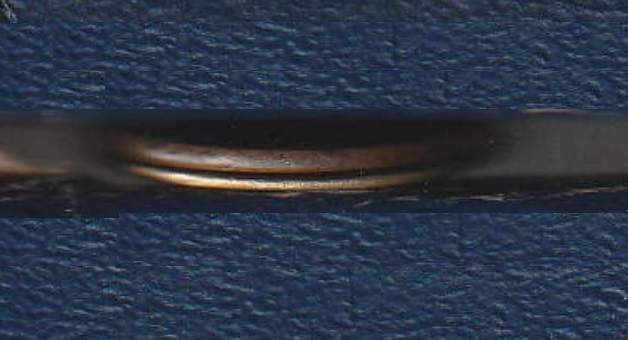 |
|
Moderator
 United States
34575 Posts |
"If you climb a good tree, you get a push."
-----Ghanaian proverb
"The danger we all now face is distinguishing between what is authentic and what is performed."
-----King Adz
|
|
Valued Member
United States
164 Posts |
It's definitely not the same as the coin at the link. Maybe it's a replica with the two sides based on two different coins?
Any other input would be appreciated.
Edited by SquareCircle
06/22/2023 1:55 pm
|
|
Moderator
Australia
17035 Posts |
The obverse is definitely the same as the coin posted by Spence. The emperor is the Dao Guang emperor (reigned 1820-1850). The reverse of these coins gives the mint, in the Manchu language. In this case, the mint-name (on the right) is "Yun", for Yunnanfu, Yunnan Province. So this one is a better Numista example. Here's a whole page of them on the zeno.ru database. The other word (on the left) is "boo", which is the Manchu word for "mint". Your "boo" is very oddly-shaped, but coins from Yunnan Province were often poorly written. The thickness also is not of too great a concern; Chinese cash coins varied considerably in size and thickness over their 2500-year-long existence. As a rule, they generally got smaller and thinner with time. Don't say "infinitely" when you mean "very"; otherwise, you'll have no word left when you want to talk about something really infinite. - C. S. Lewis
|
|
Bedrock of the Community
Australia
21794 Posts |
About 45 years ago I bought over 100 varied cast cash coins at 20 cents each in a single lot
I had no idea of what I was buying then, except that the choice I made was to ensure the characters were different from each other.
I had no idea if they were genuine or not.
Hindsight suggests to me is that they all may be genuine.
To be honest, I am still not much wiser now, but for 20 cents each, it didn't matter then, and it still doesn't matter very much now, except
that after identifying them all by reign name, I seem to have covered all dynasties, and most of the more common Emperors, from the T'ang period, until the last Emperor.
For over a thousand years, cast cash coins were made in truly industrial quantities, and if any cash coin in your collection happens to be a very deceiving fake, I wouldn't worry too much about it.
The more obvious 'fake' coins usually present themselves as modern fantasies.
Forming a largish collection of cash coins can be lots of fun, but for me, it matters little if the collection happens to be of not much real value.
|
|
Valued Member
United States
164 Posts |
Thanks for the information.
Unfortunately, I can't see the zeno.ru page. But I find a number of pictures of genuine Dao Guang cash coins online, and they very typically have a very different look from this item -- basically, rougher. Based on that, I'm tentatively concluding that this is indeed a replica and not the real thing.
Let me know if anyone has any opinions on this, or any advice as to how I might be able to tell. I know this wouldn't be valuable even if it is genuine, but I don't want to be thinking it's fake if it's real, or vice versa.
Edited by SquareCircle
06/23/2023 2:35 pm
|
|
Pillar of the Community
United Kingdom
2944 Posts |
This is just a normal,worn Yunnan cash. Thicknesses vary quite a bit as has been mentioned before.
|
|
Valued Member
United States
164 Posts |
OK, if you guys figure this is a real coin and don't see anything fishy about it, then I'll take your word for it.
I've searched online for more pictures of cash coins from the emperor in question, and what stands out about them -- particularly given the very simple and standardized design of such coins -- is how wildly inconsistent their looks are. It's almost like every single specimen was made by a different person.
|
|
Bedrock of the Community
Australia
21794 Posts |
SC:- with Chinese cast cash coins, your reasoning is correct.
|
|
Pillar of the Community
United States
883 Posts |
You have to remember : these coins were not struck but cast.
An original coin would be made, often by the lost-wax process (the wax model being made by hand, or possibly by pouring wax into a hand-carved mould), and used to make a mould which was then used to make a number of "mother" pieces which in turn would be used in the moulding process. Hundreds of coins would be cast simultaneously in a single pour, in an extremely complex mould. Within one pour (not to speak of variation from pour to pour), the weight of any given piece might vary by perhaps as much as 40%, due to differences in thickness and porosity, and the composition might also vary due to stratification of the melt. As a result, circulation wear on individual pieces might be quite different from one to another, even before you account for the habit of carrying them on strings for large payments.
|
|
Valued Member
United States
53 Posts |
|
|
Valued Member
United States
164 Posts |
Quote:
It is a fake. AlfredG - I just now saw your post. What makes you say it's a fake? Edited by SquareCircle
07/21/2023 09:32 am
|
|
Valued Member
United States
164 Posts |
AlfredG -- I'm going to ask again since it's been a while.
Based on your other posts about Chinese coins I'm assuming I can trust your expertise on this. But what is it specifically about this item that makes you say it's a fake?
|
|
Valued Member
United States
53 Posts |
Because bao yun mint (yunnan mint) has a unique way of casting coins, and all the coins from the yunnan mint looks more or less the same way, i.e the metal composition are similar, and the styes of the characters are similar. This coin looks 20000000 miles away from coins made from bao yun mint, and I have personally seen a full set of coins like this one made for each mint, I am guess these were made to fool tourists.
|
|
Valued Member
United States
164 Posts |
OK, thanks for responding. This has been sent back to my "replicas" file where I originally had it.
|
| |
Replies: 21 / Views: 2,521 |







 Posted 06/22/2023 1:50 pm


