| Author |
 Replies: 64 / Views: 5,893 Replies: 64 / Views: 5,893 |
|
|
|
Moderator
 United States
56855 Posts |
|
|
Forum Dad
United States
24233 Posts |
Sorry, I'm not seeing an error coin. I see a possible die crack on the bottom of the right wheat stalk and from these pics the rest looks like stains.
|
|
New Member
 United States
12 Posts |
Die dent from feeder finger, is the name for the two lines on the reverse side. The right stalk error is called a Retained Cud. Both are in the link ai provided. Now for the staple issue, I this coin is in my safe by itself, no issue of it damaging anything else or itself. Sorry for saying dye, that was my phone auto correcting, and I didn't go back to check. |
|
Moderator
United States
56855 Posts |
|
|
Bedrock of the Community
United States
19626 Posts |
I too believe there is some staining present. Suggest giving the coin a long soak in 100% acetone--may (may...) reduce or eliminate the staining.
|
|
Moderator
United States
108114 Posts |
Quote:
Sorry for saying dye, that was my phone auto correcting Ah, ok, I get that. I hate that auto correct thingy. (we get a lot of folks using the incorrect word, so it is a common thing to try to help out with terminology too.) but the line by the wheat stalk is no a Retained Cud, Cuds always involve the rim of the coin and will have 2 points of contact to the rim. You see a Cud is a raised feature at the rim cause by a piece of the die falling away from the edge of the die itself. If it is in the center of a coin it could be called a 'RIDB" or Retained Interior Die Break - of which that on your coin is not either. The 'T' on the obverse is misshaped by circulation hits moving the metal up to the rim. |
|
Forum Dad
United States
24233 Posts |
Quote:Die dent from feeder finger, is the name for the two lines on the reverse side. The right stalk error is called a Retained Cud. Sorry, but no and no. |
|
New Member
United States
12 Posts |
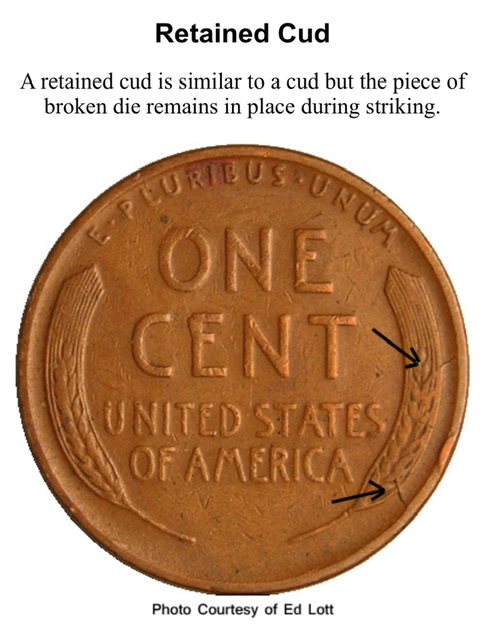 Retained Cud Retained Cud, doesn't always have to touch the rim of the coin. |
|
Forum Dad
United States
24233 Posts |
You see the crack goes from rim to rim in your picture right? You can't always see it on the upset part off the rim because it's much thicker, but the die is broken rim to rim on a Retained Cud. Again, yours is NOT a Retained Cud. Not even close. |
|
New Member
United States
12 Posts |
First off, you're a troll Bobbie, just stop. Secondly, if you read the description you would know it's a piece of the die, not a darn crack. Third, difference between a Cud and a retaining Cud is one is stamped into the rim of the coin, the other is inside the coin. Either in the center or off to the side. If you zoom in, you can see that the Cuds in the picture don't actually touch the rim of the coin, but come close. |
|
Pillar of the Community
 United States
9018 Posts |
|
|
Forum Dad
United States
24233 Posts |
Ok lets address your concerns one at a time..... Quote:
First off, you're a troll Bobbie, just stop. I'm not a troll, I own this place and obviously know way more than you just from the terminology you've used. Like face/front, double stamped in the letters and numbers, dye leaking, double stamp print, etc. Quote:
Secondly, if you read the description you would know it's a piece of the die, not a darn crack. This is what a die looks like that makes a Cud coin like the cent shown. Now imagine that the same piece is broken, but hasn't fallen out of the press yet. That makes a Retained Cud and shows a rim to rim die crack (see more info below) instead of a blob.   Quote:Third, difference between a Cud and a retaining Cud is one is stamped into the rim of the coin, the other is inside the coin. Wrong again, if it doesn't involve the rim, it's not a Cud, it's just a die crack. Quote:Either in the center or off to the side. If you zoom in, you can see that the Cuds in the picture don't actually touch the rim of the coin, but come close. I explained that. The rim is much thicker than the field because it's run through an upset mill first, the raised "crack" on the coin doesn't always extend though it, but the die is still cracked. A few more points.... They call them die cracks, but the coin is NOT cracked, the die is. Cuds are not "stamped" into the coin. They are Cuds because nothing is stamped into the coin, because that part of the die is gone. |
|
Pillar of the Community
United States
9018 Posts |
bobby, I've only been on your site a couple of years but don't recall you ever being called a troll before. Is that a new one? You have some pretty good numbers for a troll.  -makecents-
|
|
Pillar of the Community
United States
4618 Posts |
Umm... Wow!  ANA ID: 3203813 - CONECA ID: N-5637 Clean a coin that may be worth collecting? Please DON'T! When in doubt, leave it dirty!! 
|
|
Pillar of the Community
United States
7174 Posts |
 to the CCF There is a lot to learn here. I'm still learning after almost 60 years. This site is the best place to do that. With just the responses in this thread there are centuries of experience. Your pictures are a little small, but what I see is just a well circulated Wheat cent. The T that looks like a Y has taken a hit from another coin or something else. The line through ONE on the reverse looks to me like glue. The only thing that looks interesting is the thing that's on the bottom of the right side wheat head. It looks to straight to be a die crack. The rest of the reverse looks like staining, which we see a lot of here. My suggestion is to soak it in 100% acetone. It won't hurt your coin. If it's glue it will take it off. After that come back with bigger in focus pictures. |
| |
Replies: 64 / Views: 5,893 |





 First Page


 Posted 06/29/2023 4:56 pm





