| Author |
 Replies: 13 / Views: 806 Replies: 13 / Views: 806 |
|
|
Pillar of the Community
United States
911 Posts |
Looking for opinions as to grading on this coin. I did my best to compare it to those on PCGS Photograde. The comparisons seem to be all over the place. It appears to be comparable to the AU58 example and just as good as the MS61 example. My grading skills are about zero. So I turn to the expert opinions here. This is one of five won at auction. To follow: 1851 O, 2x 1852, 1856. Thanks in advance.  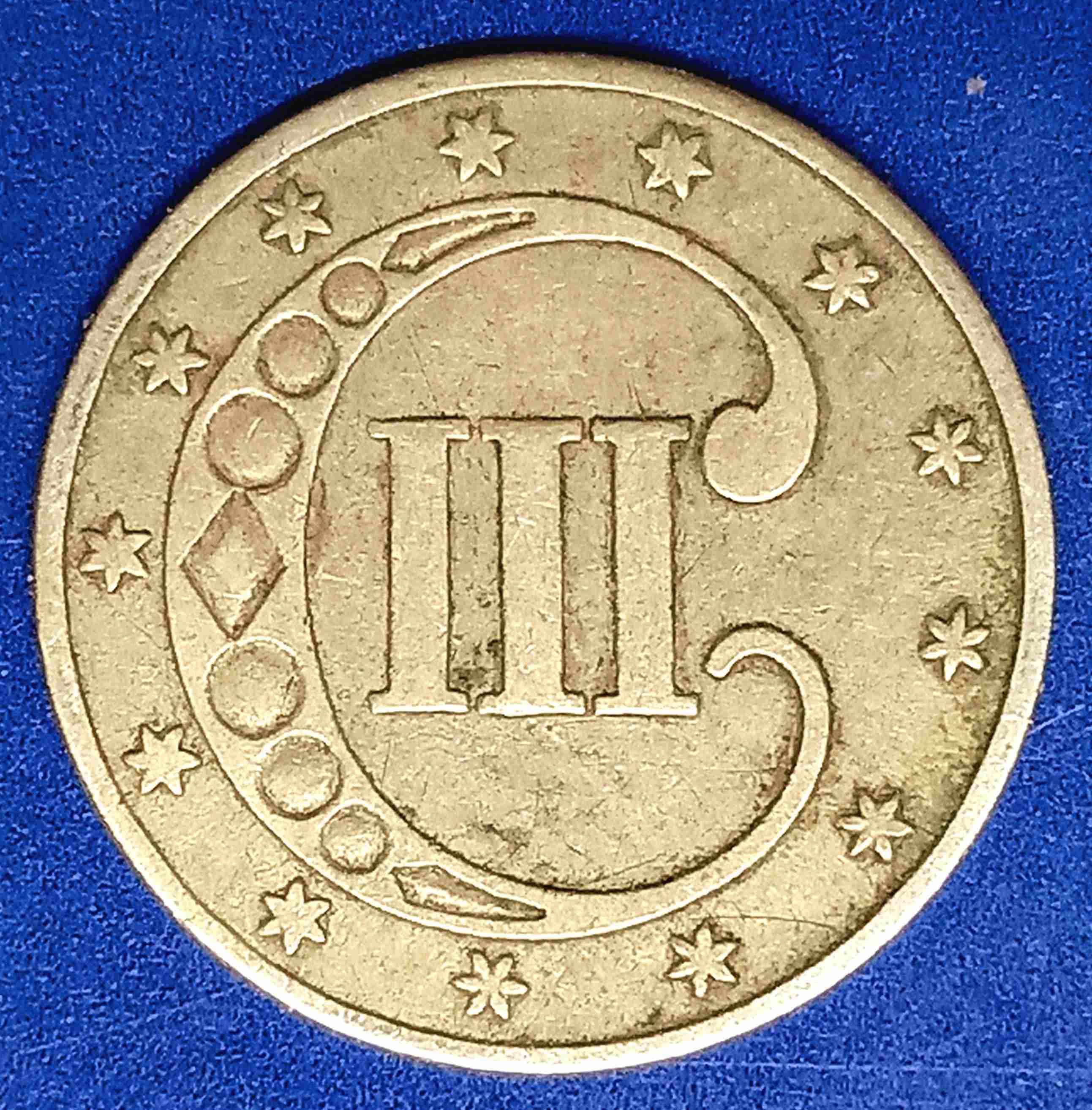   |
|
|
|
Pillar of the Community
United States
5825 Posts |
IMO it's a VF-20 or VF-25.
If you want to grade coins yourself purchase The Official American Numismatic Association Grading Standards for United States Coins.
|
|
Bedrock of the Community
United States
94367 Posts |
I'll say VF details (scratched, cleaned).
|
|
Pillar of the Community
United States
883 Posts |
If you look at the first "S" in STATES you will notice that the letter, the field, and the rim are all merged into each other. That's a heavy degree of wear, which certainly excludes the coin from any MS or AU grading category. Similarly, the inward points on the central star at "9 o'clock" and "3 o'clock" have practically disappeared.
Unfortunately, the "Photograde" picture for MS61 is quite bad, and misleading.
|
|
Bedrock of the Community
United States
94367 Posts |
 Good analysis. |
|
Pillar of the Community
 United States
5725 Posts |
I'd say VF-20, possibly details from an old cleaning. The scratches I think are acceptable for a coin this small with this much wear.
|
|
Pillar of the Community
 United States
911 Posts |
Boy oh boy, do I have alot to learn. Thanks you all for the input. The VF20 example in photograde appears to have a bit more wear on the rims and legends than this one, but you all have been at this for a long time. Judging from the MS61 example, I might roll the dice and send it in. Maybe the same grader will end up with it at the end of a long day and it comes back MS64! LOL. Thanks again. Unfortunately, this is the best of the five.  |
|
Pillar of the Community
United States
9811 Posts |
It can certainly take a lot of time to learn grading and to become proficient at it. I think the ANA Grading guide book is a great start, but the one thing that really got me up to speed was the ANA Summer Seminar classes on grading, I've taken 3 of them over the years and 2 on Counterfeit Detection from the 9 total courses I've attended over the years. Next up is to look at a lot of coins, Auctions are a great place to do this. But the downside is you need to be close to an auction house to attend preview viewing. Los Angeles, New York, or Dallas for the big companies (Stack's/Bowers, Heritage, Goldberg's, Legend, Kagin's, etc.), or attend a coin show where an auction is being held and previewing is offered. Looking at many coins over time will enhance your skills and teach you things some books never will, like how certain years in a series is always struck nice or poorly, or how the blank planchets come (useful in early and colonial coinage). Hands on lots and lots of coins is something you can't replicate with photos or books only. Also finding a mentor that is near you in person that can help tremendously, I was lucky growing up, I had many such folks around me. Some other good books to read on grading are found in this CCF thread, http://goccf.com/t/438875#3781510P.S. Don't feel too bad as the 3 Cent Silver trimes are some of the toughest of all the US coins to grade well, even for experts. "Buy the Book Before You Buy the Coin" - Aaron R. Feldman - "And read it" - Me 2013! ANA Life Member #3288 in good standing since 1981, ANS, Early American Coppers Member (EAC), Colonial Coin Collectors Club member (C4), Conder Token Collector Club member (CTCC), Civil War Token Society (CWTS) member, Liberty Seated Collectors Club (LSCC) & Numismatic Bibliomania Society member (NBS), USMex, Member in good standing, 2¢ variety collector. See my want page: http://goccf.com/t/140440 |
|
Pillar of the Community
United States
911 Posts |
Good advice westcoin. Thanks for that.
|
|
Pillar of the Community
United States
5725 Posts |
I agree with @westcoin. The more coins you inspect in hand, especially less common issues like the trime, the better you'll get at grading. If you have the opportunity to attend a coin show, get some opinions from some dealers before you consider paying to have it graded at a TPG. Sending it in for grading would be an expensive way to get a grading lesson. |
|
Pillar of the Community
United States
911 Posts |
Thanks zurie, I was jetting about TPG. I have you all for the heads up. |
|
Pillar of the Community
United States
4623 Posts |
The photograde pictures are correctly graded, but very weak strikes.
Does anybody want to know the tell for high AU/MS?
Look at the edges of the right side of the C on the reverse and notice the tiny fins. Below about AU53, they're gone.
-----Burton 50+ year / Life / Emeritus ANA member (joined 12/1/1973) Life member: Numismatics International, CONECA Member: TNA, FtWCC, NETCC, EveryCountry (online) coin club Owned by three cats and a wife of 40+ years (joined 1983) Author: 3rd Edition of the Sample Slabs book, https://www.sampleslabs.info/ |
|
Bedrock of the Community
United States
18978 Posts |
westcoin is correct. one of the most challenging series to grade. thin metal. all kinds of strike issues.
any AU coin or above is going to show some of the original surfaces. none here at all. the coin is heavily circulated. on this series you cannot look at just one or two markers. look at the entire coin. wear can specifically be determined on the reverse looking at the diamonds and dots. also important are the centers of the points to the shield. these are all gone. letter sharpness helps to determine strike. no doubt this coin is weakly struck. the date, lettering and stars are stronger than a 20 as are the rims.
the coin has been cleaned so whatever the grade you are looking at a details grade on this. I can get it to VF25
|
|
Pillar of the Community
United States
646 Posts |
I'd give it a VF-30. As Westcoin well said, there is really no substitute for actual hands-on experience. But until you aquire that experience, the ANA Grading Standards book is a great help. |
| |
Replies: 13 / Views: 806 |
|




 Posted 07/01/2023 10:40 am





