| Author |
 Replies: 36 / Views: 2,608 Replies: 36 / Views: 2,608 |
|
|
|
Valued Member
 United States
72 Posts |
Has a sound of a penny when dropped on table
|
|
Moderator
 United States
108733 Posts |
Have you explored what looks like a seam I highlighted yet?
|
|
Valued Member
United States
72 Posts |
Dearborn if there is a seam does it matter if it's incase or raised? I'll look when I get home
|
|
Pillar of the Community
United States
6928 Posts |
According to the U.S. Mint, the core is 100% copper, the cladding is 77% copper, and the overall average is 88.5% copper. The coin's mass is 8.1g. According to my math, that makes the pure copper core approximately half the mass at 4g, and the two brass cladding layers are each 2g. I am going to speculate that one of the cladding layers is missing. That's why the obverse looks so different from the reverse, and why the coin is so thin. The features and rim are a weak strike due to thinness, obviously. Further, I speculate that the face is the copper side, and the reverse is the properly clad side. It's entirely possible that the planchet is just rolled thin, but mathematically it seems very conspicuous that the coin is missing almost exactly the mass of a single clad side, and visually the two sides look different. Also, the rim looks rough, although that could also be a result of circulation or the fact that thin planchets often don't have enough material on the rim for a strike to properly obliterate and shape the proto-rim into a squared rim. If it's missing a clad layer pre-strike, that might also explain the seam that Dearborn pointed out. That would be pure copper sticking out, which is meant to be internal and covered by the cladding. Although I am curious how the Sacagawea dollar manufacturing process takes a clad sandwich and produces a coin with no exterior edge seam. Whichever side that has the copper sticking out is missing the clad layer, obviously. |
|
Pillar of the Community
United States
6928 Posts |
|
|
Valued Member
United States
72 Posts |
Thank you for the info Brandmeister I believe your right I saw an example that looked like mine and weighed 6 grams
|
|
Pillar of the Community
United States
6928 Posts |
Well, I am presenting an alternate hypothesis to test. At this point thin planchet also makes sense, and there are other possibilities (like acid damage) beyond those two. I'm not sure how you'd verify the missing clad layer possibility without metal testing. We would have to devise a test that could conclude thin planchet vs. missing clad layer.
Unfortunately, none of the examples I located via Google had listed a mass. A few of them did appear to have weak strikes. Sullivan has a coin currently for sale, so you could ask them to weigh it.
|
|
Pillar of the Community
United States
6928 Posts |
|
|
Valued Member
United States
72 Posts |
That was a good read thanks for the info Brandmeister I understand that process a lot better now
|
|
Pillar of the Community
United States
6928 Posts |
|
|
Pillar of the Community
United States
6928 Posts |
|
|
Valued Member
United States
72 Posts |
Tried to get a better pic so you can see the copper better 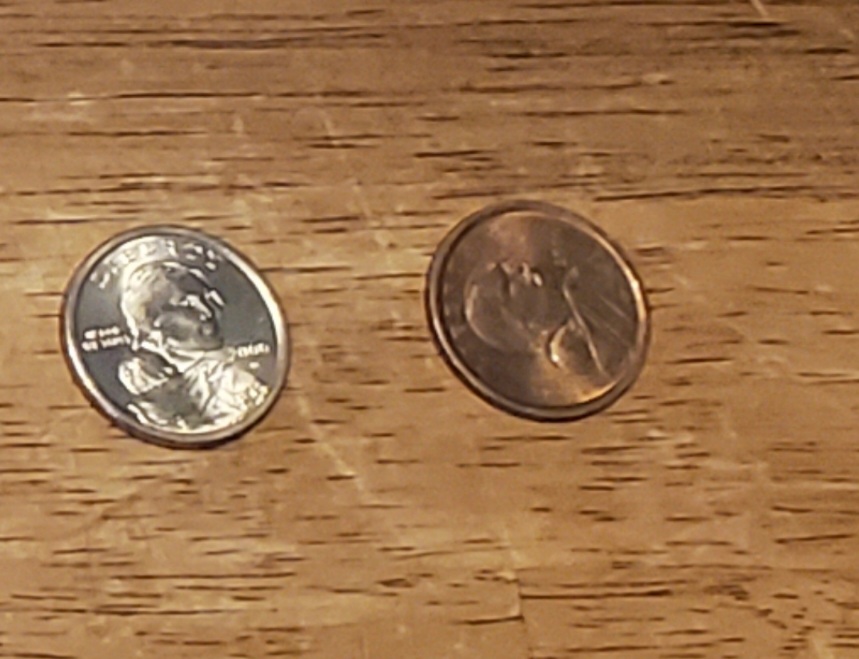 |
|
Pillar of the Community
United States
6928 Posts |
Wow, that picture really shows the difference. You've got a pretty cool coin there!
|
|
New Member
United States
5 Posts |
This is indeed a missing clad layer. It has the obverse clad layer missing, which is why the coin is "coppery" colored on that side. It's worth around $400 retail.
|
|
Valued Member
United States
72 Posts |
That is awesome thanks everyone
|
| |
Replies: 36 / Views: 2,608 |





 First Page


 Posted 07/19/2023 08:46 am


 Uncirculated American Silver Eagles


