| Author |
 Replies: 15 / Views: 1,661 Replies: 15 / Views: 1,661 |
|
|
Valued Member
United States
412 Posts |
So I purchased a bag of foreign coins (you have heard this story before) and found the coin below. The weight seems dead on at 31g and it appears to be silver but I'm sceptical. Thoughts? 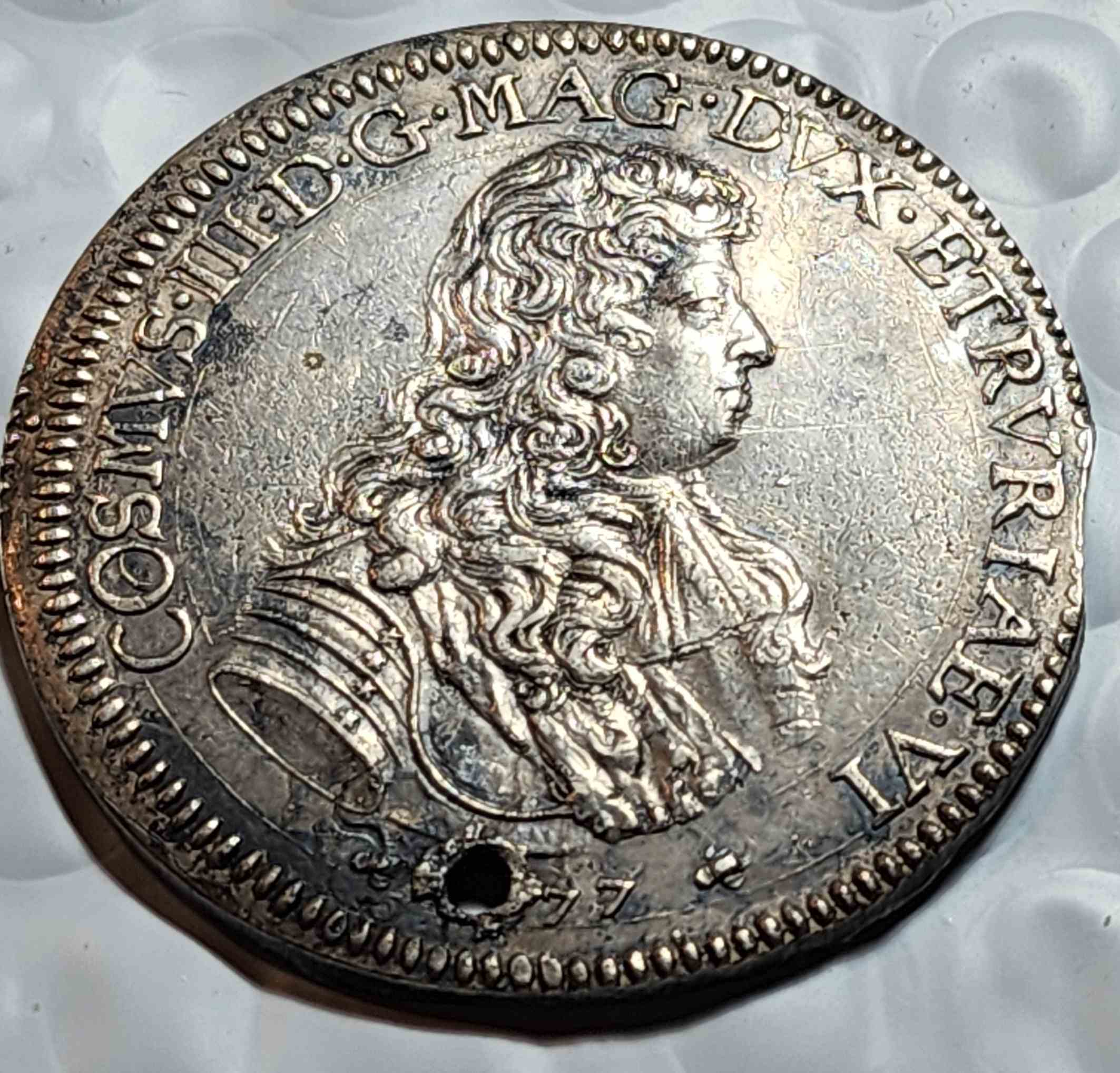 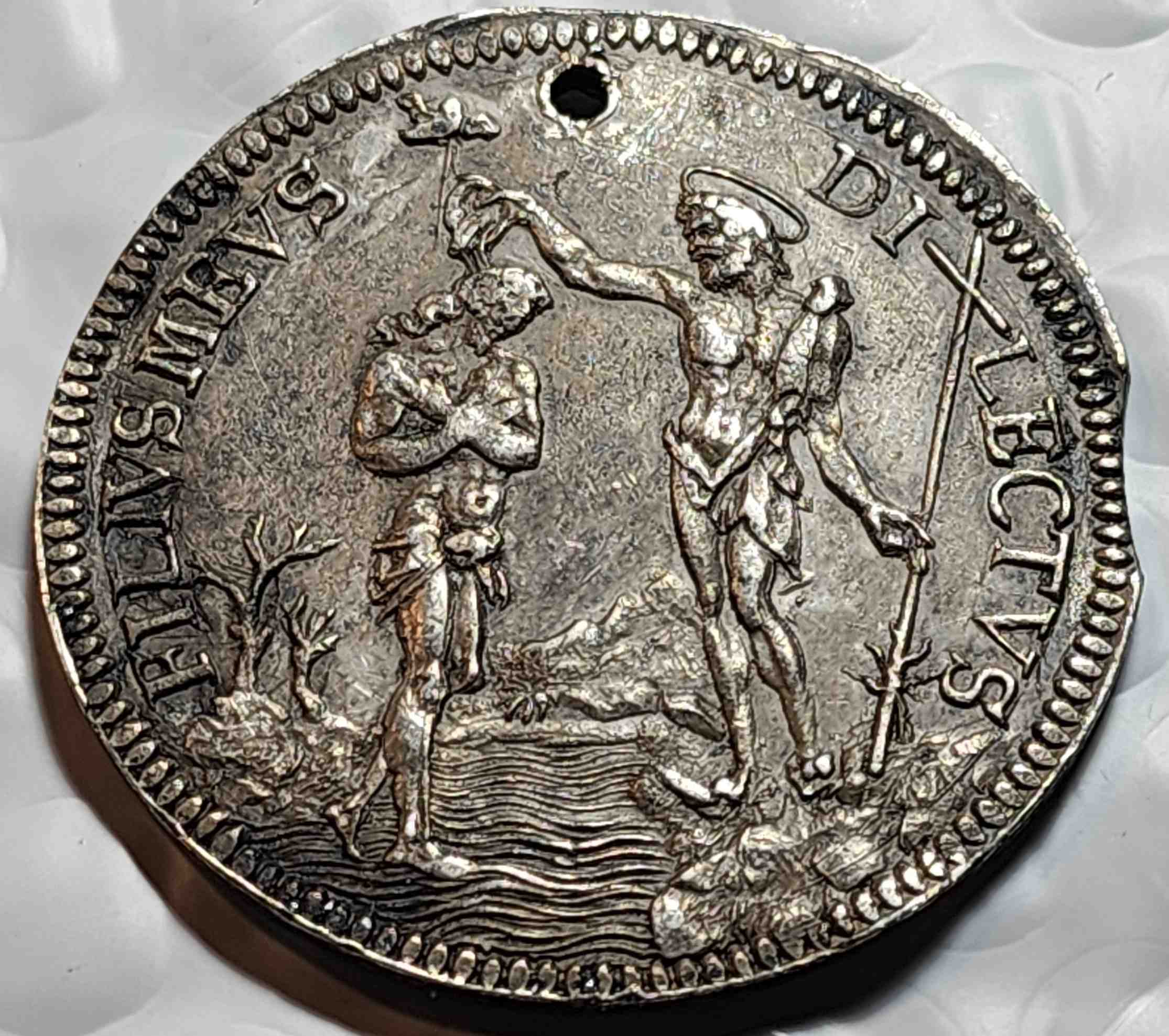 |
|
|
|
Moderator
 United States
56855 Posts |
|
|
Pillar of the Community
United States
807 Posts |
I wouldn't be at all surprised if it were genuine.
|
|
Pillar of the Community
United States
2015 Posts |
This coin is way out of my wheelhouse but certainly would be a cool find if genuine. I know that many coins of this period are crude, misshapen, etc...But I do have a couple of observations. You say the coin is of the correct weight. Wouldn't the drill hole reduce the weight if only a little bit? I also note the varying lengths of some of the denticles. I don't know if that is common for the period. If you have a small digital scale accurate to two decimal points, and a cup of water, you could conduct a Specific Gravity test. You already have a hole in which to pass a thin line for suspending the coin in water and recording the weight. When you do the math calculations on the specific gravity test the results should be in the 10.1 to 10.5 range indicating silver. Lower readings in the 8.7 to 9.3 would indicate a lesser metal than silver. I'm sure your can find a youtube video on how to perform the test. Hoping for you that it turns out to be silver and genuine, that would surely make your day!
|
|
New Member
United States
1 Posts |
I'm in possession of a coin that I reviewed years ago for a friend but decided it to be fake and tucked it away with my paperwork concerning the coin. Here it is several years later. I've attempted to follow the same internet path as before, only to find much info has evolved and it probably is authentic 1652 Masatihvsets. .
|
|
Valued Member
 United States
412 Posts |
According to Numista the weight shoould be 31.14g, mine is 31.0 slightly below normal which would account for the hole.
Specific gravity is 10.3 so it appears to be silver. It's looking more likely to be genuine.
|
|
Moderator
United States
56855 Posts |
novice101,  Best to start your own thread with a few good photos. John1  |
|
Pillar of the Community
United States
2015 Posts |
Dar, that is good news. I was intrigued after seeing this coin that I had to look it up on the web. Italian coin from Tuscany. Firenze mint, and I checked PCGS. PCGS only has graded 4 of this specific coin. I know NGC has also graded at least one but I haven't looked that up. Anyway the specs are supposed to be 31.09 grams, 45mm diameter and silver. In a Stacks Bower auction on 8/12/20 a Au-55 specimen sold for $900. At a 5/26/08 Goldberg Auctioneers auction one sold for $4255. in AU-58. I've seen some sites where the average selling price is in the $3500 range. There is one listed on ebay for $1063 right now. I don't know how accurate this is but another site gave the values as follows: VG-$150, F-$300, VF-$600, XF-$1500, MS-$3700. Edited by MisterT
09/04/2023 2:51 pm
|
|
Pillar of the Community
United States
2015 Posts |
Here is an NGC AU-50 for almost $3000. https://www.ebay.com/itm/274906827310. Some others on ebay look like a stock picture or perhaps fakes since they are all worn identical. Cool coin! thanks for sharing. |
|
Pillar of the Community
United States
2015 Posts |
Still intrigued by your coin, as a side note I had to do a wikipedia search on Cosimo III and it was quite an interesting read, how he bankrupted the country, caused inflation and persecutions.
|
|
Moderator
Australia
16968 Posts |
The spacing of the reverse legend is curious to me. See how the cross breaks the word DILECTVS in the reverse legend? Looking at other examples of this coin (Google Image search for "Tuscany piastre 1677") and I'm seeing numerous varieties: DIL-ECTVS and DILEC-TVS being common, as is unbroken DILECTVS with the cross disappearing behind the lettering - so there must have been plenty of dies made for these coins. But this coin is unique: DI-LECTVS, with the "L" distorted to fit, as if it were placed in afterthought. It looks like the die-cutter for this coin forgot to add the letter "L" to the word until after he'd finished, and there wasn't space to squeeze it in above the cross, so squeezed it in underneath.
That funny-shaped "L' drew my eye at first glance, because I'd normally take mis-shapen letters to be a sign of a cheap Chinese fake, but in this case, I can imagine a perfectly valid reason for it being like that. I'd lean towards "genuine", even without the SG test results.
The hole kills the value from what it might have attained otherwise, and makes it ungradable, but still a very nice, appealing coin.
Don't say "infinitely" when you mean "very"; otherwise, you'll have no word left when you want to talk about something really infinite. - C. S. Lewis
|
|
Pillar of the Community
United States
2015 Posts |
Even holed, it must still hold some decent value if genuine. My guess is that it was holed to use as a religious medal or necklace at some point. With the SG test results indicating 10.3, that would confirm 90% silver. I am inclined to say genuine on this one.
|
|
Pillar of the Community
 United States
8038 Posts |
Also leaning toward genuine. Though @sap's point is well-taken. I also looked at 1676 and could not find a reverse with that break in the lettering (thinking maybe an older reverse die got paired with a current obverse). Another impression is the dentils look a bit off, maybe a bit widely spaced? But the other design elements all look good to me. Here is mine: 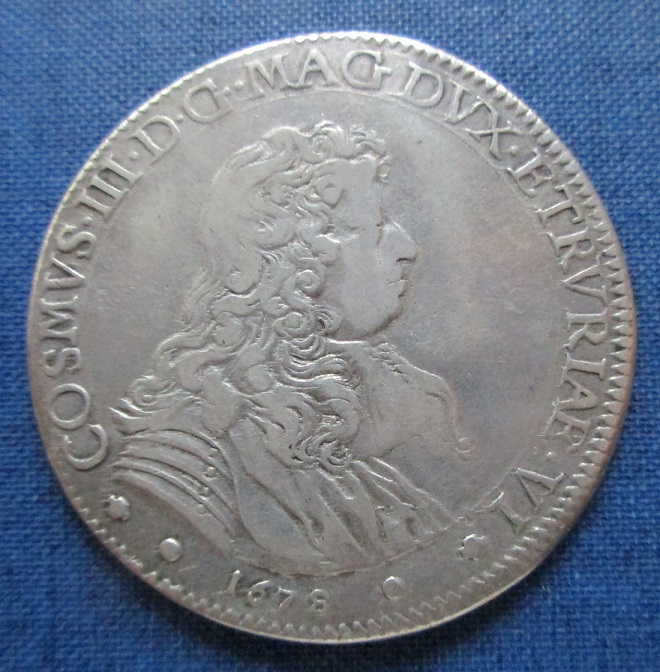 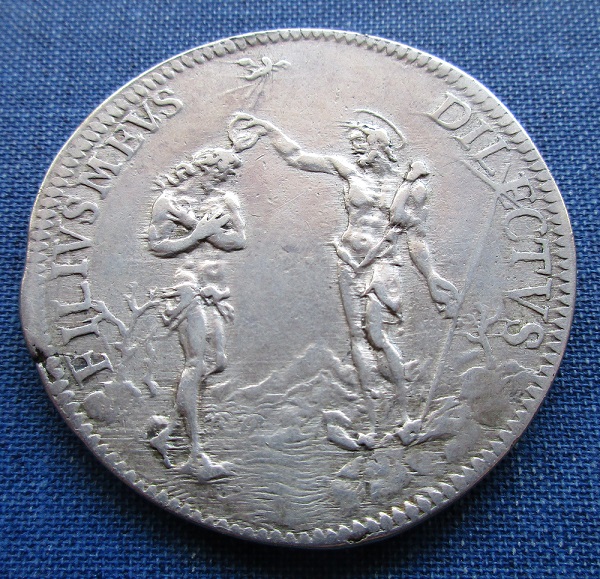 Always tough to assess the value of a holed coin. Without the hole, yours would have been in exceptional condition. Mine was $280 in 2015. I would guess yours would fetch at least that much if genuine. Quote:
I don't know how accurate this is but another site gave the values as follows: VG-$150, F-$300, VF-$600, XF-$1500, MS-$3700. I usually figure a holed example of an otherwise interesting coin might get 20-30% of the value of an unholed example. If you like religious (Christian) imagery on your coins, 17th century Italy is the place to look. Ranaissance/baroque engravers seemed to use the large format of those Papal and Tuscan piastres like a painter used a canvas. Edited by tdziemia
09/06/2023 09:58 am
|
|
Valued Member
United States
412 Posts |
Thanks for all the replies on this. Two other unusual items on this coin. If you look closely the buttons on the sleave are actually stars. I cannot find another example like this. Also there is doubling on the obverse especially around the lips. Obviously since this is off center it was not help securely when struck. I have no idea which direction (genuine or not) these items point to.
Thanks again.
|
|
Moderator
Australia
16968 Posts |
Quote:
Also there is doubling on the obverse especially around the lips. Obviously since this is off center it was not help securely when struck. Doubling is common on certain Renaissance and early-Modern European coins, depending on method of manufacture. This was the era when old-fashioned big-guy-with-a-hammer minting technology was being replaced with newfangled machinery, and some of those new machines operated quite differently to the standard screw-press that eventually became industry standard. The rocker press and roller press, as two examples, were used to create multiple coins from a single "striking", and often caused doubling as the coin passed under the dies several times to attain the full strike. Pine Tree shillings were apparently made on a rocker press. The roller press in particular operated in a similar way to an "elongated penny" souvenir-maker, with the blank strip being fed into a roller bearing the coin dies, and finished coins then punched directly out of the metal strip. Roller presses were "poor" technology in that the dies were usually far more prone to cracking, and if one of the dies on the barrel cracked, then all the dies had to be thrown away, since they were all attached to each other on the same barrel. It was this wastage, as well as other issues such as a tendency to jam, and difficulty in ensuring the dies always lined up properly, that spelled the doom for the roller press. Look on your coin, at the far left of the obverse. See the ring of denticles, then a single "dot", then another ring of denticles that seems to curve the other way, out of the flan? That looks to me like the dies from the "next" coin, clipping a little onto this coin. Which indicates to me that this coin was probably made on a roller press. Don't say "infinitely" when you mean "very"; otherwise, you'll have no word left when you want to talk about something really infinite. - C. S. Lewis
|
|
Pillar of the Community
United States
807 Posts |
Quote:
The roller press in particular operated in a similar way to an "elongated penny" souvenir-maker, with the blank strip being fed into a roller bearing the coin dies, and finished coins then punched directly out of the metal strip I have seen the reconstructed "Walzenwerk" at Hall-in-Tyrol. Impressive in concept, but in the end it proved something of a disappointment as a way of mass-producing coins. And this piece might well have been produced by such a means. Good catch, Sap. I suspect the "bite" opposite the extra denticles is also the result of poorly-spaced punching-out of the finished pieces. The stars for buttons are still a point of divergence which requires further exploration. But with the amount of re-cutting that Walzenwerk dies required, I shouldn't be entirely surprised if there were many die varieties for this coin. |
| |
Replies: 15 / Views: 1,661 |
|







 Posted 09/04/2023 1:18 pm





