The 1960s were definitely a time for the authorization of national commemorative medals by Congress as it heeded the Treasury's "advice" and moved away from authorizing legal tender commemorative coins. I've written about a few of these previously, and will (hopefully!) post about others going forward.
This time out, I am relating the story of the 1968 bronze and silver medals struck to commemorate the 250th anniversary of the founding of San Antonio, Texas.
The idea of San Antonio hosting an exposition to celebrate its 250th anniversary originated in 1959. The concept gained steam in the early 1960s, with San Antonio Fair, Inc. being formed in 1962 to plan and organize it. In October 1965, Congress authorized the Federal Government's participation in the Exposition and the construction of a US Pavilion to house its exhibits (Public Law 89-284).
Earlier in the year, In April 1965, Henry Barbosa Gonzalez (D-TX) introduced a bill that called for "the striking of medals in commemoration of the 250th anniversary of the founding of San Antonio." The bill was referred to the House Committee on Banking and Currency.
San Antonio traces its formal roots to May 1, 1718 and the establishment of the Spanish mission - San Antonio de Valero. It was followed just days later, on May 5, 1718, with the founding of San Antonio de Bexar Presidio; it was within the Mexican province of Texas. San Antonio was a settlement of military personnel and civilians (Mexicans and Native Americans) and would go on to play a strategic role in the war for Mexican Independence (from Spain) and Texas Independence (from Mexico).
The bill called for up to 100,000 medals to be struck on behalf of the Hemis-Fair Corporation, with the size(s), composition and designs of the medal(s) to be determined by the Corporation (with the approval of the Secretary of the Treasury).
The bills for the US participation in HemisFair 1968 and the commemorative medal for it were considered during the summer of 1965, with the medal bill being reported out of Committee in October just days before the Act authorizing US participation in the Exposition was signed into law by US President Lyndon Baines Johnson. The medal bill was reported without amendment and with a recommendation to pass.
When brought up for consideration in the House, Representative Gonzalez offered a technical amendment to the bill, changing the sponsor's name from "Hemis-Fair Corporation" to "San Antonio Fair, Incorporated" - the corporation managing the exposition. Durward Gorham Hall (R-MO) questioned Gonzalez and the amendment, wanting to get an assurance that the medal was not to be paid by the $125,000 appropriation previously granted to the HemisFair by Congress. Once Gonzalez assured him/all that the medal would not be connected with Federal funds, the amended bill was engrossed, read a third time and passed. It was then sent to the Senate for its consideration.
Once received in the Senate, the bill was referred to the Senate Committee on Banking and Currency. It was not reported out until March 1966; it was reported without amendment and with a recommendation to pass. The bill was considered and passed in the Senate without objection.
With each chamber passing the bill, it was examined and signed in each then sent to the President for final approval. President Johnson signed the bill into law on March 31, 1966.
The Mint struck medals in bronze and silver. The designs, by John Phillip Evett of Trinity University in San Antonio, featured on the medals are the same for each metal; they are 1-5/16" in diameter. Mintage for the medals amounted to 8,000 for the silver (the first 5,000 with serial number on the edge) and 10,000 for the bronze.
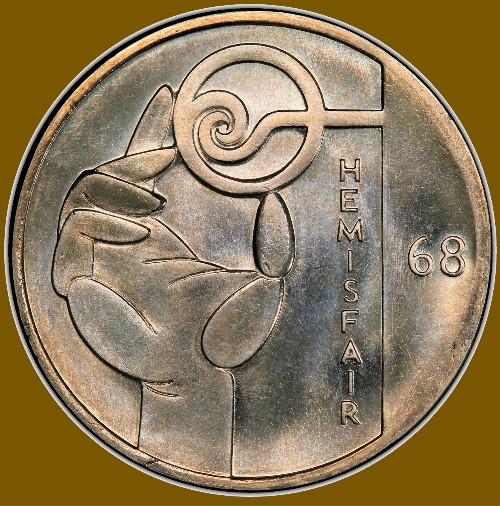
The obverse design presents a dove at its center. The dove has a ribbon in its beak that encircles it. Upon the ribbon is the inscription "250th ANNIVERSARY" in the top segment and "SAN ANTONIO - TEXAS" in the bottom. A "P" mint mark (Philadelphia Mint) is seen at the six o'clock position. The medal's reverse features a hand (right) holding the logo of the HemisFair between its thumb and forefinger, with "HEMISFAIR" inscribed vertically and "68" at right.
The HemisFair logo is made up of four symbolic elements. The outer circle is meant to represent "the world," with the small inner circle representing the Western Hemisphere. The lines coming in from either side represent pathways from the Old and New Worlds. The paths come together at the inner circle, surrounding it and representing a meeting of the old and new. The logo's symbolism may not be obvious, but is. IMO, quite clever when understood.
I have examples of each type of silver medal as well as a pair of bronze examples.
1968 San Antonio HemisFair 1968 Medal - Silver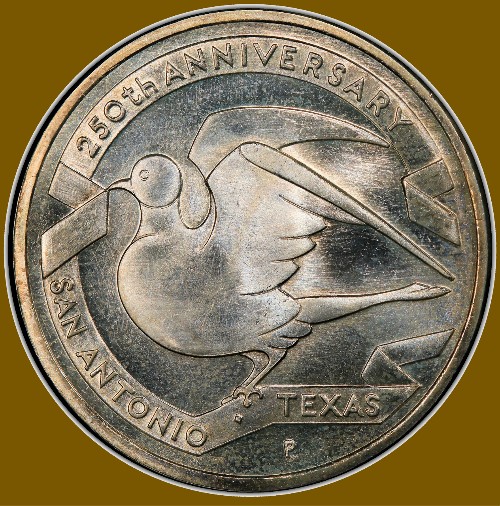
For other of my posts about commemorative coins and medals, see:
Commems Collection.
US Mint National Commemorative Medals are included under "Classic Commemoratives." 






 Posted 09/11/2023 1:30 pm


