The 2005 Chief Justice John Marshall 250th Anniversary of Birth Silver Dollar was proposed via a pair of bills (with minor differences in wording) in the Senate and House of Representatives in July 2003 during the 108th Congress. The House bill was introduced by Spencer Bachus (R-AL) and the Senate bill by Orrin G. Hatch (R-UT).
The House bill was referred to the House Committee on Financial Services, then to its Subcommittee on Domestic and International Monetary Policy, Trade, and Technology. The Senate bill was referred to its Committee on Banking, Housing, and Urban Affairs.
Each of the bills called for the striking of up to 400,000 0.900 fine silver dollars to be dated "2005." The issue price of the SD was to include a $10 surcharge, with collected surcharges paid to the non-profit Supreme Court Historical Society for its use in:
(1) supporting historical research and educational programs about the Supreme Court and the Constitution of the United States and related topics;
(2) supporting fellowship programs, internships, and docents at the Supreme Court; and
(3) collecting and preserving antiques, artifacts, and other historical items related to the Supreme Court and the Constitution of the United States and related topics."
A "Findings" section was included in each, though they differed slightly. The House version stated:
"The Congress hereby finds as follows:
(1) John Marshall served as the Chief Justice of the United States Supreme Court from 1801 to 1835, the longest tenure of any Chief Justice in the Nation's history.
(2) John Marshall authored more than 500 opinions, including virtually all of the most important cases decided by the Supreme Court during his tenure.
(3) Under his leadership, the Supreme Court of the United States gave shape to the fundamental principles of the Constitution, most notably the principle of judicial review.
(4) John Marshall's service to the United States -- not only as a Chief Justice, but also as a soldier in the Revolutionary War, as a Member of Congress, and as Secretary of State -- truly makes him one of the most important figures in our Nation's history.
The Senate version of the bill included:
"Congress finds that --
(1) John Marshall served as the Chief Justice of the Supreme Court of the United States from 1801 to 1835, the longest tenure of any Chief Justice in the Nation's history;
(2) Under Marshall's leadership, the Supreme Court expounded the fundamental principles of constitutional interpretation, including judicial review, and affirmed national supremacy, both of which served to secure the newly founded United States against dissolution; and
(3) John Marshall's service to the nascent United States, not only as Chief Justice, but also as a soldier in the Revolutionary War, as a member of the Virginia Congress and the United States Congress, and as Secretary of State, makes him one of the most important figures in our Nation's history.
Essentially the same sentiment was presented in each, just with a slight difference in expression.
Though it was the second to be introduced, the Senate bill was the first to begin its journey. Senator William H. Frist (R-TN) motioned for the Senate Banking Committee to be "discharged from further consideration" of the bill and that it be considered directly by the Senate. After extended supporting remarks by the bill's sponsor, Senator Hatch, the bill was passed without debate or amendment on November 21, 2003. The bill was sent to the House, but not acted upon there.
The House moved forward with its version of the coin bill more slowly, not holding a Hearing on the bill until March 2004; the Hearing was held by the House Subcommittee on Domestic and International Monetary Policy, Trade, and Technology. Based on its recommendation, a favorable Report was issued by the parent Committee on Financial Services. Within the Report is what, IMO, is a defining statement of Marshall's legacy, it was stated "Chief Justice Marshall is widely regarded as the person who elevated the Court's status to one equal with the executive and legislative branches. In the Marbury v. Madison decision written two years after he became Chief Justice, Marshall laid the legal groundwork for modern-day Constitutional law and established the doctrine of judicial review."
The bill was recommended by the House Committee on Financial Services after positive feedback from its Subcommittee. The bill was then sent to the House Ways and Means Committee by which it was amended to ensure it conformed to the Commemorative Coin Reform Act of 1996 (i.e., ensuring no more than two surcharge-eligible commemorative coin programs in a given year). The House then considered and passed the amended bill and sent it to the Senate for its consideration.
The Senate passed the House bill without objection by Unanimous Consent. The agreed to bill was then examined and signed in each chamber before being sent to the President for approval. It was signed into law by US President George W. Bush on August 6, 2004.
2005 John Marshall 250th Anniversary of Birth Silver Dollar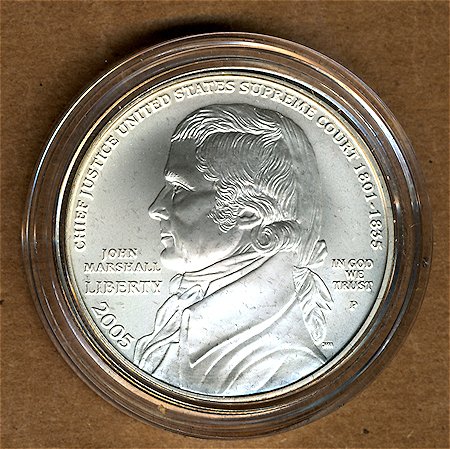

Soon-to-be US Mint Chief Sculptor-Engraver
John Mercanti designed the obverse of the 2005 Chief Justice John Marshall commemorative silver dollar. He based his design on the painting done by Charles Balthazar Julien Fevret de Saint-Memin in 1808. The coin's reverse, by
Donna Weaver, presents a view of the Old Supreme Court Chamber in the US Capitol Building.
Portrait of John Marshall - 1808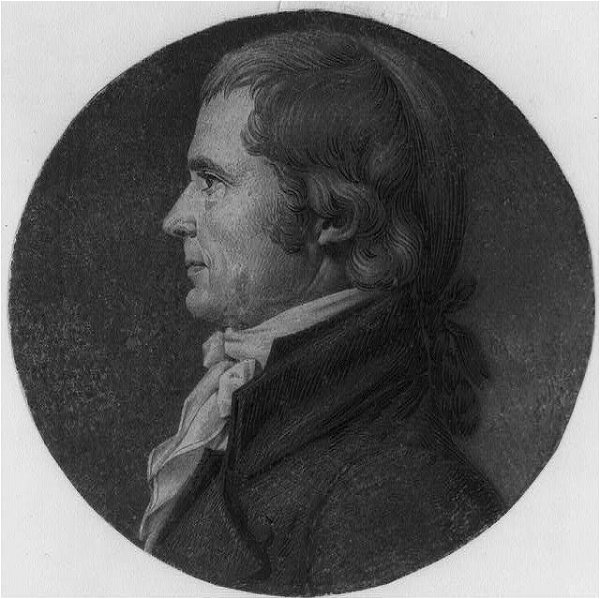 Image Credit: Library of Congress, Prints and Photographs Division. Public Domain.
Note: I flipped the image horizontally to match the coin and make it easier to compare the two; the original is a right-facing portrait of Marshall.The coin was sold individually in Proof for $35/$39) (Pre-Issue/Regular Issue) and Uncirculated for $33/$35 (Pre-Issue/Regular Issue). It was also sold in a "Coin and Chronicles" Set ($59.95) - subject of a future post - as well as the "American Legacy" Proof Set paired with the Marine Corps 230th Anniversary Silver Dollar and all of the 2005-dated circulation coins ($135).
Individual Proof coin sales totaled 148,696 with 48,057 additional coins in the "American Legacy" Sets. Sales of the individual Uncirculated SD totaled 49,031 with an additional 18,065 included in the "Coin and Chronicles" Set. The Proof subtotal is 196,753; the Uncirculated subtotal is 67,096 for an overall SD total of 263,849.
With total sales of approximately just 66% of its authorized maximum, the Chief Justice John Marshall Silver Dollar can't be called a big success. IMO, however, its disappointing sales figures do not reflect the importance of the subject being commemorated - Marshall is an instrumental historical figure that helped shape how the US has/does interpret its Constitution.
For a review of John Marshall's long public service career, check out:
-
John Marshall Public Service BiographyFor other of my posts about commemorative coins and medals, including more modern US commemorative stories, see:
Commems Collection.










 Posted 10/03/2023 05:47 am


