| Author |
 Replies: 12 / Views: 2,644 Replies: 12 / Views: 2,644 |
|
|
New Member
United States
3 Posts |
Couple of years ago I bought a 1928G $2 misprint bill and have been curious about it ever since. The bill is not in pristine shape by any means as it looks like it lived in someones wallet for many years. The bill has no serial number, no seal and the back is blank. Has anyone ever seen anything like this before? I have searched and searched so now I am here. Let me know what you think! thanks and happy collecting 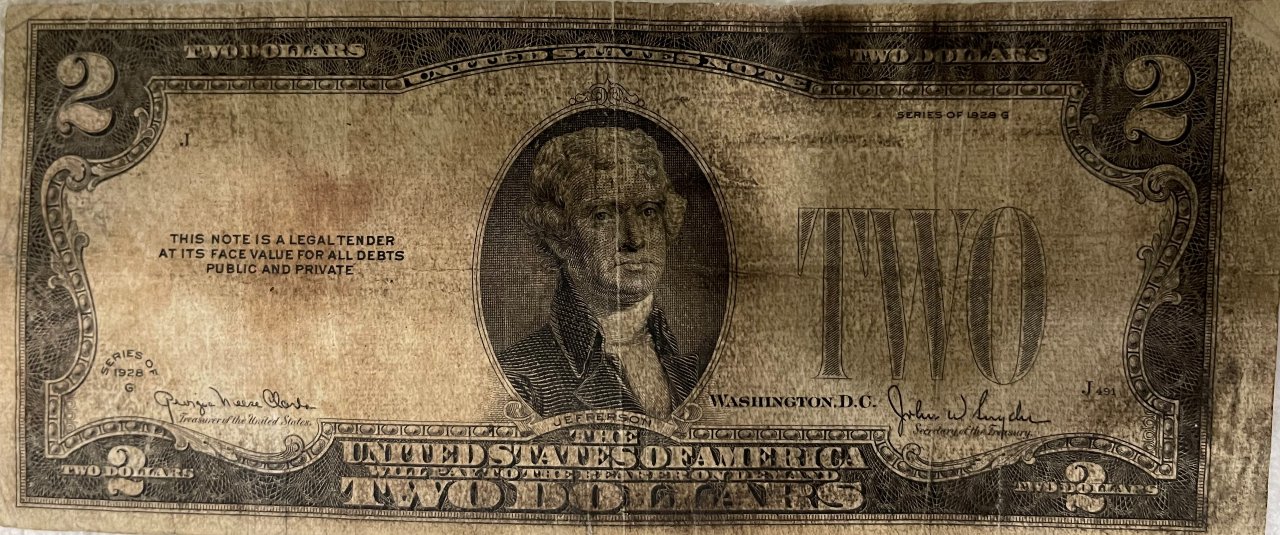 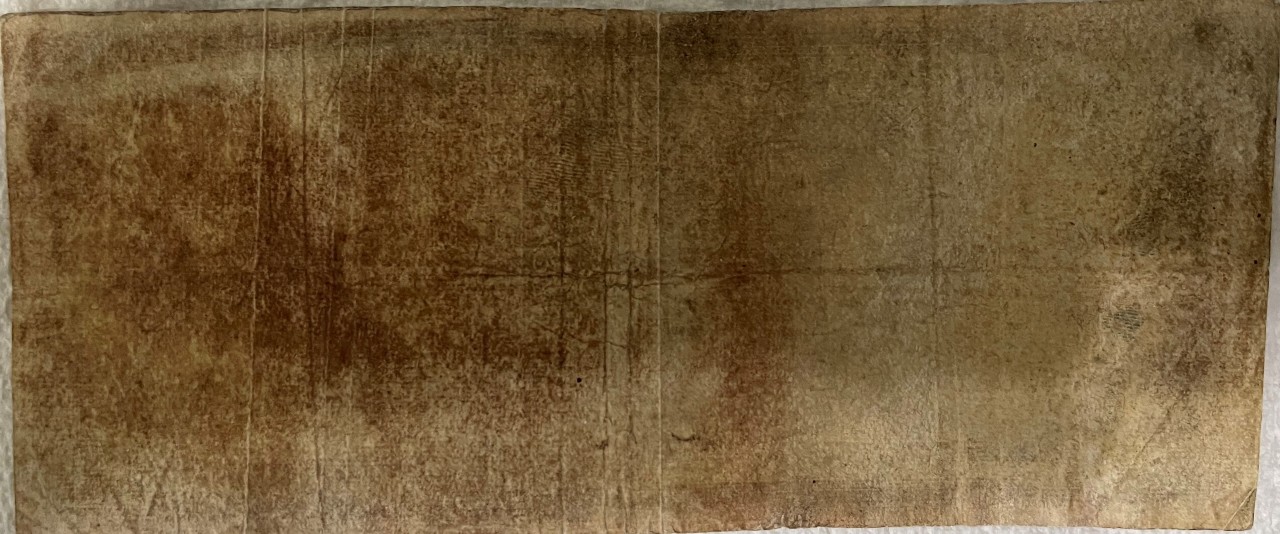 |
|
|
|
Pillar of the Community
United States
4637 Posts |
Welcome to CCF.
My first thought was, I hope you didn't pay too much for it. It's obviously been tampered with and most likely by a chemical solvent. Calling it "not pristine" might be the biggest understatement I've heard today.
|
|
Bedrock of the Community
United States
94367 Posts |
Agree, appears chemically altered.  to the CCF! |
|
Pillar of the Community
United States
7722 Posts |
Red and green ink was been removed by some sort of chemical reaction. Various dry cleaning solvents are notorious for causing damage like this.
This is one I can say is not worth the paper it is printed on nor worth the original $2 face value it once had!
Just a novelty or conversation piece now. It cannot be redeemed.
|
|
Pillar of the Community
United States
727 Posts |
|
|
Moderator
 Australia
16959 Posts |
As noted by others, there is no way this could be a "misprint". See how heavily circulated it is? Lots of folds and creases. That means hundreds of people would have used it as money - so you would presume that hundreds of people looked at the note (and $2 was a lot of money back then, so people would have been looking at notes), and none of them noticed that the printing on the back was missing? If anyone had noticed, they would have refused to accept it (just like you, today, would hopefully refuse to accept a $20 note with printing only on one side), and the first time it passed through a bank it probably would have been withdrawn as a suspected counterfeit. Rather, it is more reasonable to assume that the serial numbers and back-printing disappeared some time after all of that circulation happened. I would hypothesize some kind of bleach; the note looks very badly affected by mould of some kind. Perhaps someone tried to "clean" it using bleach, and destroyed the coloured printing that way. Quote:
Are you sure? See the following: The problem is, with no seal or serial number, I can't see how anyone can authenticate it. I highly doubt any bank would accept it in its current state. To redeem it, you'd either have to go in person to the BEP in Washington, or mail it. And printing out the form and mailing it would use up a large chunk of your $2, and would eliminate it entirely if you sent it Registered or Certified as they BEP recommends. Form 5283 also requires you to describe how the note became mutilated; I don't know if they'd accept "I don't know, you tell me" as an answer. "Bleach" is my hypothesis, but with no evidence, it's not an answer that would stand up in court. Your best chance of getting your $2 worth from it would be to find some kind-hearted soul (a coin dealer or collector friend) who is already sending off a big batch of mutilated notes for redemption, and see if they'd buy it off you so it can be piggybacked onto their submission. Don't say "infinitely" when you mean "very"; otherwise, you'll have no word left when you want to talk about something really infinite. - C. S. Lewis
|
|
Pillar of the Community
United States
727 Posts |
Quote:
[W]ith no seal or serial number ...how anyone can authenticate  I don't think the presence or absence of the seal is any more important than the presence or absence of any other element of the design. While you might think the serial number is of great importance, the truth is that in modern times there is no comprehensive database of the ultimate fate of each serial number. Heck, the Federal Reserve doesn't even keep track of which federal reserve bank issued a note when it is destroyed. They just make an estimate based on the total outstanding notes of each federal reserve bank. (Yeah, I know, this particular note is an obligation of the U.S. Treasury and not an obligation of the federal reserve system. They also make minor adjustments for the estimated amounts of obsolete types such as this, silver certificates, etc. when notes are destroyed.) Given the age and low denomination of the note, I speculate the B.E.P. might accept a thorough and complete explanation of how dreese4506 acquired the note as sufficient. If it were me (but I'm not quite right in the head) I wouldn't hesitate to fill out my Form 5283 and send the note by first class mail to the B.E.P. just for entertainment and educational purposes. I encourage dreese4506 to do the same and report back to us what happens. Edited by Ynnad
10/26/2023 2:38 pm
|
|
New Member
 United States
3 Posts |
Thank you all for your feedback. Out of anyone I have talked too about this bill none have said what you all did about it being altered with maybe a chemical or bleach agent. I had not heard of that before.
Question I have is why is the front of the ink untouched? Wouldnt the bleach or chemical cause issues there too?
I always just assumed it was folded and in someones wallet for years and was sweat stained.
Thanks again for all the feedback. As curious I am to see what they would say if I sent it back I will probably just keep it in my collection as a novelty piece for others to wonder.
|
|
Moderator
Australia
16959 Posts |
Quote:
Question I have is why is the front of the ink untouched? Wouldnt the bleach or chemical cause issues there too? You'll notice all of the ink that's disappeared is the coloured ink - the blue from the seals and serials on the front, and the greenback printing on the back. The only ink remaining is the black. This is the telltale that some kind of solvent or chemical agent has soaked the entire note, dissolving some inks but not others. Banknotes aren't printed all at once, they are printed in several different stages: first the front, then the back, then the serial numbers, with the note sheets left to dry in between stages. The inks used in each stage are differently based, meaning that the ink dyes have different chemistry and are dissolved in different solvent mixtures. If all the inks were based in the same solvent, then the inks from separate print stages would tend to run together, causing ink bleed, smudging and smearing. This has the side effect of there not being any one "universal solvent" that completely strips a banknote clean of all ink, all at once, which is also something that governments want to avoid (because a blank piece of banknote paper can then be easily used to make a convincing higher-face-vale forgery). I suspected "bleach", because coloured inks tend to be much more vulnerable to bleach action than black ink. The black ink they have always used is very thick and waxy, and quite chemical-resistant compared to their other inks. I also suspected bleach because of the mould-like stains, and some people's natural instinct when seeing mould is "ooh, yuck, I'd better bleach that". Don't say "infinitely" when you mean "very"; otherwise, you'll have no word left when you want to talk about something really infinite. - C. S. Lewis
|
|
Bedrock of the Community
United States
94367 Posts |
|
|
Pillar of the Community
United States
727 Posts |
I have a series 1928? two dollar bill that was in ridiculously horrible shape when I acquired it from a bank. I tried washing it in a strong solution of some powerful industrial detergent that did not contain bleach or solvents and immediately the red seal and numbers began to fade. I pulled it out right away and rinsed it but the red had already turned yellow and the green on the back didn't fare so well either. This is evidence that the red and green ink used in that era is subject to degradation by detergents in addition to bleach and solvents.
I know some of you will think I am an idiot (you may be correct) for washing an old note but this note was in such poor shape that it would never be worth more than two dollars before or after washing.
I should probably spend it. It's already lost at least half its value due to inflation while just sitting around.
Edited by Ynnad
10/28/2023 10:18 am
|
|
New Member
United States
3 Posts |
SAP,
That is a perfect explanation. I was not aware of that. I am a coin collector more than paper currency.
|
|
New Member
United States
17 Posts |
This is so educational. Some of you folks have big brains!  |
| |
Replies: 12 / Views: 2,644 |
|







 Posted 10/25/2023 5:01 pm





