

 Posted 11/13/2023 11:47 am


Quote:
Wondering . . . why/how so many different DDR's in that same area?
Wondering . . . why/how so many different DDR's in that same area?
I can take a stab at that question from the perspective of the lines-in-doors nickels. They are Class IX pop doubles analogous to the LSC stripe lines, extra Lincoln thumbs, Washington doubled ears, and so forth. Note that I am excluding the Tootsie roll doubling, date doubling, extra thickness, and that sort of thing, which seems to have a different (and less understood) cause.
You actually need multiple factors to line up for a visible pop double.
First, it has to be central, where the conical die blank first makes contact with the hub. Once the die and hub are fully engaged and the die has settled in the single squeeze collar, it can no longer pop sideways as it deforms into a snug fit. That's why you don't see IX.1 doubling in peripheral elements.
Second, it has to be somewhere that you can actually see the double. Imagine that the hubbing process made a line in a busy area of the design. Odds are that the continuing hubbing would just wipe out all evidence of the pop double because something else occupies that space.
Third, there has to be enough vertical distance between the doubled feature and the open area that the hub (and coin) have a right angle edge there. Otherwise the hub can't grab into the die as they meet, and then leave a dug-in feature after the die pops into its final collar position.
That's what makes then lines in door nickel DDRs straightforward to find. The door is central. It is a big, flat rectangle that is deep in the exact center of the die. The door frame and triangle lines stand up strongly on the design relative to the flat area. There are no design elements inside the door that would conceal the pop double after it forms.
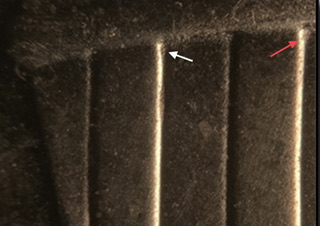
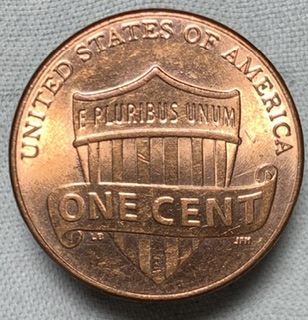
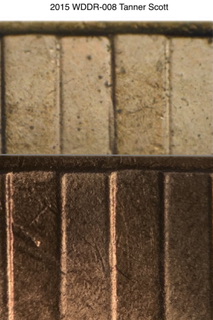
I imagine that these vertical bars on the shield are the same way. That is a deep right angle edge next to a flat area. Once the pop double gouges that flat area during hubbing, there are no design elements to conceal the unintended feature as the hubbing proceeds.