| Author |
 Replies: 46 / Views: 5,438 Replies: 46 / Views: 5,438 |
|
Pillar of the Community
United States
6194 Posts |
Found this minor clipped planchet in a bag the other day. Common and not very remarkable, but since I hadn't seen any posts on how to ID legit clips lately I figured I'd put this one up as demo coin.  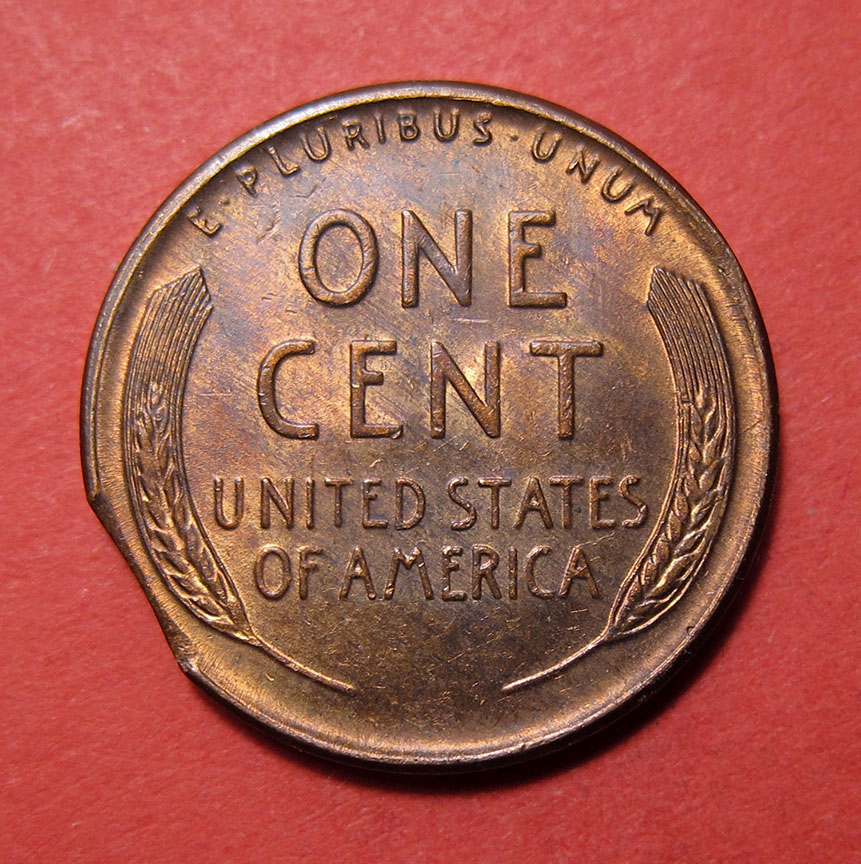 So while not every coin has every characteristic, here are the basics for determining a legit clip. The Blakesley Effect: When a coin with an incomplete planchet goes through the upset mill, it has a slightly smaller diameter when the missing part comes around. This ends up not putting a full proto rim on the opposite side 180 degrees from the clip. When the coin is struck this imperfection shows up as a weak rim. It varies in size and shape so to speak, and surprisingly can be entirely absent on really large clips, but it's a good start to knowing your coin is a real clip.   The Smith Effect: I don't think this has really been fully figured out as to exactly why it is so, but for many clips some or all of the contact points where the clip meets the rim will show an angle from the inner rim edge to where the clip starts. It honestly gets tougher to see the more magnification you use, but simply looking at those points with a loupe will usually show this quite well.  Device Distortion: Areas near the clip will often show distortion on the devices. This can be really strong or just a small bit, but if it's there then it's a pretty good chance you have a real clip. This coin shows nice distortion along the outer edge of the left wheat. 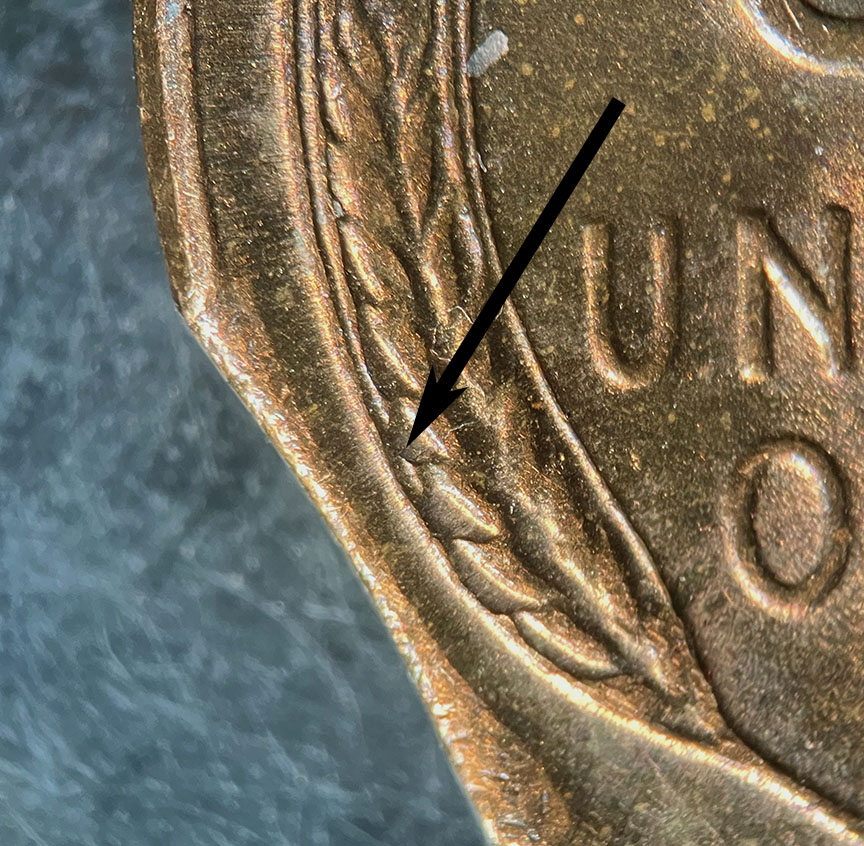 Asymmetrical Clip Edge: Finally, something I look for but can also be present on certain fake clips depending on how they were made, is somewhat of a separation line down the middle of the clip between the obverse and reverse. One side usually looks different from the other side, with this light, but visible, line separating them. Here the reverse side of the clip shows a relatively smooth metal edge, while the obverse side of the clip is rugged. 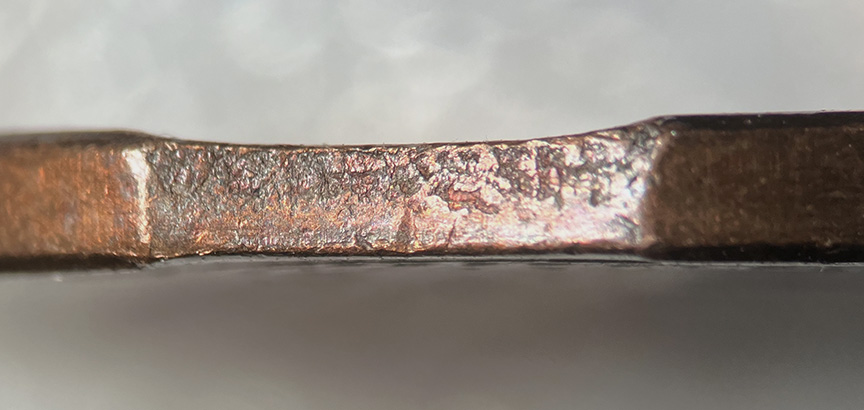 |
|
|
|
Bedrock of the Community
United States
78480 Posts |
Nice Clip! And also, thank you for the good information on how to ID a clip.  Errers and Varietys.
Edited by Errers and Varietys
11/22/2023 12:15 am
|
|
Moderator
 United States
34538 Posts |
Interesting @tb. I hadn't heard of the Smith Effect previously so thank you for helping me learn something today.
"If you climb a good tree, you get a push."
-----Ghanaian proverb
"The danger we all now face is distinguishing between what is authentic and what is performed."
-----King Adz
|
|
Moderator
United States
56855 Posts |
tropicalbats, Very good info and photos, thanks for posting this thread. Very useful. John1  |
|
Moderator
United States
15867 Posts |
Very much appreciate you showing the various clip diagnostics. I learned from it, thank you.
Take a look at my other hobby ... http://www.jk-dk.art |
|
Pillar of the Community
United States
2376 Posts |
Thanks TB for including my "Smith" Effect ! When a planchet is struck between the three dies ( the obverse , reverse , and collar dies ) , the coin metal flows somewhat like a liquid to to fill these dies. When a incomplete planchet is struck , and if enough coin metal is missing, all aspects of the die will not be filled by the flowing metal. In the case of a clip , this lack of coin metal occurs at the clip. With the Smith effect, imagine a wave crashing into a cliff.  The wave will hit the the base of the cliff first then flow up until the force behind the wave abates . The way this relates to a clip and the Smith effect is the wave of coin metal crashes into the collar then flows up to fill the rim gutter. The very last part of the rim gutter to be filled is the inside ridge towards the center of the coin. Just as the ocean hit the base of the cliff and flowed up , the coin metal will flow up against the collar till it hits one of the other dies and flows back towards the center of the coin . The lack of coin metal at the clip will show as the Smith effect where it stops filling the inside ridge of the rim gutter, as TB pointed out in the photo above. I hope this explanation clears things up a bit. Edited by stoneman227
11/22/2023 09:47 am
|
|
Pillar of the Community
United States
4135 Posts |
Thanks for the inf. I wrote it all down for my notes.
|
|
Pillar of the Community
 United States
6194 Posts |
I don't have cool wave graphics, but I always thought a little differently about this effect. When the clipped coin goes through the upset mill, the inward pressure on the rim would push a little bit of metal toward the center of the clip since that would be the path of least resistance. This would occur across a gradient with more metal pushed near the clip contact and reducing quickly with just a tail left after half a mm or so, and when struck create the angled rim. I know this is a bit short for an explanation, but arrived at work and not really supposed to be fussing with the finer points of the minting process right now.
|
|
Pillar of the Community
United States
5869 Posts |
A nice clip and great write up of the points to look for.
Thanks Stoneman for adding that, since that was my understanding about the metal flow causing the "Smith Effect".
Words of encouragement are one of the major food groups.
We need to consume them regularly to thrive and grow.
|
|
Moderator
United States
105745 Posts |
great looking clip! I had forgotten what you had called that effect, thanks for reminding me of it (Smith effect) I was just grabbing a random name to use for it.. lol.
|
|
Bedrock of the Community
United States
27283 Posts |
tropicalbats, thank you for this education in clip diagnostics!
Inordinately fascinated by bits of metal with strange markings and figures
|
|
Pillar of the Community
United States
2376 Posts |
TB , the look and sound of that wave was better than the picture.
Took that pic a few years ago while on vacation!
|
|
Pillar of the Community
United States
4048 Posts |
One thing that bothers me about this coin is the edge of the clip region is raised above the field. I'm not an expert on clips, but it does seem to me that those areas should not be raised, but would instead be at the same level as the field. The die wins in the battle of planchet vs die, and the die is flat in that area, not recessed.
I think this might be an excellent counterfeit, but they did something to the edge of the "clip" that pushed the metal in just a bit, and this made a slightly raised edge, sort of like what happens in the upsetting process. And if I looked at a clipped planchet as it left the upsetting machine, I'd expect to see some upsetting in this area. But after striking, the upset area would be pressed flat against the die surface, and would no longer be upset.
Contact me for photographic equipment or visit my home page at: http://macrocoins.comEdited by rmpsrpms
11/22/2023 10:31 pm
|
|
Pillar of the Community
United States
6194 Posts |
The coin is certainly not a counterfeit. Your observation is astute, but look at the L of LIBERTY in relation to the rim. Note that the fields actually rise as you go from about the inner side of the upright bar of the L to the inside rim edge. This is true most of the way around the coin and easily visible in the full obverse image. So the fields themselves are not flat as they approach the rim in that area, but do rise, as is evident at the clip as well.
|
|
Pillar of the Community
 United States
1322 Posts |
Thanks.. One of the best post I've seen on CCF. Show and Tell never fails.
|
|
Pillar of the Community
United States
1034 Posts |
Thank you TB. Very helpful
|
| |
Replies: 46 / Views: 5,438 |










 Posted 11/22/2023 02:45 am


