| Author |
 Replies: 11 / Views: 2,285 Replies: 11 / Views: 2,285 |
|
|
Valued Member
United States
59 Posts |
   Coin collecting so often leads to interesting history. I doubt if I would know much of Haiti otherwise. It was the second country in the hemisphere to gain independence, but the first to gain independence as a slave rebellion. It was relatively rich insofar as it produced sugar, which was a valuable cash crop in those days. Haiti supported other rebellions on the condition that any liberated countries abolish slavery. Haiti became independent in 1804. Early coinage is confusing. It initially seems to have been continuance of French Livre coinage. I have never seen such coins and suspect they would be quite valuable. The Haiti Gourde became the currency in 1813. The earlier silver coins of the Gourde system are interesting: 6, 12, 25, 50, and 100 centimes. 100 centimes weighed 10 grams etc. I have looked and can find little history of the minting of coins. No mention of a mint, or of purity (simply reported as being silver), or of method of manufacture. Numista reports the edge as being smooth. I surmise that the coins were made on the island by primitive means. The silver might be from foreign silver coins melted for the purpose. The manufacturing may have been familiar to a Roman, or certainly to the colonial Spanish mint workers. They used the French dating system, An 1, An 2 etc, dating from the French revolution. They kept using that system after the French had abandoned it in 1815. The coin above is dated An 25, or 1828 by conventional dating. One interesting thing about the coin pictured above is that it has serrations for maybe 70% of the edge. I have not seen that on other Haiti coins of the period. Any further insights into this interesting coinage would be appreciated.
|
|
|
|
Pillar of the Community
Russian Federation
5186 Posts |
Quote:
They used the French dating system, An 1, An 2 etc, dating from the French revolution. AFAIK they actually started from their own Haitian revolution, i.e. independence from France, in 1804 (which is why year 25 corresponded to 1828). |
|
Moderator
 United States
34538 Posts |
That is a really cool coin @wize. I agree that numista says the edge is smooth ( https://en.numista.com/catalogue/pieces26480.html) si I wonder if the reeding was added to your coin after it left the mint, either just the product of idle hands or else to harvest a little silver. Or maybe numista is wrong? I'm not sure. "If you climb a good tree, you get a push."
-----Ghanaian proverb
"The danger we all now face is distinguishing between what is authentic and what is performed."
-----King Adz
|
|
Bedrock of the Community
United States
94367 Posts |
Interesting, thanks for sharing!
|
|
Pillar of the Community
United States
1915 Posts |
It looks genuine but damaged so if reeding is missing it could be shaved or maybe not fully formed. I have 4 of these coins with edges shown here. 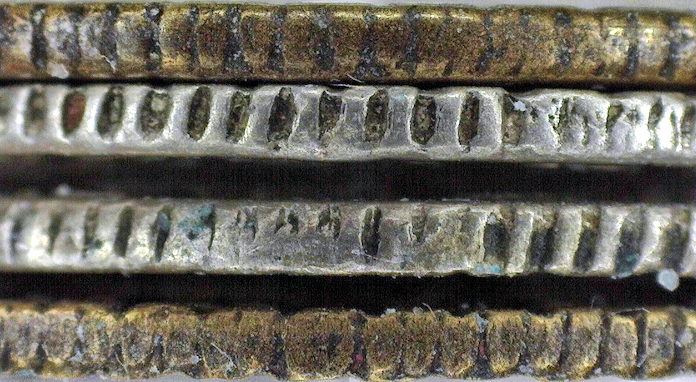 |
|
Valued Member
 United States
59 Posts |
Good points. I checked French Revolution year one for coins (An 1) was 1791. It would make sense that Haiti would use their own revolution to reset the calendar. But they did eventually go back to traditional dating, as did the French.
I have a number of the Haitian coins, and I do not recall seeing edge reeding on any. My guess is that the smaller coins never got the reeding, although it may be that the reeding simply wore off with use.
It is unusual for a coinage to have such minimal information available on standards and mints. I'd do a specific gravity test but the primitive way I do such tests is not suitable to smaller coins. The silver seems solid enough, so I would guess in the range of 90% purity, with perhaps a lot of variation year to year, month to moth.
|
|
Moderator
United States
194816 Posts |
Very interesting!  |
|
Pillar of the Community
United States
1758 Posts |
Its also been shown recently that Belleville, NJ produced many contemporary circulating counterfeits of this type in the 1830 period. Just to make this series even more complex. Recently saw a silver plated one in an NGC holder in AU. <BG>
|
|
Pillar of the Community
United States
1915 Posts |
I have a couple of those as mentioned by colonialjohn and from what I get out of the references so far- yes it can be complex as I have one or two unresolved questions about them myself. I went ahead and made the album pages but uncertainties remain about what is noted about them.
|
|
New Member
Mexico
1 Posts |
This is a beautiful 1828 coin by haitian president Jean Pierre Boyer. Earlier coins were made in Haiti by Henri Christophe, between 1806 and 1820. Little known fact is that during the reign of Christophe, Haiti had the second best mint in the world, and if you google "Henri Christophe coins", you will see even better looking coins from above mentioned mint.
Edited by enamkani
04/01/2024 12:42 am
|
|
Moderator
United States
194816 Posts |
 to the Community, enamkani! |
|
Moderator
United States
105622 Posts |
great looking coin! (I wish they minted on in 1962 though..
|
| |
Replies: 11 / Views: 2,285 |
|










 Posted 12/08/2023 7:43 pm


