| Author |
 Replies: 27 / Views: 1,702 Replies: 27 / Views: 1,702 |
|
|
|
Valued Member
United States
57 Posts |
Sorry to disagree with the majority, but this is a handsome F-15 with an old cleaning (but there is a chance it might straight grade depending on the mood of the grader at the time). Personally, I prefer the scarcer JR-2 (R4), but this is still a nice example where all the reverse lettering is clearly defined.
When it comes to grading bust coinage accurately, one often needs to take into account the die characteristics and striking quality of that year or variety. This example is nowhere close to VF-30 or VF-35 as some others have guessed. The most obvious deficiency is the heavy wear on the upper facial features and the hair above the eye down to the ear. Other places where the wear is heavier than a typical low VF coin include the jawline, the front left drapery, the clasp (which is usually well struck on most 1823s), the mid curls as well as the 10 o'clock to 11 o'clock denticles.
The reverse is consistent with a VF grade, so in determining whether to assign F or VF, the obverse and the obverse alone must be considered, and in my opinion it is just a bit shy of VF-20.
|
|
Bedrock of the Community
United States
12057 Posts |
Put me in the VF20 camp.
Member ANA - EAC - TNA - SSDC - CCT #890 "Most of the things worth doing in the world had been declared impossible before they were done." -- Louis D. Brandeis |
|
Bedrock of the Community
 United States
18961 Posts |
Quote:
one often needs to take into account the die characteristics and striking quality of that year or variety. Reivers_Jewels...one should. however, tell that to PCGS and NGC. rarely do they take strike quality into consideration. they may add for a stronger strike but so many cases we have seen the knock the coin for wear when in reality it was strike. Quote:
he most obvious deficiency is the heavy wear on the upper facial features and the hair above the eye down to the ear. Other places where the wear is heavier than a typical low VF coin include the jawline, the front left drapery, the clasp (which is usually well struck on most 1823s), the mid curls as well as the 10 o'clock to 11 o'clock denticles. I'm going to disagree with you on some of your points for the grade you assigned. which is ok since grading is quite subjective. I think the areas you are pointing out as wear such as on the upper facial features and the hair above the eye down to the ear.and the front left drapery are more raised on the die which require more pressure to force the die into the metal. imo these areas are more prone to weakness than wear. although I do agree with you that some is due to wear. check the denticles on this one. from K8 to K2 you are seeing quite a bit of weakness compared to K3 to K8. draw a line from K8 straight to K2 and notice the details below and above that line including the date typically wear is about even on both sides. its more rare to have a F15 side with a mid VF side. therefore I attribute a lot of the obv to strike. just my opinion. you see this a lot on bust halves as well where the TPG's nail coins several grades when a good portion of the coin can be attributed to strike. |
|
Pillar of the Community
United States
3848 Posts |
This example has a weaker strike visible on the brow and drapery clasp. Besides that, the coin has sharp detail and decent surface preservation, in which it deserves at least a high VF.
@Reivers_Jewels First you said one needs to acknowledge die characteristics, then continue to say all weakness is wear with this example. I am acknowledging the weak strike did not count it as wear. Curious to see what "die characteristics" you are seeing.
OP, take new photos with no direct/reflective light under an incandescent lamp if you have one. If you have two lamps, place them at 10:00 and 2:00 to get good lighting. Sunlight is not the best light to photograph with.
Suffering from bust half fever. Want to learn how to attribute early half dollars by die variety? Click Here: http://goccf.com/t/434955Shoot me a PM if you are looking to sell bust halves. |
|
Pillar of the Community
United States
1876 Posts |
VF-25. I see this much closer to a 20 than most here who think it is closer to XF
|
|
Pillar of the Community
 United States
995 Posts |
Okay, here are some more pictures. I'm using an iPhone 11 and iPad and with my limited skills, this is probably as good as it's going to get. First two pics are the sharpest I could get, color distorted with LED lighting. Second set of pics gives a much more true view of the coin color. Fifth pic at an angle to better see some of the facial details, nose eye, etc. Sixth pic I've circled areas that I think might be due to late state die rust. It is bubbled and is protruding. Or maybe it is corrosion on the coin, curious what any of you think on that? I did soak it in VerdiCare and gently poke at a couple of these tiny spots and they aren't loose or flaky. Last pic is just general state of the edge Last comment, if you go look at PCGS for this variety, there are a good number of MS coins with what to me look like weak strikes or late die state including the MS66 that is the first coin presented when in the iPad app. And that coin similarly has denticles fading away from 9-12 o'clock on the reverse. The spread of opinions is certainly quite large from F15 to F35, hopefully the new pics help narrow the gap. I would appreciate any feedback that any of you care to share. I still have lots to learn. Thx, Adam 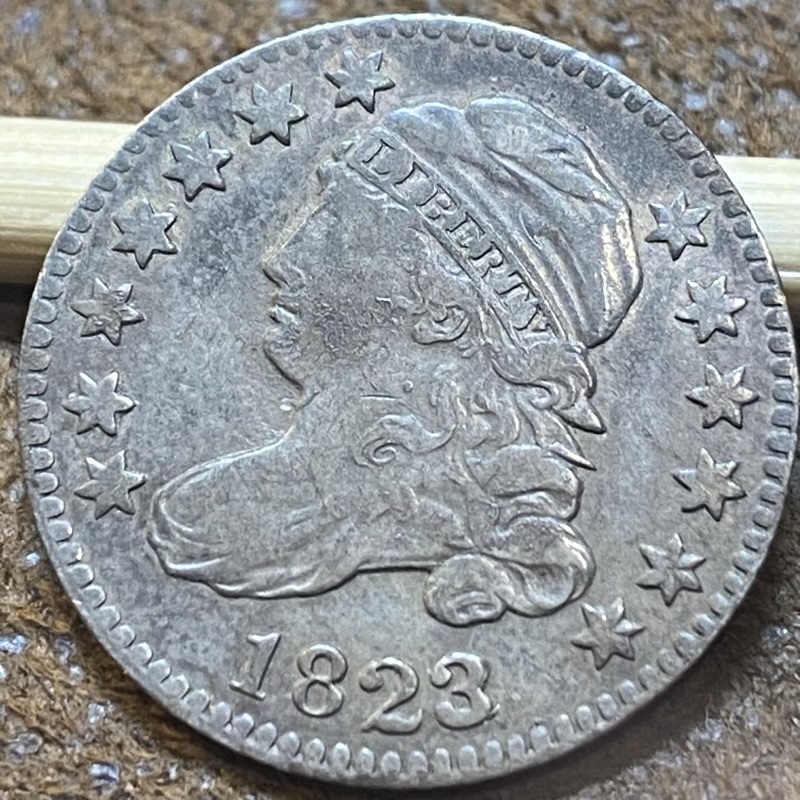 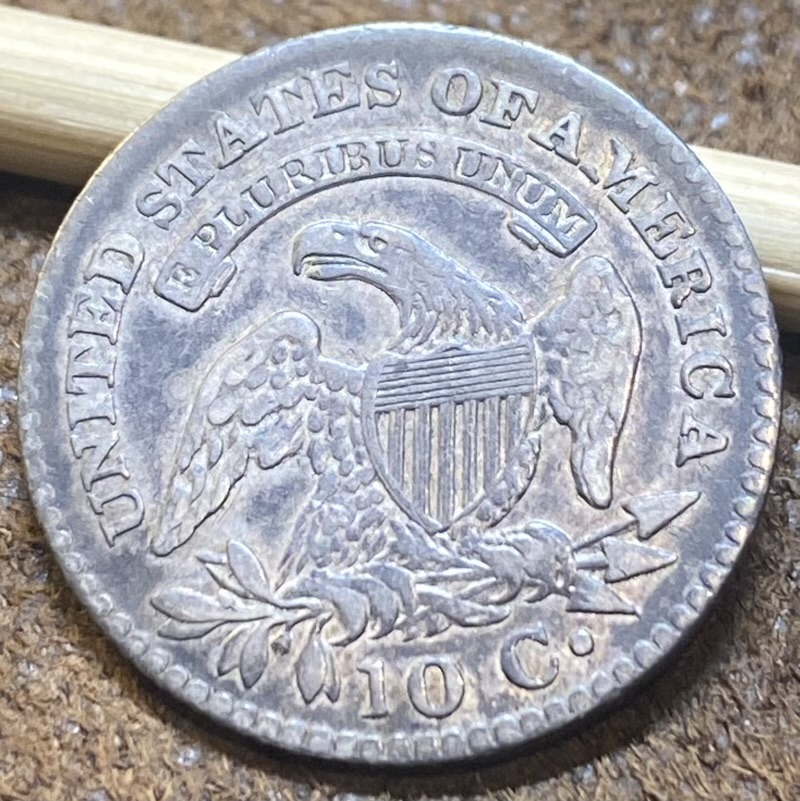 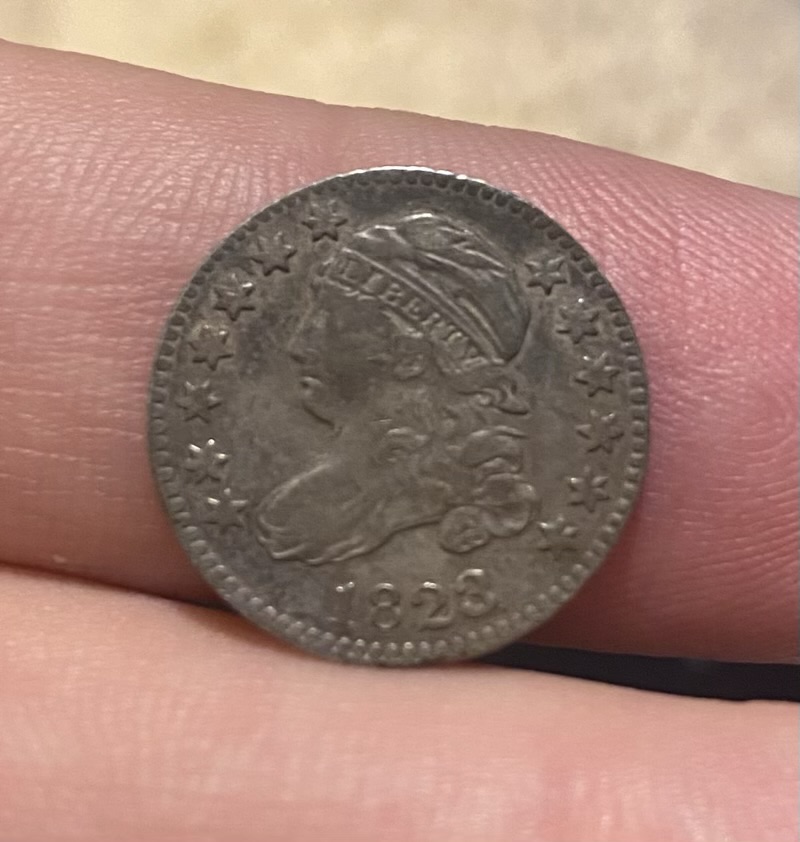 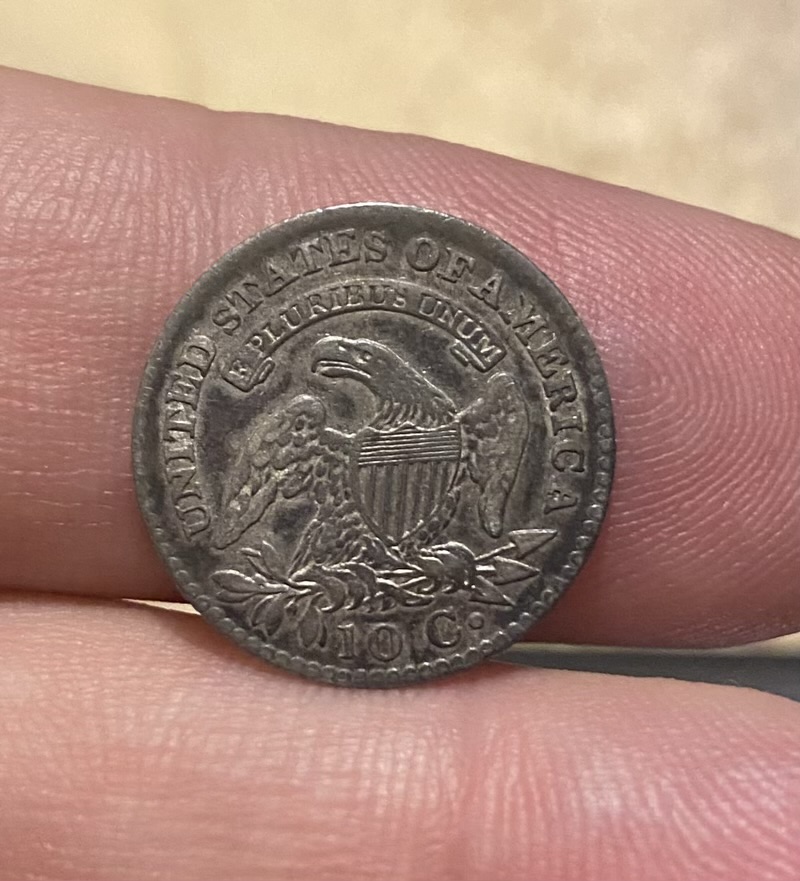 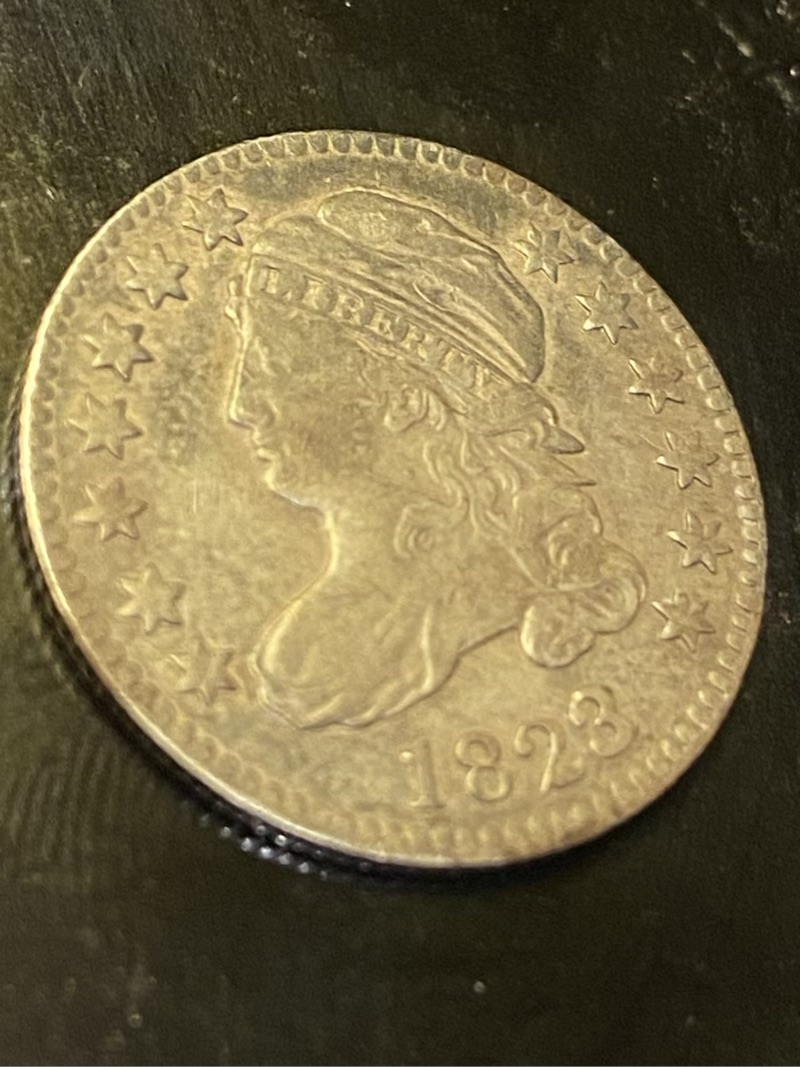 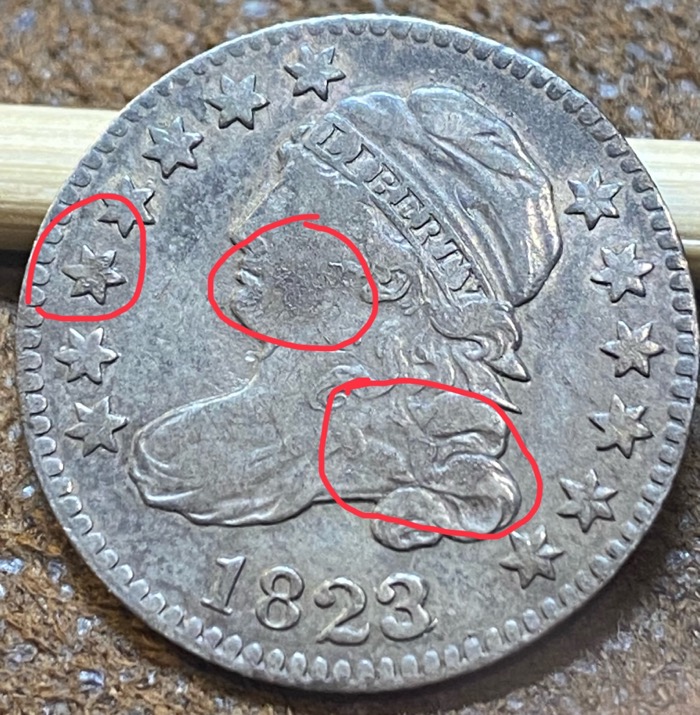 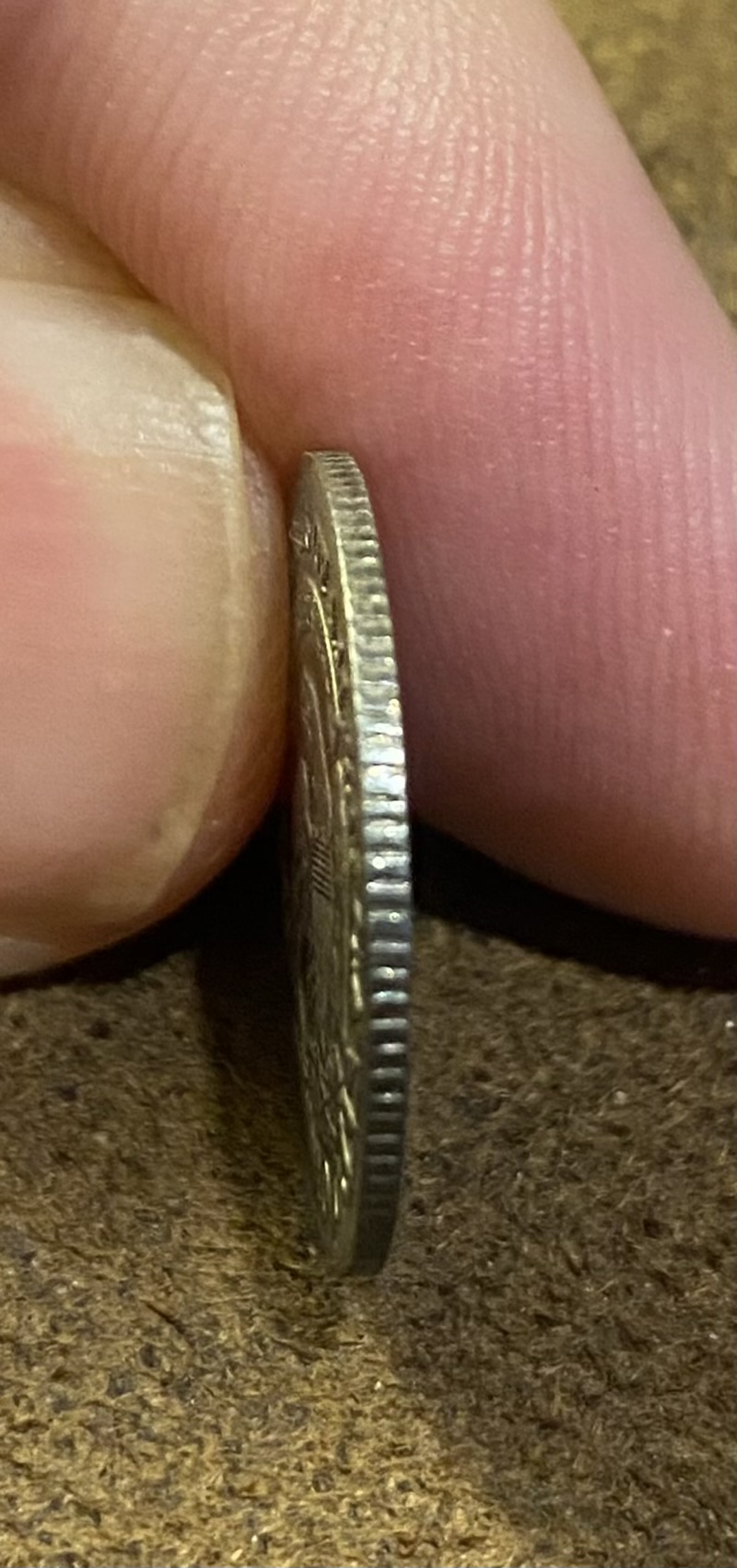 Edited by adam126402
02/15/2024 01:06 am
|
|
Bedrock of the Community
United States
11992 Posts |
VF details. I don't think that the obverse areas you point out are due to die rust. It looks like remnants of solder for an loop or attachment to make the coin into a button or pin. It also looks like the coin is cleaned, more prominently in the reverse which would be the side that is showing if worn as a pin or button.
It also is a little cringy that you are handling the coin by touching the obverse and reverse with your fingers. That transfers oils from your fingers to the surfaces of the coin altering it, usually in a bad way. It is a good habit to hold coins by their edges.
IN NECESSARIIS UNITAS - IN DUBIIS LIBERTAS - IN OMNIBUS CARITAS THE MAN IN THE ARENA, Theodore Roosevelt at the Sorbonne Paris on April 23, 1910: " It is not the critic who counts; not the man who points out how the strong man stumbles or where the doer of deeds could have done better. The credit belongs to the man who is actually in the arena, whose face is marred by dust and sweat and blood, who strives valiantly, who errs and comes up short again and again, because there is no effort without error or shortcoming, but who knows the great enthusiasms, the great devotions, who spends himself in a worthy cause; who, at the best, knows, in the end, the triumph of high achievement, and who, at the worst, if he fails, at least he fails while daring greatly, so that his place shall never be with those cold and timid souls who knew neither victory nor defeat." My coin website: https://fairfaxcoins.comEdited by numismatic student
02/15/2024 09:47 am
|
|
Pillar of the Community
United States
3848 Posts |
I actually see some luster in behind the stars and legend. I know luster stays in the design longer on the bust dime series, but that still guarantees a mid to high VF. I will stick with my initial conservative figure of VF-30 minimum.
Surfaces are a little funky, with the bright and unnatural color weakening the appeal. If the surfaces were smooth and even, I would venture into the XF grades.
I would personally keep the coin in an environment which it could darken, like an envelope, velvet pad, or in the humid bathroom.
Suffering from bust half fever. Want to learn how to attribute early half dollars by die variety? Click Here: http://goccf.com/t/434955Shoot me a PM if you are looking to sell bust halves. |
|
Valued Member
United States
57 Posts |
Thank you for the extra pictures, as they make it more clear what is wear and what is weakness. I have been convinced to change my original opinion to VF-25. The different lighting definitely helped. Thank you for your differing opinions, @jacrispies and @panzaldi. I definitely did subtract too many points in the areas I pointed out. By "die characteristics" I really just meant the typical amount of weakness on a given die variety, whether due to the die or the strike. After comparing with more JR-3 specimens, the most recent pictures do seem to align better with weakness. And @panzaldi, yes the TPG should take into consideration weakness, but I definitely agree that this ideal does not always happen! I am sometimes pleasantly surprised by their treatment of the draped bust series, where strike weakness was even more prevalent. (Also since I'm still relatively new to the site, I don't know how to reply to a quote; apologies.) |
|
Bedrock of the Community
United States
18961 Posts |
like the in hand photos except the handling. I'm still calling between VF30 and 35. I'm really leaning to the 35 side. I don't think it had a cleaning at least that would details the coin. I like it
|
|
Pillar of the Community
United States
995 Posts |
Thank you NumiStu, Panz, Jacr amd Reivers for the feedback.
NS, I wish I had a scope to share better pics as I'm quite certain it is not solder. I leaned away from corrosion/ED as I think if it was that it would not be as isolated to what amounts to very tiny raised spots on the coin. Looking at it with a 14x loupe, it looks much like the examples Ive seen online that exhibit die corrosion with what look like micro blisters.
After looking at this long and hard, I also lean away from the assessment that it has been cleaned. Of course we will never know the story behind this piece.
I figured I might catch a little flak for the handling. I was having a moment of "I don't care" when trying to get some clear pics, but thanks for the reminder.
Jacrispies, I do agree that it looks like a few protected spots with luster remnants.
I'm surprised no one mentioned the state of the large die chip on liberties neck. I've not seen an example below EF that didn't have this die chip severely worn down.
Someday I plan to send off my California fractionals and some other gold coins to PCGS for authentication, when I do I might send this along just for kicks and giggles.
Edited by adam126402
02/17/2024 02:25 am
|
|
Pillar of the Community
United States
5724 Posts |
Quote:
.the state of the large die chip on liberties neck. It's actually not a die chip, but a center dot placed by the engraver to help align the obverse devices. Fairly common in early Bust coinage. I'm at VF-30 straight grade with your new pics. |
| |
Replies: 27 / Views: 1,702 |





 First Page


 Posted 02/12/2024 12:16 pm


