| Author |
 Replies: 8 / Views: 787 Replies: 8 / Views: 787 |
|
|
Pillar of the Community
United States
1003 Posts |
For anyone that would care to share, what happens to luster, if anything, over the course of a die's life? Will old dies produce the same cartwheel effect? And does die polishing change how luster appears? I see many morgans listed as DMPL, do these display luster in the same fashion?
Of course I don't have any proofs, DMPL or LDS AU/MS coins to twirl around a light source for comparison.
Any and all feedback would be greatly appreciated. Or if there is some reference material on the subject somewhere, please point the way.
Thanks, Adam Edited by adam126402
07/08/2024 11:15 pm
|
|
|
|
Pillar of the Community
United States
3848 Posts |
When the dies deteriorate, die flow lines begin to appear and grow as more coins are struck. Die flow lines, creating ultra fine texture on the metal surfaces, actually increase luster. That is because the light has more slanted surface area to bounce off and project the light to your eyes. With this in mind, some series come strong in luster and some weak. Some late die state capped bust halves with heavy flow lines can have a tad bit of luster even in mid to low VF grades. On the other hand, you can find uncleaned Trade dollars in AU-53 without luster. Perfectly DMPL Morgan dollars have no luster in the field because they have been polished smooth and can't reflect any light up toward your eyes. But about a couple hundred strikes later, the PL quality has nearly disappeared. With a collar-less striking setup (pre 1836), that effect lasts even shorter because the outward force is greater and not retained. For example, I believe the PL quality on Capped Bust half dollars last about 12-20 strikes until it goes almost unnoticed. Here is a PL bust half in which the dies were recently polished, but the polishing machine could not reach the depths of the warp in the field. Visually, you can compare the polished (less luster) surface next to the textured (lustrous) surface. *Couldn't post photo will try tomorrow Suffering from bust half fever. Want to learn how to attribute early half dollars by die variety? Click Here: http://goccf.com/t/434955Shoot me a PM if you are looking to sell bust halves. |
|
Pillar of the Community
 United States
1003 Posts |
Thanks for the info, Jacrispies. Definitely interested in seeing the photo you mentioned when you have time.
|
|
Pillar of the Community
United States
6965 Posts |
I will echo what jacrispies said, and add a few of my own learnings. Luster is scattered light. As JA said, the rivulets of die flow from Die Deterioration will produce a coin with a very pleasing glow. I have particularly noticed this with nickels. A War Nickel with sufficient die flow produces a warm, luminous photo. In contrast, a highly polished and flat field—embodied by a proof strike—will produce a harsh glare. A perfect proof field is like a mirror. It doesn't produce scatter, it just bounces the light precisely at the original angle, according to geometry. A DCAM proof is judged on two aspects: how cleanly the fields bounce the light, and how much frosty luster is demonstrated by the devices. Photographed at a right angle, with light coming from a shallow angle, the fields will look black (because they do not scatter any light towards the camera) and the devices will look silvery white (because their luster scatters a ton of light towards the camera). I believe cartwheel has more to do with flat reflectiveness than with luster. But I am not as sure about that. Maybe Zurie, rpmsrpms, or some of the photography pros can shed some light on that aspect. |
|
Bedrock of the Community
United States
80432 Posts |
|
|
Pillar of the Community
United States
6965 Posts |
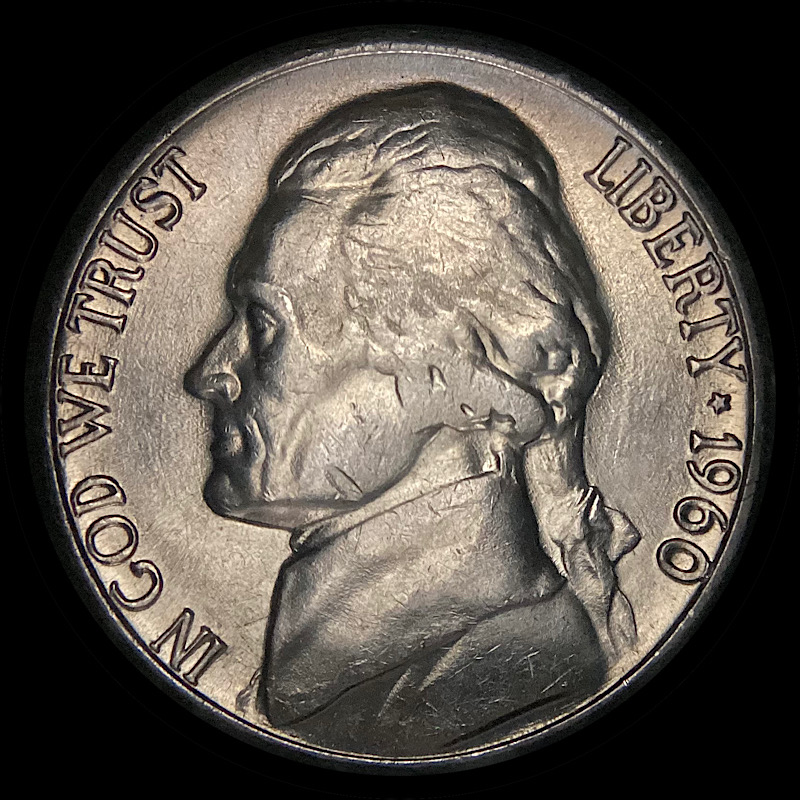 I would say that this coin has good luster. The radial flow from Die Deterioration is evident. Possibly also some die abrasion in random directions. |
|
Pillar of the Community
United States
3848 Posts |
Quote:
Here is a PL bust half in which the dies were recently polished, but the polishing machine could not reach the depths of the warp in the field. Visually, you can compare the polished (less luster) surface next to the textured (lustrous) surface. 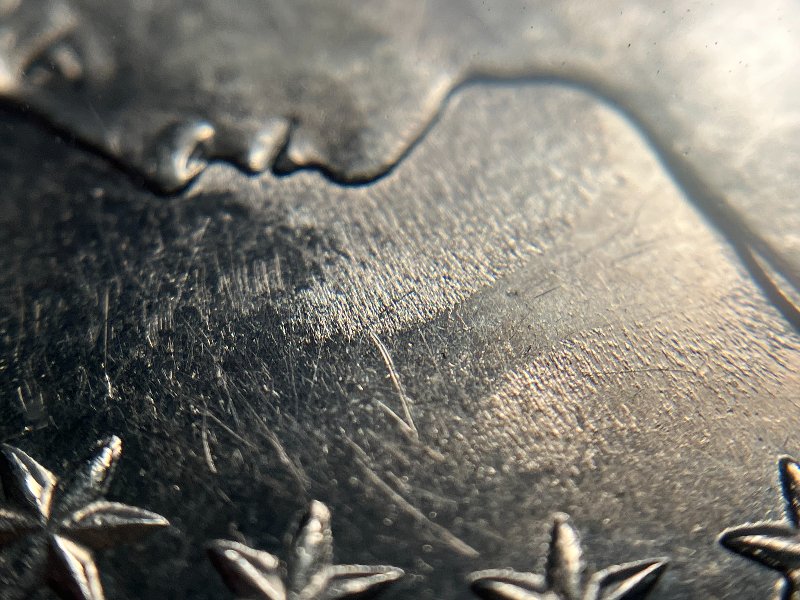 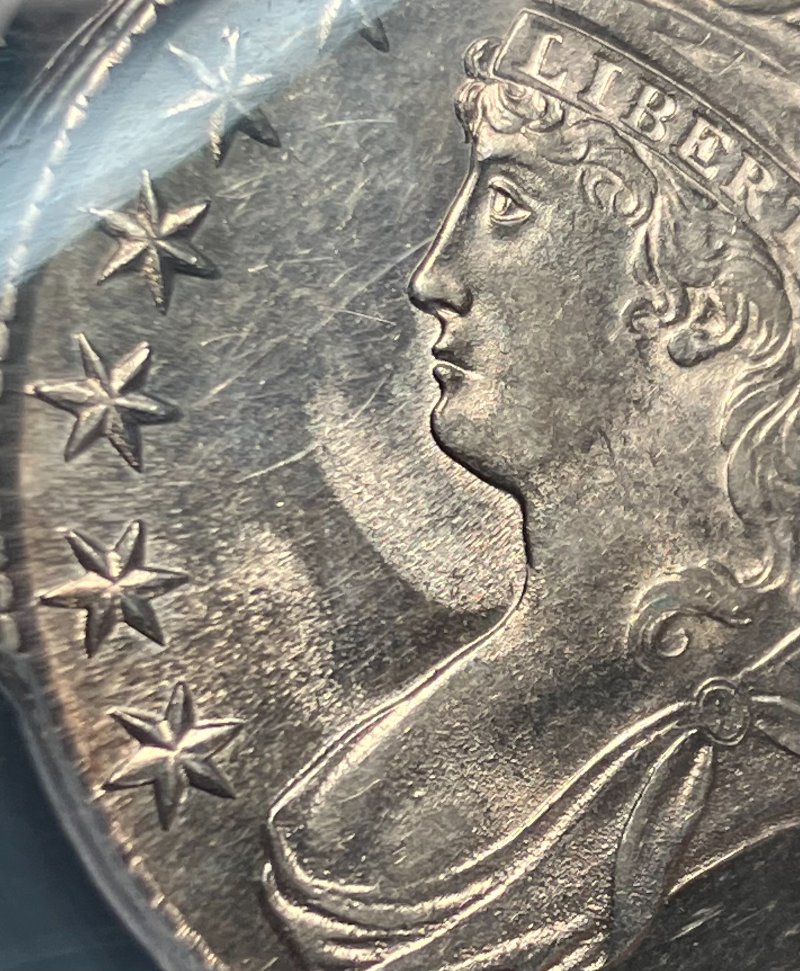 Suffering from bust half fever. Want to learn how to attribute early half dollars by die variety? Click Here: http://goccf.com/t/434955Shoot me a PM if you are looking to sell bust halves. |
|
Pillar of the Community
United States
1003 Posts |
Jacrispies, wow, great photos of the coin! Thanks for posting.
|
|
Moderator
 United States
110055 Posts |
very nice example Jac!  |
| |
Replies: 8 / Views: 787 |
|




 Posted 07/09/2024 7:23 pm





