| Author |
 Replies: 16 / Views: 1,032 Replies: 16 / Views: 1,032 |
|
Pillar of the Community
United States
654 Posts |
|
|
|
|
Bedrock of the Community
United States
78375 Posts |
|
|
Pillar of the Community
 United States
6880 Posts |
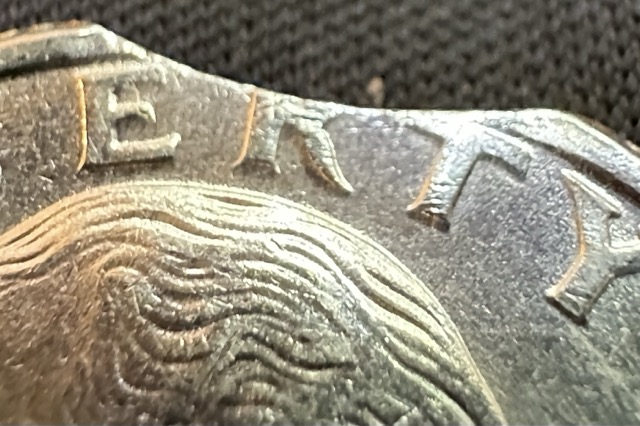
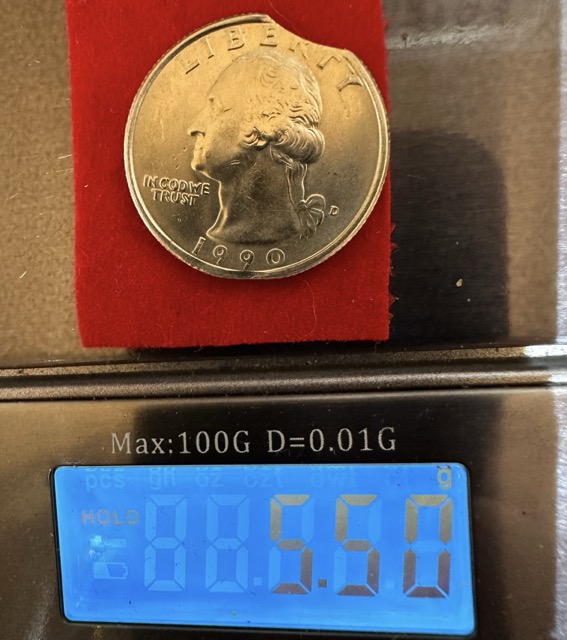
Looks legit to me. Metal flow towards the gap. The coin is neither double clipped, nor clipped plus PMD (as a main factor, anyway). The flattened area across from the clip is called the Blakesley Effect. The planchet isn't properly rounded there because every time the blank rolled past the clipped portion in the rim upset mill rails, it bounced instead of forming the proto-rim. When the coin is struck, that slightly flattened area often doesn't strike up into a perfect rim. It does appear like maybe the part with the Blakesley Effect took a small knock, which would indeed be PMD, but the flattened area across from the gap is definitely normal for a small curved clip coin. https://www.error-ref.com/_curved_clips_/ |
|
Bedrock of the Community
United States
19526 Posts |
|
|
Pillar of the Community
 United States
654 Posts |
Thanks for that explanation!
|
|
Bedrock of the Community
 United States
10601 Posts |
Excellent - text book clip diagnostics!
|
|
Moderator
United States
105547 Posts |
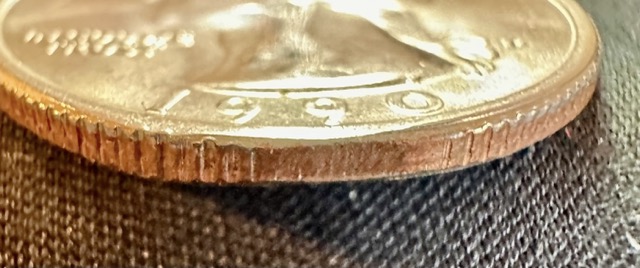
I think this a manufactures (after mint) clip.
1. the edge image is far too prefect, clean and vertical
2. the "Blaksely effect' is not Directly (108 degrees from the 'clip'
3. where the 'Blaksley effect' is - it is bulging out beyond the circle where the collar should have contained it. Looks like a pliers was taken to that area.
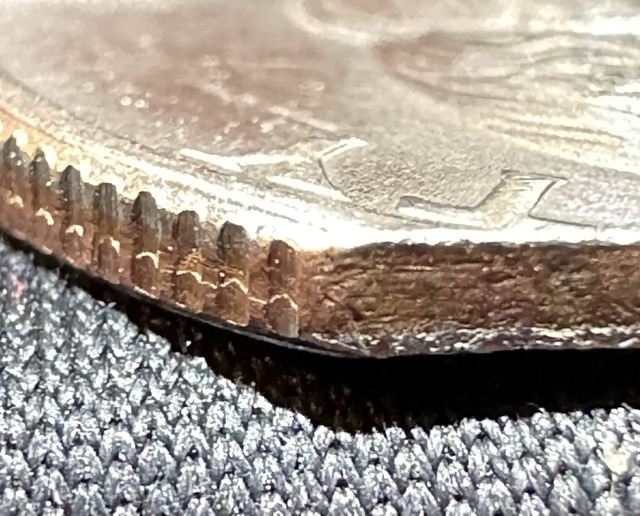
4. look at the edge image the cladding part has cut marks at an angle, not straight vertical as it should be from a punch out tool.
5. also on the edge image - If this were a clip the cut would meet somewhere in the middle of the blank from the 2 different cutting edges on the blanking machine.
|
|
Pillar of the Community
United States
6880 Posts |
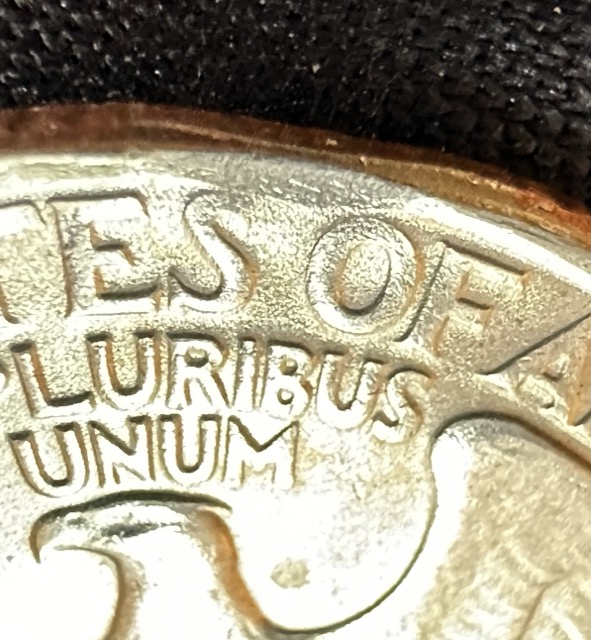
Dearborn, I think you've made an interesting case. Is R DOL distortion from metal flow, or from some kind of crushing or abrasion? Now I'm not sure.
|
|
Moderator
United States
105547 Posts |
I can add a few more points to sell you: 6. there should be no reason to have a loss of reeds where the 'blakesley effect' is the planchet would still be crushed up against the collar. 7. a lack of what Tropicalbats calls the 'Smith effect' have a look at one of his posts about the 'Smith Effect': http://goccf.com/t/456122You will notice 2 things - 1. How the rim is distorted at the edge of the clip, and 2. The center dividing line from the blanking machine. (See #5 above) |
|
Bedrock of the Community
United States
10601 Posts |
If that so called "Blakesley" effect area is indeed a very slight 2nd clip then all of those questionable statements can pretty much be thrown out of the window.......... but that is alot of "IF's"  |
|
Bedrock of the Community
United States
94367 Posts |
|
|
Bedrock of the Community
United States
78375 Posts |
Looks real to me. Not seeing any signs of it being faked by PMD. Errers and Varietys.
|
|
Pillar of the Community
United States
2775 Posts |
My first thought was and still is an incomplete planchet due to the curved clip. Metal flows as best it can, the collar acts as a barrier which encourages the back-fill . When there is insufficient or missing material present the lack of push back against the collar usually results in weak devices around the perimeter. Thanks, Doug.
|
|
Pillar of the Community
United States
6880 Posts |
Well, I would certainly be interested to know if a clipped planchet and/or Blakesley effect will result in weakly struck reeding opposite the clip.
|
|
Pillar of the Community
United States
654 Posts |
|
|
Moderator
United States
194816 Posts |
Nice example!  |
| |
Replies: 16 / Views: 1,032 |












 Posted 07/20/2024 7:25 pm