| Author |
 Replies: 12 / Views: 1,318 Replies: 12 / Views: 1,318 |
|
|
New Member
United States
6 Posts |
Hello -- I'm new (both to the forum and to numismatics), and have little knowledge. I've been buying US Mint proof sets for some years. One 2005 Silver proof set has the coin shown here. Unlike all my other proof coins, which have mirror-like backgrounds, this one (on the obverse only) has a background that looks like a polished copper representation of a gravel field. The little pockmarks stick out from the surface (rather than in), and I imagine someone will tell me a word for that. Anyway, I've photographed it through the plastic holder in which the Mint sealed it. Is this common? Have you seen it before? I've never seen anything like it. It's as if the planchet had been made from metal rolled by damaged rollers (or something). Or maybe as if the die had been fired upon by a tiny machine gun. Then of course, there's the beginner's eternal question: does it increase, or decrease, the value of the coin? All didactic posts are sought, along with the kind that only say, gosh!I just now attempted to upload the photo, but I can't tell whether or not I succeeded. 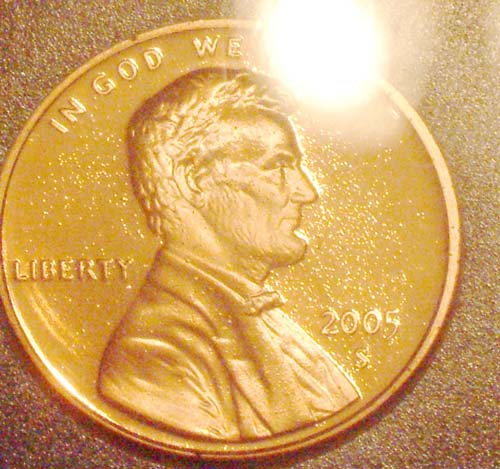 Edited by nn5i
05/17/2009 4:23 pm
|
|
|
|
Pillar of the Community
United States
3098 Posts |
Bad plating, or air bubbles trapped under the copper plating. The penny is actually solid zinc and then coated with copper. For pennies, because of the plating process, the mint does not make the blanks, but orders them from Jarden zinc. This usually has some value, but not significant, but because yours is a proof, it does add some value, or at least it's interesting since the mint should have caught this. By the way, it's not really considered an error. And before I go,  |
|
New Member
 United States
6 Posts |
Thank you. And thanks for the welcome, too. That makes perfect sense. The trapped air would compress under the pressure of the die, then expand again when the die withdrew -- causing little bubbles. Hadn't heard of that before, but that doesn't make it unique, I guess.  |
|
New Member
United States
6 Posts |
I've just posted this proof set on ebay. Let's see how it goes. Thanks again for the wisdom. It's item number 320375183845. I'd be grateful if some of the experts here would examine that listing, and let me know if I've spoken correctly. I intend complete and honest description in all my listings, and don't want to mislead either by misstatement or by omission. All help gratefully received. Edited by nn5i
05/23/2009 3:32 pm
|
|
Moderator
 United States
16694 Posts |
It may or may not command a slight premium because of the curiosity factor and due to the fact that the Mint's quality control missed this. Not so much an error as it is a quality control issue. Have fun here! swcoin.ecrater.com
|
|
Pillar of the Community
United States
1882 Posts |
Oh boy, another conversation on the meaning of the word "error".  If the mint should have caught it in quality control, isn't it an error? NGC has labeled proof coins with a die crack on them as "errors". Edited by steve199
05/25/2009 11:46 am
|
|
Pillar of the Community
United States
3507 Posts |
NGC has labeled coins with huge die cracks as MS-70 . The coins are not graded as an MS-70 error coin. Take the slabs with a grain of salt.
As to the question, There are anomalies on coins that the Mint just doesn't care about. The proof coin in question should not be considered an error just a badly produced proof coin.
Thanks,
Bill
|
|
New Member
United States
6 Posts |
Ahhh -- time to show my ignorance, so maybe I can start correcting it. What's NGC?
Also, am I correct when I infer that "mint error" is a term of art in which the word "error" has more than its usual meaning in other, more standard, usages? Specifically, does "mint error" mean an occurrence at the Mint that produces many coins having the SAME specific departure from normality -- enough of them that they can be collected and traded as a sort of subspecies? A die crack (for example) would do that (produce many coins with identical defect), until it was caught and replaced. That would be different from the defect on the coin I have, for no other coin, even with the same kind of defect, would have been identical in detail, since the little bubbles would be differently placed on each coin.
Have I got that right, or am I saying something foolish, as I so often do?
Edited by nn5i
05/26/2009 01:32 am
|
|
Pillar of the Community
United States
3507 Posts |
Hi, The answer to your question can be a book but I'll try to keep it brief. An "error" is a coin that is the result of a mishap in the actual, mechanical striking of the coin. A coin struck off center is an error, a coin struck on an incomplete planchet is an error, a coin that is struck more than once is an error. By the nature of the process, each error coin is one off. It may be similar to other errors of the same type but each individual error coin is unique. A "die variety" can be attributed to the actual dies that produced the coin. These can be matched up to other coins struck from the same die or dies. Except for the effects of die wear all examples of the 1972 Doubled Die Obverse Lincoln Cent (Die #1, The Big One) will have the exact same characteristics right down to a small finger like die gouge that leads down from the rim just above the D in UNITED. So...Die varieties match up to the particular die that struck the coin and all coins struck from the exact same die will look essentially identical down to some very minute details. (Again, wear on the coin and wear of the die that struck the coin come into play) Die cracks are used as markers on some coins but die cracks really aren't errors or die varieties. They are simply an indication of the amount of wear on the die and that indicates what is known as a "Die State". To fill this out....Variety and Die variety are not the same thing. A Variety is a planned change in the design of a coin that results in something different. The Large and Small date cents of 1960, 1970 S and 1982, for example are Varieties. Die Varieties are as explained above. Just for a kicker, a 1982 Large Date cent that is also a doubled die that was struck off center would be a Variety, a Die Variety and an Error all at the same time. Each term being specific as to its meaning and each word not being interchangeable. A Die Variety is not an Error. There will be some who will disagree but these are the basic terms as they are used by most experts in this area of numismatics. While we are in the area, and since others may be reading this as well. The term is "DOUBLED DIE" with a "D" on the end of doubled and not DOUBLE DIE. I hope this helps, Bill Edited by foundinrolls
05/26/2009 01:59 am
|
|
Pillar of the Community
United States
3507 Posts |
NGC stands for Numismatic Guaranty Corporation and they are a grading company that takes your coin identifies it and grades it and then encases it in a plastic holder, never again to breath fresh air:-) Our slang term for the plastic holders is "slab" :-) A "slab" kinda looks like a tombstone:-)
Have Fun,
Bill
|
|
New Member
United States
6 Posts |
Thank you, Bill. You explain with admirable clarity -- a skill that not everyone possesses.
|
|
Pillar of the Community
United States
3507 Posts |
Hi,
I try and Thank You. A good foundation is helpful when getting into this area of the hobby.
Have Fun,
Bill
|
|
Pillar of the Community
United States
5700 Posts |
nn5i, Welcome and ask away, there are some very talented people here, as you have seen. Also an Error can also happen in other ways, wrong Planchet, etc.....I believe Bill has explained this well enough, We will not get into another "Error" discussion as some have noted above, Be Well, Mike.....
|
| |
Replies: 12 / Views: 1,318 |
|








 Posted 05/17/2009 4:45 pm


