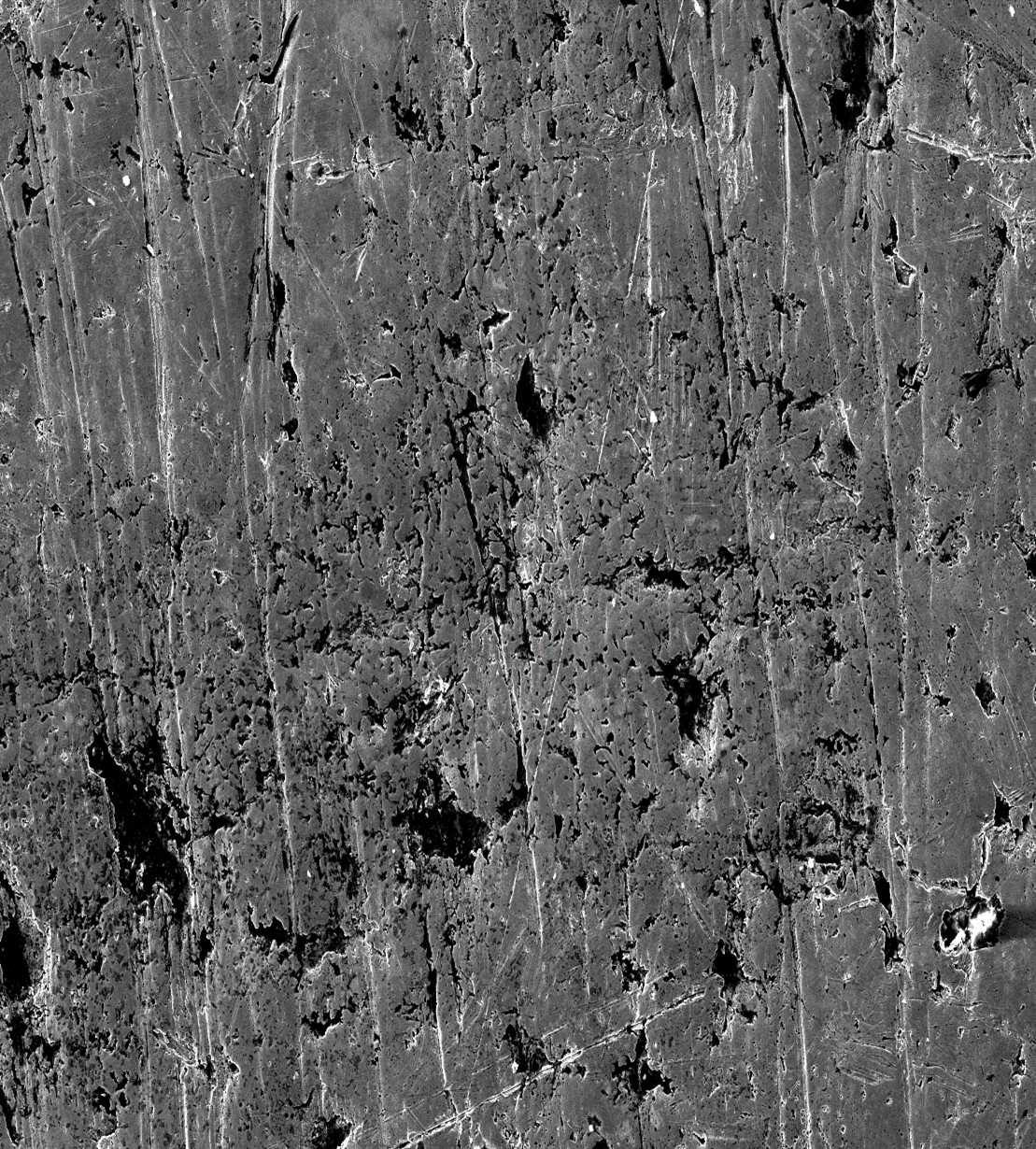
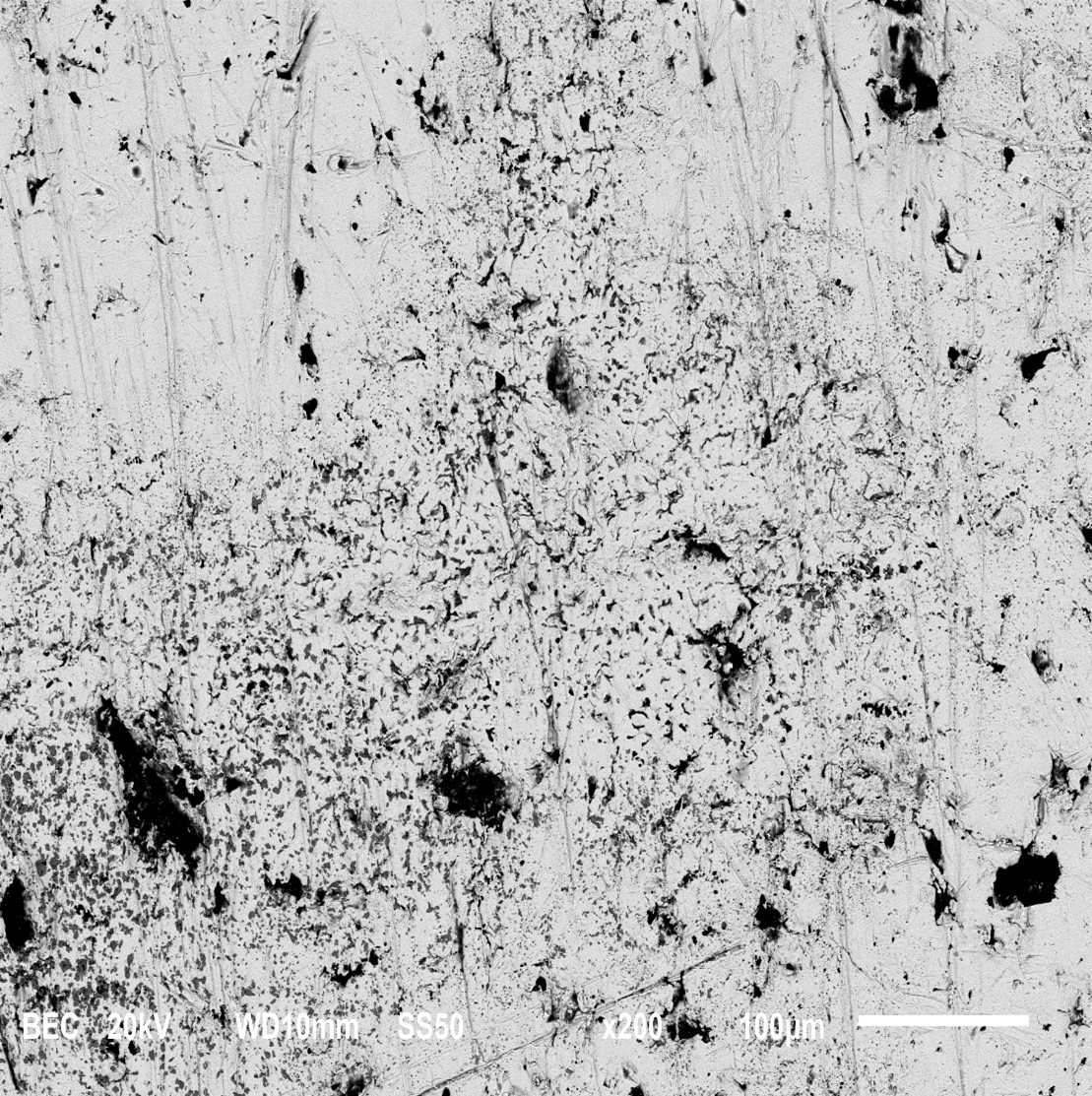
Arthur - With SEM imaging a struck high copper alloy as in these two photomicrographs above will have long and intersecting striations coupled within a jigsaw like structure. Here are two SEM photomicrographs from my Kleeberg paper on a counterfeit English 1/2d of 1775 which is struck. One is a lighter contrast the other dark. This SEM (photo)micrograph, now with lighter contrast, highlights the jigsaw patterns and long striations even more distinctly in this die-struck twin line microstructure. Magnification = 200X. Polished edge surface target point/ethanol rinsed.
Jigsaw Pattern
The jigsaw-like formations are irregular, interlocking regions that correspond to grain boundaries and phase distributions. In die-struck coins, this pattern results from localized deformation during striking, where grains are compressed and rearranged under immense pressure. The geometry of these interlocking features suggests that recrystallization or grain boundary migration may have occurred post-striking, potentially influenced by the copper alloy's composition and any trace elements present. Note in particular at the bottom right of the lighter contrast photo to see remnants of a jigsaw pattern more clearly but they are present without the micrograph.
Long Striations
These elongated, parallel features are twin lines formed due to the intense mechanical stresses from the striking process. As the metal undergoes rapid deformation, dislocation movement generates lattice distortions in certain crystallographic orientations, producing these twin bands (i.e., long and intersecting striations). The spacing and continuity of the striations can reveal valuable information about the striking pressure and the die surface characteristics. If the counterfeiters used a worn die, we might see irregularities or disruptions in the striation patterns, which could help differentiate genuine specimens from fraudulent ones.
However - the surfaces are polished and then rinsed with alcohol such as ethanol. These striation in your 20X & 100X pics are different as they are the result not of the microstructure make-up of a die struck high Cu alloy but just improper polishing of the dies and/or very abusive circulation. Although - These long striations you see may be these long striations as being from a die struck piece or possibly just planchet failure. Just saying these surface markings really have nothing to do with a coin's microstructure but these large linear striations may have and be these long striations seen in these two SEM 200X micrographs I have attached of a die struck CCC 1775 GIII 1/2d . Questions - I am sure go ahead ... <BG>.
I did not do a Point & ID analysis on these SEM 200X microgrpahs as it was not required in this study as it was mostly a die struck vs. cast cross-comparison but the lighter regions are the Cu-rich areas and the darker (black) areas are most likely impurity regions such as from CuS (copper sulfide) and other metallic sulfide compounds. JPL




 First Page


 Posted 06/12/2025 3:25 pm