| Author |
 Replies: 18 / Views: 1,994 Replies: 18 / Views: 1,994 |
Page 2 of 2
|
|
|
|
Pillar of the Community
United States
1778 Posts |
Did a review of the GNL Gurney database and additionally on my new expanded GNL variety database in my Facebook counterfeit group (~23 new varieties added from group member addition's) and no matches. It's a Non-GNL listed variety. You can give it the next available GNL variety number GNL# 1807-O: Q/R: Mo TH-008. Additionally - Not sure that is trace mercuric silvering as it looks like a crystallized foreign material which from my research is more likely AgCl residue particles. Seen this before in my studies of GNL and regal 8R surfaces. Specifically - Under magnification, silver chloride (AgCl) on a coin's surface often appears as a whitish or yellowish crust, sometimes with a powdery or granular texture. It can form irregular patches or a thin film, depending on environmental exposure. In some cases, AgCl can contribute to toning effects, interacting with light to create subtle iridescence. Mercuric silvering "never" appears crystallized or flaky (i.e., particles flaking off the main body) as this picture at 100X seems to illustrate.
Microscopic analysis, such as SEM imaging, can reveal its crystalline structure, showing fine, needle-like formations or clustered deposits. If the corrosion is advanced, AgCl may appear as a flaky or porous layer, disrupting the underlying metal surface. Its weight at 21 grams, its crude regal type edge (i.e., Inconsistency in its circle/rectangle shaped devices 360* around - any overlaps - appears there is just one? - need two on near opposite sides), its oblong shape (i.e., broken collar?) and its copper, bronze or low zinc brass appearance make it a solid candidate. I will supply the Facebook link with a J. Buck thumbs up. John Lorenzo, Numismatist, GNL Co-Author.
|
|
Moderator
 United States
196946 Posts |
I believe a Facebook link would get removed, so it might be better to send Albert an email with the details.
|
|
Pillar of the Community
United States
1778 Posts |
OK. Sent E-Mail to Arthur with Facebook link.
|
|
Pillar of the Community
 United States
1917 Posts |
Closer look at the surface reveals a pattern I've seen once before. Irregular patches of needle-like marks. Parallel striations, horizontal, verticle & angular all interecting.    I edited by deleting one image that looked redundant and replaced it with one that looks more interesting. As far as color goes, I can fuss with controls & settings resulting in widespread variation. I'm just curious about all the intersecting lines at such angles:  Edited by Albert
06/10/2025 10:19 pm
|
|
Pillar of the Community
United States
1778 Posts |
AI yields this = Looking at the 100X (?) magnification image, AI noticed irregular patches with intersecting striations and a dominant orange-brown hue, which strongly suggests oxidation effects—likely from copper-rich composition.
Analysis of Surface Features:
Striation Orientation & Texture
The presence of horizontal, vertical, and angular striations aligns with a mechanically worked planchet that experienced rolling stresses before striking.
The needle-like formations could be residual grain elongation from improper annealing or incomplete metal flow during striking.
High-Copper Alloy & Oxidation Patterns
The coloration points to surface oxidation, possibly from prolonged exposure to environmental factors.
Copper alloys can develop intergranular corrosion, deepening micro-grooves and highlighting material inconsistencies in counterfeit strikes.
Die Transfer & Polishing Marks
The counterfeit die likely had manual polishing, leaving randomized intersecting striations that transferred onto the coin.
These patterns are especially pronounced if the die was reworked multiple times, common among counterfeit operations.
This reinforces the likelihood that this probable high Cu struck counterfeit 8 Reales was produced under imperfect metallurgical conditions, leading to planchet preparation flaws, incomplete annealing, and oxidation-driven surface alterations. But again - with enough magnification no surface is perfectly smooth or uniform. IMO this information does not mean very much with just say 100X magnification view under a standard light microscope. More can be gotten from 20X under a stereo microscope IMO <BG>. JPL
Edited by colonialjohn
06/10/2025 10:10 pm
|
|
Pillar of the Community
United States
1917 Posts |
I tried the 20X under the stereo zoom scope and didn't get anything worthwhile. Larger field of view with less detail. Here's one more closeup of a different spot on the coin:  Edited by Albert
06/10/2025 11:13 pm
|
|
Pillar of the Community
United States
1962 Posts |
So John, this is another one of those along the lines of what we were discussing in this thread on 2R: https://goccf.com/t/455808&whichpage=2where, excusing some sloppiness in execution and some distortion from the mutilation, the design elements are all exactly correct for Mexico 1807 - bust, lions/castles, crown, etc. So necessarily, either a cast - or the theory you mentioned that you, Winston Zack, Jeff Rock are postulating, some sort of early die transfer piece... rather than custom-engraving. |
|
Pillar of the Community
United States
1962 Posts |
Quote:
Not sure that is trace mercuric silvering as it looks like a crystallized foreign material... Agreed... it's crusted. Regarding the striations: Particularly looking at the picture below, seeing how the coloration is slightly different/brighter where some of the more pronounced patches of lines are (esp. the turrets)... I'm sort of wondering if we're not just seeing some sort of old fine wirebrushing.  |
|
Pillar of the Community
United States
1917 Posts |
|
|
Pillar of the Community
United States
1778 Posts |
Realeswatcher - I wrote a previous SEM/EDS draft study paper that is being considered for JEAN. No word yet on its acceptance which confirms with Kleeberg CCC2R's off-metal alloys utilized on obverse/reverse dies which are regal in their design so hence the transfer die "assumption." Where not sure, can prove or determine what form of a die transfer method created these regal off-metal CCC2R's. But with 100% certainty they are not at a regal silver level (i.e., 90%) and are die struck - not cast based on their SEM microstructure micrographs with 100% certainty. This has never been seen previously in the English/Irish GII or GIII 1/2d/1/4d numismatic series. Yes - pretty certain crystallized AgCl crystals not a Hg/Ag amalgamation residue. This is not a guess but seen this form of crystallization before and verified AgCl with XRF surface verifications on multiple Ag alloy examples.
Arthur - I meant to say just using a 20X stereo microscope magnification in a general way to view a coin to determine if CCC or regal is better than 100X (too much magnification). The coin is struck - what cause these striations I have no other comments than supplied in my AI generated comments in my previous post in this thread. Its a new GNL variety and currently UNIQUE.
Edited by colonialjohn
06/11/2025 6:21 pm
|
|
Pillar of the Community
United States
1917 Posts |
Here's an enlarged view of what looks like black fractures above the turret. I understand now what was meant about the 20X, I do use a stereo-zoom and manipulate the coin by hand for general viewing. But these odd criss-cross lines caught my attention further along in the OP after looking for silvering.  Edited by Albert
06/11/2025 7:42 pm
|
|
Pillar of the Community
United States
1156 Posts |
This thread has become quite interesting and sorry for muddying the waters with my uninformed speculation about silver wash. Albert, I really like those 100x photos from an abstract art perspective!
|
|
Pillar of the Community
United States
1778 Posts |
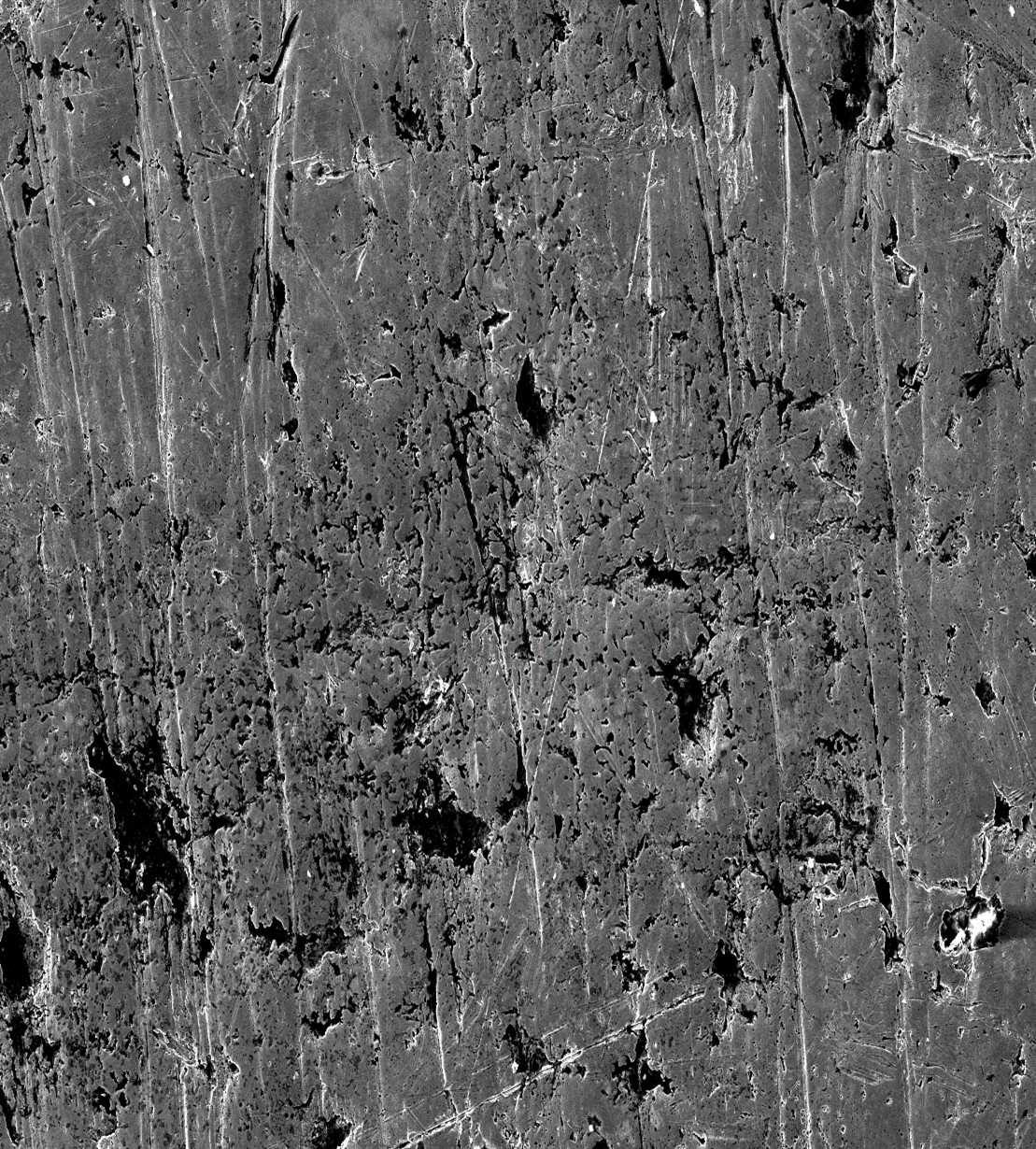 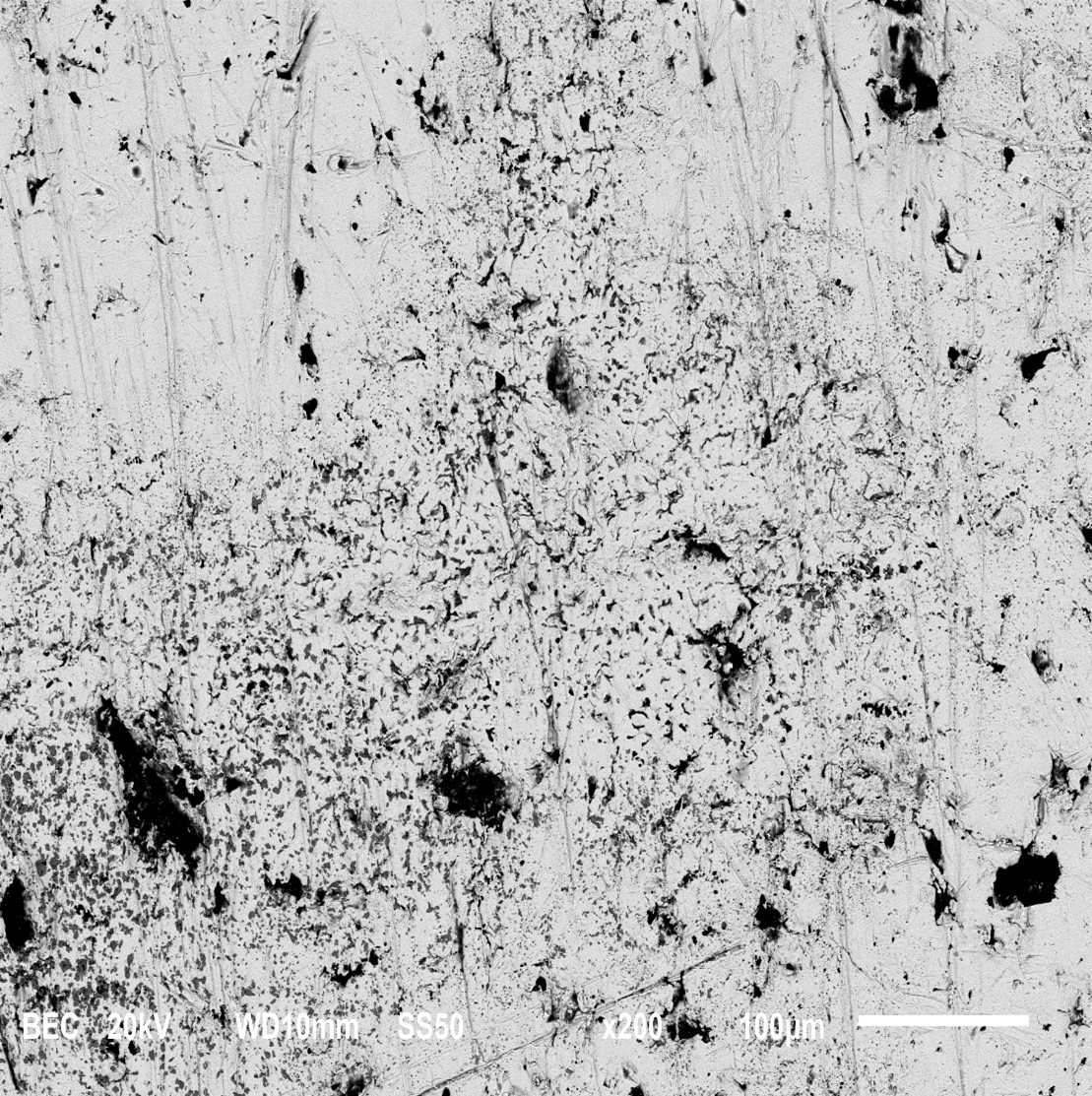 Arthur - With SEM imaging a struck high copper alloy as in these two photomicrographs above will have long and intersecting striations coupled within a jigsaw like structure. Here are two SEM photomicrographs from my Kleeberg paper on a counterfeit English 1/2d of 1775 which is struck. One is a lighter contrast the other dark. This SEM (photo)micrograph, now with lighter contrast, highlights the jigsaw patterns and long striations even more distinctly in this die-struck twin line microstructure. Magnification = 200X. Polished edge surface target point/ethanol rinsed. Jigsaw Pattern The jigsaw-like formations are irregular, interlocking regions that correspond to grain boundaries and phase distributions. In die-struck coins, this pattern results from localized deformation during striking, where grains are compressed and rearranged under immense pressure. The geometry of these interlocking features suggests that recrystallization or grain boundary migration may have occurred post-striking, potentially influenced by the copper alloy's composition and any trace elements present. Note in particular at the bottom right of the lighter contrast photo to see remnants of a jigsaw pattern more clearly but they are present without the micrograph. Long Striations These elongated, parallel features are twin lines formed due to the intense mechanical stresses from the striking process. As the metal undergoes rapid deformation, dislocation movement generates lattice distortions in certain crystallographic orientations, producing these twin bands (i.e., long and intersecting striations). The spacing and continuity of the striations can reveal valuable information about the striking pressure and the die surface characteristics. If the counterfeiters used a worn die, we might see irregularities or disruptions in the striation patterns, which could help differentiate genuine specimens from fraudulent ones. However - the surfaces are polished and then rinsed with alcohol such as ethanol. These striation in your 20X & 100X pics are different as they are the result not of the microstructure make-up of a die struck high Cu alloy but just improper polishing of the dies and/or very abusive circulation. Although - These long striations you see may be these long striations as being from a die struck piece or possibly just planchet failure. Just saying these surface markings really have nothing to do with a coin's microstructure but these large linear striations may have and be these long striations seen in these two SEM 200X micrographs I have attached of a die struck CCC 1775 GIII 1/2d . Questions - I am sure go ahead ... <BG>. I did not do a Point & ID analysis on these SEM 200X microgrpahs as it was not required in this study as it was mostly a die struck vs. cast cross-comparison but the lighter regions are the Cu-rich areas and the darker (black) areas are most likely impurity regions such as from CuS (copper sulfide) and other metallic sulfide compounds. JPL Edited by colonialjohn
06/12/2025 1:42 pm
|
|
Pillar of the Community
United States
1917 Posts |
Here's a different picture of that crack above the turret. 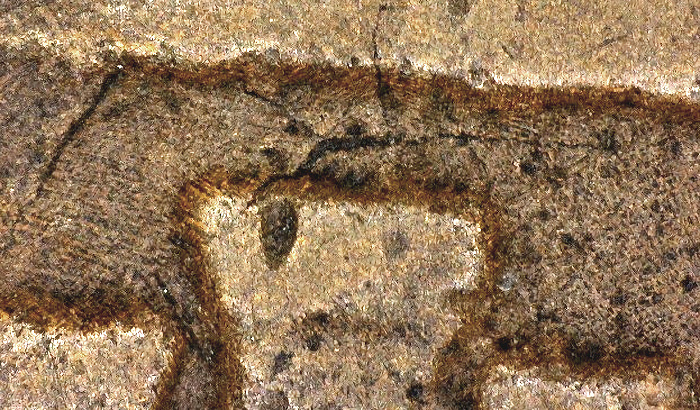 |
|
Pillar of the Community
United States
1917 Posts |
I took a careful look for overlap and followed a sequence of rectangles & circles all around the edge. There are two flat spots where the sequence is crunched. The middle image shows the only irregularity readily seen having two circles with no rectangle between them. 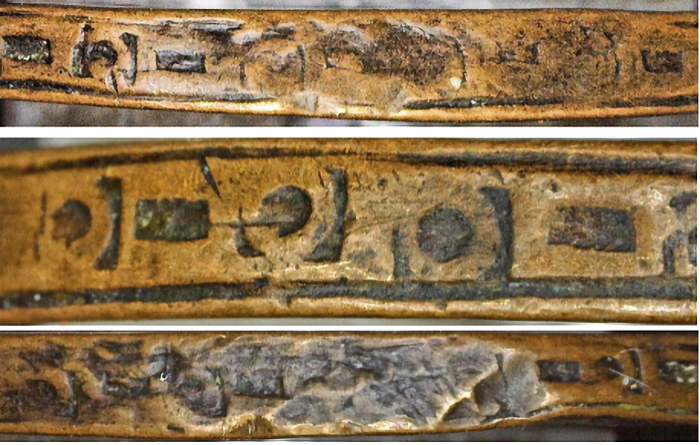 |
|
Page 2 of 2
|
Replies: 18 / Views: 1,994 |
Page 2 of 2
|




 First Page


 Posted 06/10/2025 4:29 pm





