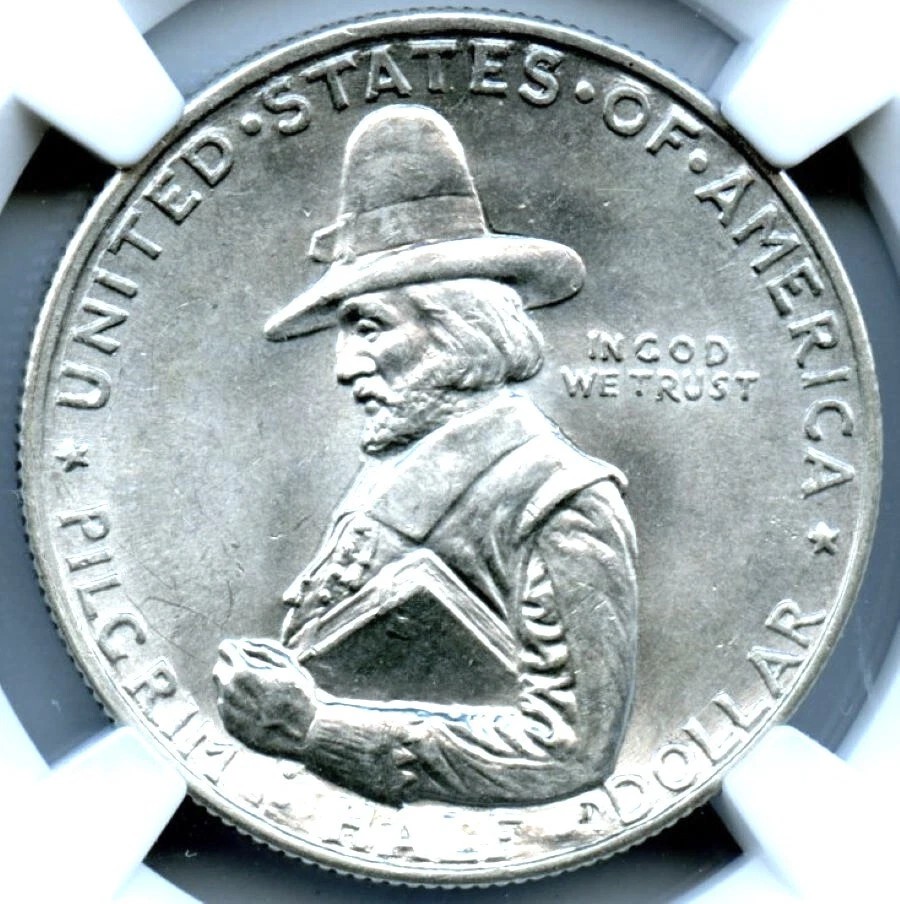
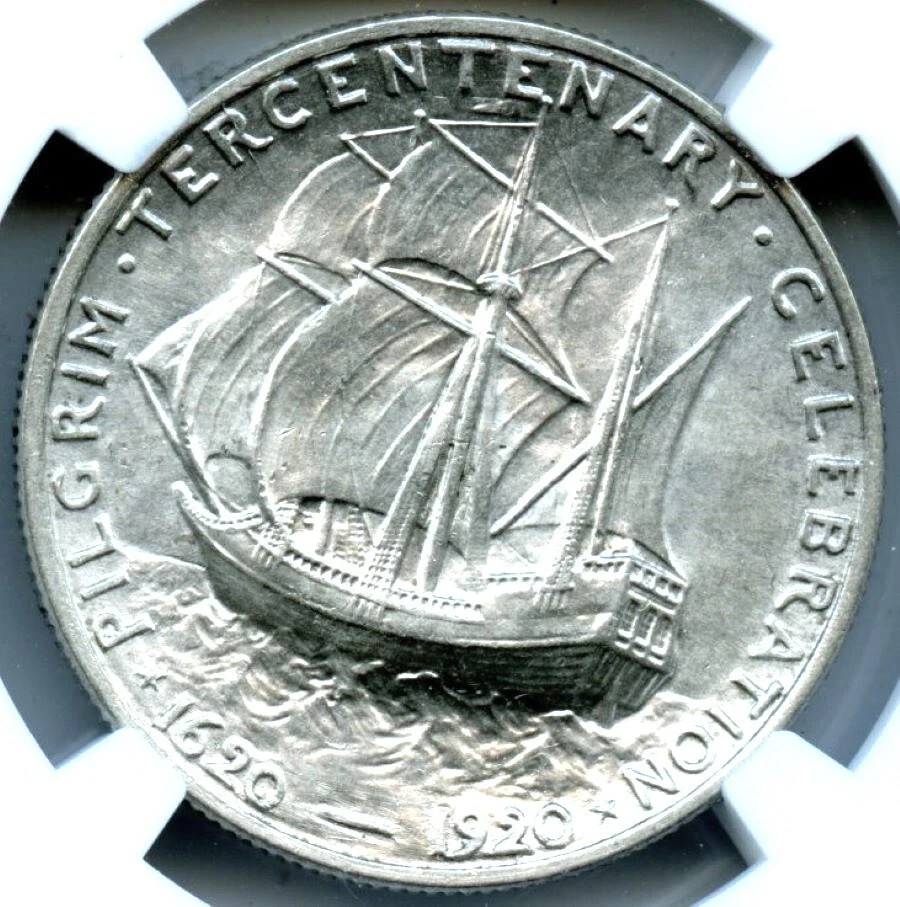
"Coins with Ships" is a popular collecting theme, with coins depicting ships being issued by countries around the world. The Classic-Era series of US commemorative coins is no stranger to the theme, with the 1892-93 World's Columbian Exposition, 1920-21 Landing of the Pilgrims Tercentenary, 1924 Huguenot-Walloon Tercentenary and 1936 Long Island Tercentenary Half Dollars being just a few of the series' "ship coin" examples. (To more fully explore Classic US Commemorative Coins Depicting Ships, check out:
US Commemorative Coins With A Ship.)
But how accurate are the depictions? Let's consider the depiction of the
Mayflower on the Landing of the Pilgrims Tercentenary coin.
From the earliest public unveiling of the coin's designs (circa 1920), eagle-eyed coin collectors/sailing ship enthusiasts noted that a forward sail depicted on the ship was an issue. Horace L. Wheeler, of the Boston Public Library, wrote to the American Numismatic Association (
ANA) and reported the following that was printed in the
ANA's
The Numismatist magazine (November 1920 issue):
"Dallin's Pilgrim Half Dollar is strong and interesting in design, spaced and lettered remarkably well, and belongs among the very best United States coins. On the obverse, 'Governor Bradford,' wearing a rather elaborate jacket, perhaps, is an extremely fine type of Pilgrim. The noble 'Mayflower' on the reverse, however, carries above her bowsprit a triangular sail which I wish were not there. That ship, I am sure, flourished in a much too early era to have a jib. There is, I think, no probability that a seagoing vessel of Stuart times had any but square head sails. These were bent to yards depending from the bowsprit or a topmast rising from it; and continued in use into the nineteenth century. The model of a seventeenth century ship, in the Philadelphia Commercial Museum, show both spirit and spirit-topmast sails; and a good probable picture of the Mayflower herself is Halsall's, which hangs in the Pilgrim Hall at Plymouth.Halsall's "Mayflower in Plymouth Harbor" - Circa 1882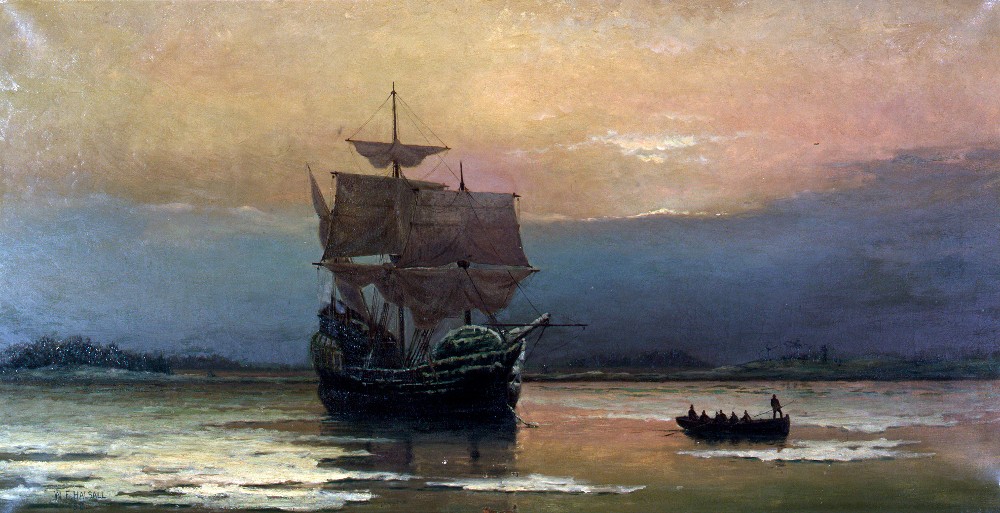 Pilgrim Hall Museum. ](Public Domain.)
So, an inaccurate inclusion of a triangular sail before its time, but the rest of the ship appears to have passed inspection. I have to admit, as someone who is definitely not a sailing ship expert, I was blissfully ignorant of the coin's issue until I read about the sail inaccuracy years ago.
Note: Wheeler's criticisms have been echoed by numismatic authors for over a century - they've become accepted beliefs. I hope he was correct!1920 Landing of the Pilgrims Tercentenary Half Dollar

For more of my posts about commemorative coins and medals, including other Pilgrim coin stories, see:
Commems Collection.









 Posted 06/18/2025 10:27 am