Many countries around the world honor their servicemen/women who died during wartime service to their country but whose remains could not be identified. The United Kingdom and France were the first countries to establish such memorials (post World War I), doing so in 1920. The United States ("US") established its Tomb of the Unknown Soldier in 1921; it is within the Arlington National Cemetery (Arlington County, Virginia). Among the other countries to have such a tomb are Australia, Belgium, Canada, India, Italy. Russia and Ukraine.
In January 2025, Canada released a commemorative Silver Dollar to help mark the 25th anniversary of the completion of its Tomb of the Unknown Soldier at the National War Memorial (Ottawa). Efforts in the US for a similar commemorative piece for the US Tomb of the Unknown Soldier began in 2018.
2025 Canada Tomb of the Unknown Soldier Silver Dollar - Reverse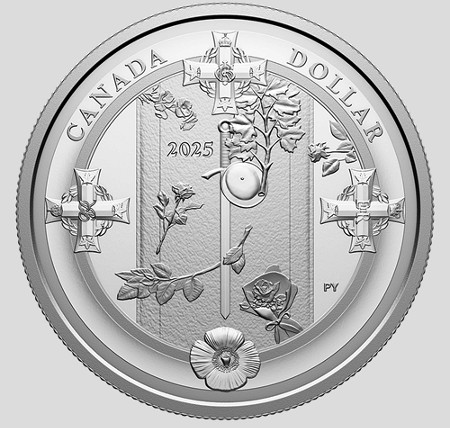 (Image Credit: Royal Canadian Mint. Media Image.)
Brad R. Weistrup (R-OH) introduced a coin bill in July 2018 during the 115th US Congress. The bill sought up to 100,000 Silver Dollars "in commemoration of the centennial of the establishment of the Tomb of the [US] Unknown Soldier."
Tomb of the Unknown Soldier - Circa 1923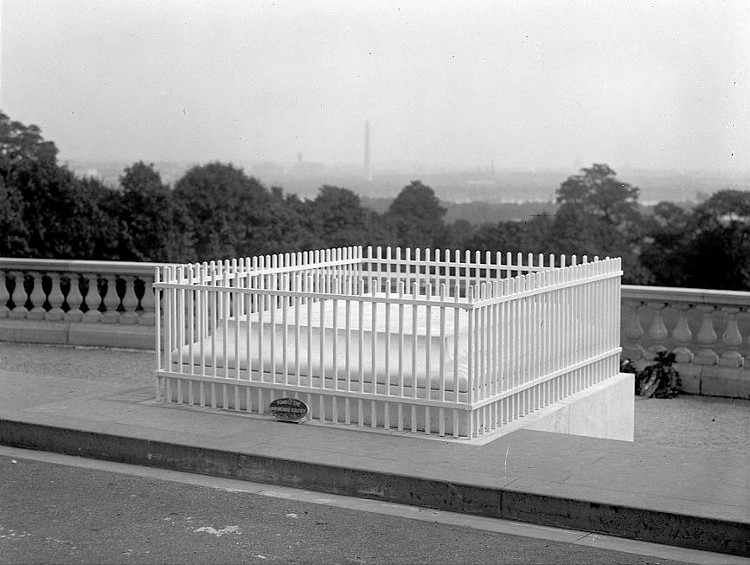 (Image Credit: Library of Congress, Prints and Photographs Division. Public Domain.)
As is the current norm, the coin bill included a "Findings" section that provided background and context for the proposed coin:
Congress finds the following:
(1) The Tomb of the Unknown Soldier is a memorial site at Arlington National Cemetery. On March 4, 1921, Congress approved the burial of an unidentified soldier of the United States on the site to commemorate the unknown soldiers who died during World War I.
(2) As of the date of enactment of this Act, the site also includes unknown soldiers from World War II and the Korean War. These graves are marked with white marble slabs embedded in the plaza below the original sarcophagus.
(3) The original white marble sarcophagus of the unknown soldier from World War I features 3 Greek figures representing peace, victory, and valor. There are 6 wreaths, 3 sculpted on each side, which represent the major campaigns of World War I.
(4) The original unknown soldier lay in the rotunda of the Capitol from his arrival in the United States until Armistice Day, 1921. President Warren G. Harding officiated at the interment ceremonies at the Memorial Amphitheater at Arlington National Cemetery.
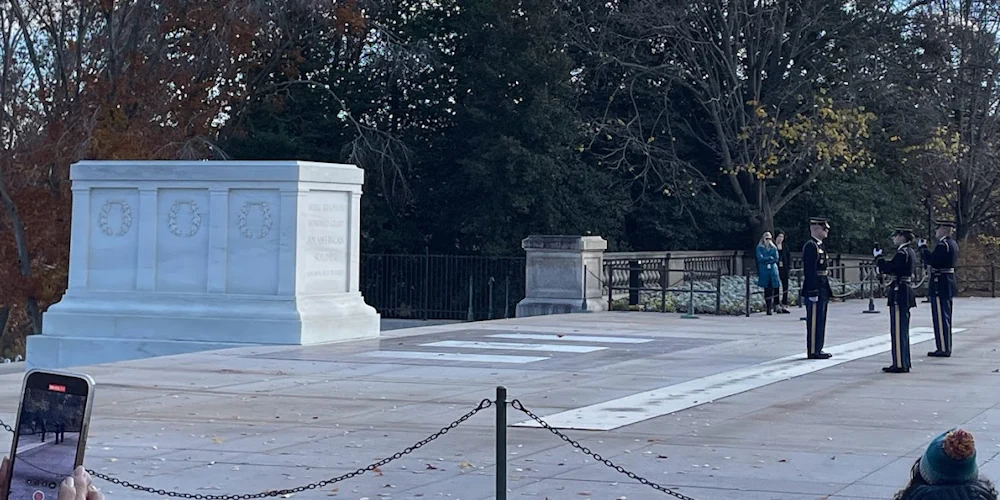
(5) The Tomb of the Unknown Soldier is guarded 24 hours a day, 365 days a year, and in any weather by Tomb Guard sentinels. The sentinels, all of whom are volunteers, are considered to be the best of the elite 3d Infantry Regiment of the Army (commonly known as the "Old Guard"), headquartered at Fort Myer, Virginia.
(6) Inscribed on the back of the Tomb of the Unknown Soldier are the words, "Here rests in honored glory an American soldier known but to God".
Side Note: At one point, the US Tomb included the unidentified remains of a soldier from World War I, World War II, the Korean War and the Vietnam War. In 1998, however, the remains of the Vietnam Veteran were identified via DNA testing as First Lieutenant Michael Blassie of the United States Air Force. His remains were removed and buried in Jefferson Barracks National Cemetery in St. Louis County, Missouri. Sine 1999, the Tomb's Vietnam War veteran crypt remains empty and is dedicated to all missing US Service personnel from Vietnam.
Tomb of the Unknown Soldier - Circa 1937
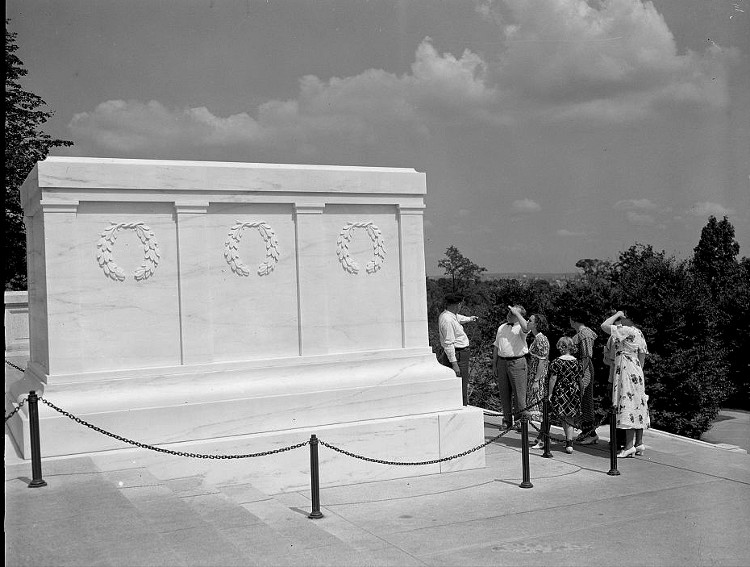
[i](Image Credit: Library of Congress, Prints and Photographs Division. Public Domain.)The Silver Dollar's designs were to be "emblematic of the centennial of the establishment of the Tomb of the Unknown Soldier." The Secretary of the Treasury was to select the final designs in consultation with the Society of the Honor Guard, Tomb of the Unknown Soldier, and the Commission of Fine Arts. The designs were to be reviewed by the Citizens Coinage Advisory Committee ("CCAC").
Proof and Uncirculated coins were to be struck during Calendar Year 2021.
The issue price of each Silver Dollar was to include a surcharge of $10, with collected surcharges to be distributed to the National World War I Museum and Memorial (Kansas City, Missouri) "for the purposes of assisting in commemorating the centennial of the establishment of the Tomb of the Unknown Soldier." The Museum would have received $1 million if the Silver Dollar was a sell out.
Upon its introduction, the coin bill was referred to the House Committee on Financial Services, but went no further. A companion bill was introduced in the Senate at the same time by Tom Cotton (R-AR) and referred to the Senate Committee on Banking, Housing, and Urban Affairs - it also stalled in Committee.
Senator Cotton re-introduced his bill in March 2019, during the 116th Congress, and Representative Wenstrup offered a companion bill soon after. Once again, each of the bills stalled in Committee.
While the 2022 Purple Heart commemorative coin program paid homage to those who died or were wounded in combat and were recognized by the award, it did not honor those who did not receive the award - I think this Silver Dollar would have addressed, at least in part, that segment of our wartime military forces. I would have supported this one.
To learn more about the US Tomb of the Unknown Soldier, see:
-
Tomb of the Unknown SoldierFor other of my posts about commemorative coins and medals, including more What If? stories, see:
Commems Collection.









 Posted 09/03/2025 8:35 pm


