| Author |
 Replies: 15 / Views: 6,005 Replies: 15 / Views: 6,005 |
|
|
Pillar of the Community
Philippines
1156 Posts |
In 1975, I stored away about a hundred pieces Philippine 1974 "Lapu-Lapu" one centavo solid aluminum coins in uncirculated condition inside a plastic polyethylene bag. I chanced upon it last month, but then, inside the bag, the aluminum coins had lost their luster, surface very dull grey, looking corroded, and there is fine grey dust on surfaces and bottom of the bag. The powder is like grey talc consistency. Does aluminum corrode? has anybody come up with something similar? Thanks
|
|
|
|
Moderator
 United States
16694 Posts |
Aluminum is highly susceptible to corrosion. Any moisture to aluminum coinage long term, will result in unwanted consequences. The powder I believe is aluminum oxide. I could be wrong, but that is what that is I think. Others will chime in on this I'm sure. Store all future aluminum coins in very dry conditions and air tight.
swcoin.ecrater.com
|
|
Valued Member
United States
61 Posts |
I would agree with Vermon that it is probably Aluminum Oxide (Al2O3). It is the most likely circumstance considering they would have been exposed to air for 34 years inside of a bag.
Air tight containers are a must for coins. Also, if you plan to store them in a container you may consider getting some silica gel packs in order to absorb any moisture.
|
|
Moderator
United States
16694 Posts |
Quote:
if you plan to store them in a container you may consider getting some silica gel packs in order to absorb any moisture.
 swcoin.ecrater.com
|
|
Moderator
Australia
16959 Posts |
Yes, aluminium does corrode quite easily, and yes, the powder is likely to be alumina (aluminium oxide) with some aluminium hydroxide, aluminium carbonate and aluminium sulfide thrown in the mix.
Aluminium is also a very soft metal, compared to other coinage metals; if you were to toss a bunch of aluminium coins into a bag and jingle them around for a bit, they'll wear each other away quite quickly; this will also create a pile of "dust" at the bottom of the bag, though this dust will be mostly powdered aluminium metal.
Aluminium can also get "cancer" in the same way that bronze coins can get "bronze disease". In aluminium, it usually begins with a small spot where some impurity in the metal used to make the coin reacts with the aluminium, creating a pit of corrosion. It spreads from there, much faster than the metal would otherwise corrode.
To keep aluminium nice and shiny, it really needs to be kept completely away from air and moisture.
Don't say "infinitely" when you mean "very"; otherwise, you'll have no word left when you want to talk about something really infinite. - C. S. Lewis
|
|
Bedrock of the Community
United States
20753 Posts |
As noted already what you have is Aluminum Oxide. So unless you would have kept those in a vacuum, the Aluminum would have Oxidized and moisture has nothing to do with it with Aluminum. The good part of it is Aluminum is a type of metal that one the outer layer Oxidizes, the rest of the Aluminum is safe. In other words this metal has the properties of the Oxide sticking to the surface of the Aluminum protecting it from further Oxidation. Once this was discovered it became a great element to add to other metals for this reason.
Note on Aluminum storm windows after many years how they still look the same as they did a few weeks after installation. The first few weeks they Oxidized ane after that, nothing. The fact that many have colored Aluminum windows is only decorative, not protective. Many strutural steel buildings now use a system incorporating Aluminum for this purpose. In Chicago there are several large black building of all steel that use this pricipal and they never rust. Better than Stainless Steel.
So in other words what has already happened to your coins is as far as it will go. Do not clean them of course since you do not want to remove the protective Oxide.
|
|
Valued Member
United States
240 Posts |
Like just carl said, it is its very oxidation that protects it. This is why mercury is not allowed in airplanes. If it were to come into contact with with the fuselage, there would be a hole in the plane in seconds.
There is a cool video of mercury being poured onto a block of aluminum on youtube.
|
|
Pillar of the Community
United States
3098 Posts |
Wow! I never knew Mercury eats away Al! Thanks for sharing!  |
|
Pillar of the Community
 Philippines
1156 Posts |
Thanks to all you guys for the detailed response! Great note on mercury, didn't knew that! Thanks to just carl! I was previously a cleaner buff, now striving hard to pull away from the habit. Info much appreciated!
|
|
Valued Member
United States
61 Posts |
|
|
Pillar of the Community
United States
6428 Posts |
The time-lapse period in the You-Tube video is not specified, but it isn't an instant process. I remember keeping liquid mercury in an aluminum, screw-top film can as a kid and the can did corrode, mainly around the rim. It took several days for noticeable corrosion to form and when I noticed I transferred the mercury into a glass bottle.
Mercury forms alloys with many other metals including silver, gold, and copper. It was widely used in placer gold mining operations (and probably still is!) by putting mercury in the bottom of a sluice and passing gold-bearing sand and gravel through the sluice. Gold dust would dissolve into the mercury, gradually increasing in concentration. Eventually the mercury-gold alloy would become semi-solid and the miner would put it into an oven. The mercury evaporates and leaves the gold behind. Thrifty miners would condense the mercury vapor into liquid so it could be re-used.
|
|
Pillar of the Community
Australia
2830 Posts |
G'day & thankyou: I wasn't aware that Al & Hg would react al all.
I've just come back from Indoneasia, where I collected a lot of their current aluminium coins. I think I'd better separate the near-unc from the grubby ones while I ponder what to do with them.
Just Carl: "In Chicago there are several large black building of all steel that use this pricipal and they never rust"
- the BHP Research Centre, near Monash Uni, in the suburbs of Melbourne, was built on this principle, and in order to make a commercial point.
- Herr GLOCK's hardware has oxidized surfaces that are resistant to further oxidation, and to scratching, and routine wear from contact.
Jaobler: "The time-lapse period in the You-Tube video is not specified, ..."
- look at the right hand side of the screen; click on "more info"; and this is revealed -
"A small amount of mercury amalgamates itself into an aluminum I-beam and destroys it from within. Gallium scratched into the surface allows the mercury to penetrate the protective oxide layer that normally surrounds anything made of aluminum.
This is a time-lapse video, the action takes about two hours in real time. The powdery oxide is falling off, what you don't see is a significant pile of it building up underneath."
Peter in Oz
|
|
Bedrock of the Community
United States
20753 Posts |
Quote:
Thanks to all you guys for the detailed response! Great note on mercury, didn't knew that! Thanks to just carl! I was previously a cleaner buff, now striving hard to pull away from the habit. Info much appreciated!
If you watch the Antique Road Show on TV they too usually warn abou cleaning old items. Many pieces of old wooden funiture are protected by old varnishes, paints, oils, etc. Removing those would expose the bare wood to all kinds of problems. Actually on coins of other metals there are other reasons for not cleaning. As with Aluminum, the outer layer of a coin is usually attacked by numerous substances that form a compound. If this is removed, in many instances some or much of the original meterial of the coin is also removed and unless properly protected the process starts over again. And one more thing about Aluminum coins. Attempt to keep them from touching each other or other coins of different metals. A reason but a little to long for this post. |
|
Pillar of the Community
Philippines
1156 Posts |
I found out only last week that not only my 1974 1centavo aluminum coins were affected, but also the 10centavo coins. Picture scanned as shown, I think its aluminum powder, grey white that materialized inside the bag. The oxide flakes are stuck on surface of the now bad looking, previously UNC coins. Any suggestion of any chemical on how to get it at least rinsed off would be appreciated. Big thanks!  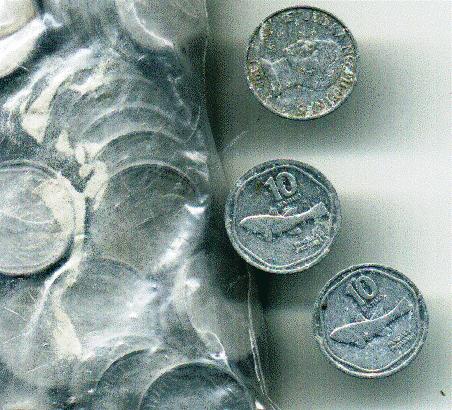 |
|
Bedrock of the Community
United States
20753 Posts |
Quote:
I found out only last week that not only my 1974 1centavo aluminum coins were affected, but also the 10centavo coins. Picture scanned as shown, I think its aluminum powder, grey white that materialized inside the bag. The oxide flakes are stuck on surface of the now bad looking, previously UNC coins.
Any suggestion of any chemical on how to get it at least rinsed off would be appreciated. Big thanks!
I would first attempt to just wash off with warmed distilled water. However, if your really dedicated to cleaning those coins, there is a possilbe solution to that. I really dread mentioning this on a coin forum since I really, really hate the thought of anyone doing this, but.... If you go to a decent hardware store and ask for products that are used to clean household Aluminum screens, there are several. One is a Naval Jelly substance. There are others that really do clean Aluminum Screens. They remove that outer protective covering. It will work but remember it will take off material from the coin and make it worth a lot less but will now look much newer and/or pretty. |
|
Pillar of the Community
Philippines
1156 Posts |
Big thanks justcarl! as it is now, I dont even like to handle or touch it, the coating is like greasy powder. A good rinse is what I'll do, reserving the aluminum screen cleaner for the really hopeless and erroded. thanks again
|
| |
Replies: 15 / Views: 6,005 |
|










 Posted 07/09/2009 11:00 pm


