







 First Page
 Previous Page


 Posted 07/24/2009 2:04 pm


I've taken the liberty of capturing your pics to post here full-size:
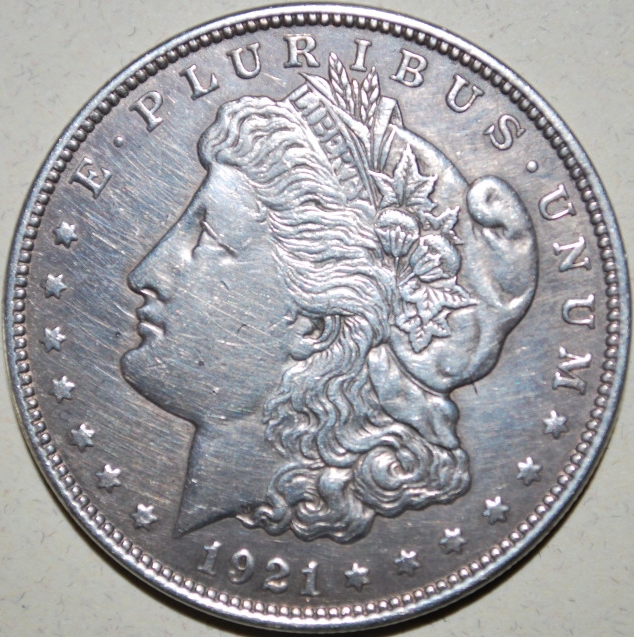
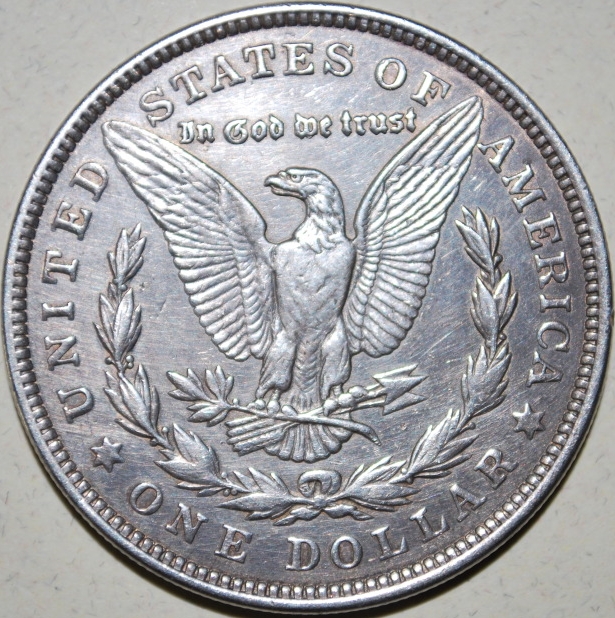
It is not, I believe, a Chapman coin, but a rather curious one all the same. We'll discuss that in a minute.
First, given these pics, 100 out of 100 discerning numismatists would believe it has been brushed at some point - the parallel lines classic to brushing are predominant in these pictures. It may be that the lighting angle used in these pics (very good pics, for the record) is the only angle at which the brushing lines can be seen, and any other inspection of the coin might not reveal them.
Now. 1921 Morgans were minted with two different reverses, and two different reed counts. The "standard" reed count is 189, but some number of examples were minted in a collar of 157 reeds. These are referred to as "Infrequent Reeding" coins.
The reverse dies, called D1 and D2, are characterized by these features: There are 17 berries in the wreath of D1, and 16 in D2, with the extra berry being found at the viewer's top right - D1 has a berry on the inside of the wreath here, and D2 does not. The top arrow fletch of D1 meets the eagle's talons at the center talon, whereas with D2 the fletch meets the eagle's talons between the right (viewer's left) and center talons. The olive branch on D1 is noticeably weaker than D2 in this area.
The coin shown here has the characteristics of a D2 reverse, most easily visible through the talon features I mention. Chapman Proofs used the D1 reverse. This coin, therefore, cannot be a Chapman Proof.
Now, here's the kicker: Only one die pair is noted which used the D2 reverse and also the Infrequent Reeding collar. This variety, known as VAM-44, is rare indeed. With a coin showing some circulation, as does the example here, the best marker to identify this variety is a die scratch inside the ear, pictured below:
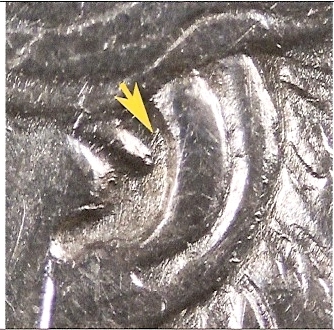
So, it's important to determine, first, if this coin used the Infrequent Reeding collar. If you have another Morgan, any Morgan, compare them side-by-side. An Infrequent Reeding 1921 will have noticeably wider flat areas between the reeding gaps; it's very much the fewest reeds used on any Morgan. If this coin proves to have 157 reeds, then it should be studied very carefully, starting with the detail I pictured above.
It is not, I believe, a Chapman coin, but a rather curious one all the same. We'll discuss that in a minute.
First, given these pics, 100 out of 100 discerning numismatists would believe it has been brushed at some point - the parallel lines classic to brushing are predominant in these pictures. It may be that the lighting angle used in these pics (very good pics, for the record) is the only angle at which the brushing lines can be seen, and any other inspection of the coin might not reveal them.
Now. 1921 Morgans were minted with two different reverses, and two different reed counts. The "standard" reed count is 189, but some number of examples were minted in a collar of 157 reeds. These are referred to as "Infrequent Reeding" coins.
The reverse dies, called D1 and D2, are characterized by these features: There are 17 berries in the wreath of D1, and 16 in D2, with the extra berry being found at the viewer's top right - D1 has a berry on the inside of the wreath here, and D2 does not. The top arrow fletch of D1 meets the eagle's talons at the center talon, whereas with D2 the fletch meets the eagle's talons between the right (viewer's left) and center talons. The olive branch on D1 is noticeably weaker than D2 in this area.
The coin shown here has the characteristics of a D2 reverse, most easily visible through the talon features I mention. Chapman Proofs used the D1 reverse. This coin, therefore, cannot be a Chapman Proof.
Now, here's the kicker: Only one die pair is noted which used the D2 reverse and also the Infrequent Reeding collar. This variety, known as VAM-44, is rare indeed. With a coin showing some circulation, as does the example here, the best marker to identify this variety is a die scratch inside the ear, pictured below:
So, it's important to determine, first, if this coin used the Infrequent Reeding collar. If you have another Morgan, any Morgan, compare them side-by-side. An Infrequent Reeding 1921 will have noticeably wider flat areas between the reeding gaps; it's very much the fewest reeds used on any Morgan. If this coin proves to have 157 reeds, then it should be studied very carefully, starting with the detail I pictured above.


