| Author |
 Replies: 35 / Views: 9,525 Replies: 35 / Views: 9,525 |
|
New Member
Canada
15 Posts |
I have a silver coin made in 1774 in Ottoman Empire in time of reign of sultan AbdulHamid I. It is 1 Kurush (equal to 40 Para).
This coin is covered with layers of ancient dirt accumulated for the centuries.
I have tried to brush it off with a toothpaste, just a little bit came off but not too much. I tried "Silvo" (solution for cleaning and polishing silverware), it did take some dirt off but still not quite there yet.
Can someone advise me on what can be used in order to clean this silver kurush completely?
Thanks in advance
|
|
|
|
Pillar of the Community
United States
5362 Posts |
Sounds like you are already using rather harsh treatments, but I would try sitting it in pure acetone for a period of a few hours (cover the container) followed by a bath in a very mild detergent and warm water. But I would not use abrasives at all unless the coin is essentially worthless.
Can you post a picture of the coin to see what you are starting with?
|
|
New Member
 Canada
15 Posts |
Thanks allot for your advise. Actually I did try the 70% acetone (nails cleaner), but it didn't do anything. Hence I decided to go a bit harsh way. I will try the pure acetone method today. Here are the photos of the coin in its original stage (prior to me starting to clean it): 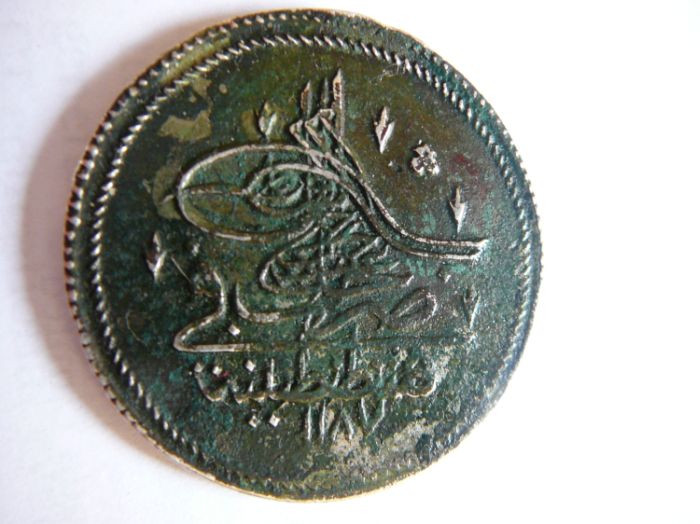 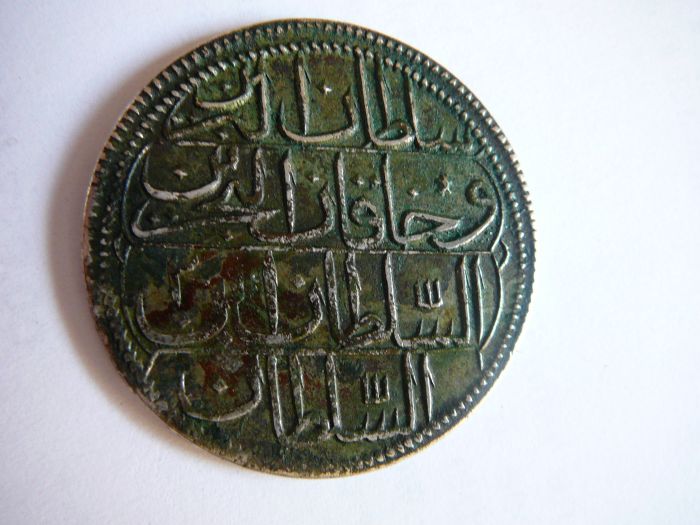 Later on today I will make new pictures (i.e. same coin after my attempts to clean it) and post them here... Edited by Yober
08/13/2009 3:28 pm
|
|
Pillar of the Community
United States
5362 Posts |
I think anyone can put up a picture it just has to meet the required criteria. If not you can send it directly to me swamperbob22@aol.com and I can try
|
|
New Member
Canada
15 Posts |
I was using the wrong mode for the reply  , i.e. Quick Reply which didn't have the picture attachment option. See my revised message above with the pictures attached. |
|
Pillar of the Community
United States
5362 Posts |
I would not really clean that one anymore - the surfaces are corroded and there is NO way to restore this damage. Cleaning anything but lose dirt will likely make the coin a non-collectable curio.
|
|
New Member
Canada
15 Posts |
Wow , I already did clean about a half of the dirt layer. As I can see the actual metal hasn't been coroded. I will post the photos of this coin in its current semi-cleaned stage (prior to do anything more to It) for your review. I wonder what is this coin worth ?
|
|
Pillar of the Community
United States
5362 Posts |
According to Krause - the coin is made of billion which is a very low grade silver alloyed with copper which corrodes very easily. The green color is copper oxide so some amount of corrosion is present. The coin was made I believe in Constantinople and is a fairly common variety worth between $10 and $15 if not harshly cleaned.
|
|
New Member
Canada
15 Posts |
Here are the photos of this coin in its current condition (after partial clean up): 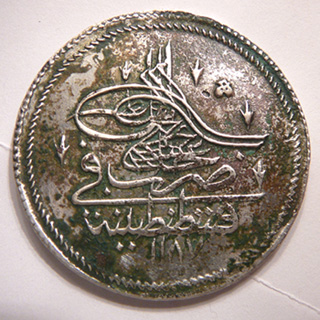 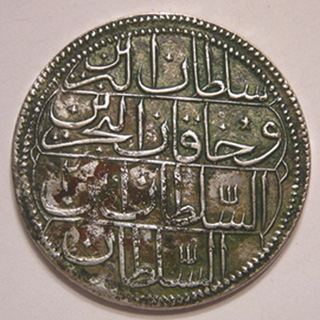 I hope you can see from these photos that the metal is in very good condition. It's a bit hard to see on the photos, but the letters and symbols are quite convex. What would you say? Should I continue with the pure acetone procedure? |
|
Pillar of the Community
United States
5362 Posts |
Well the details on the coin certainly looks clearer (cleaner) in the new photograph but it is also equally clear in the picture that there is some corrosion of the writing on both surfaces. I would at this point do the acetone soak (sometimes harder acretions take some time to soften) and then I would oil the coin. But I would not use any additional abbrasive methods at all. They are not helping the value of the coin.
For anyone reading this thread perhaps a brief comment on how to ID a Turkish coin is in order. It is not as hard as it would appear. The key is getting a good reference book which provides the dating method used. Krause is a very adequate reference for this purpose for common dates.
The Krause number for the coin is 396 - the Mint and date are below the Toughra - under what looks like a line crossing the coin. The upper line reads Constantinople and the date is 2 followed by 1187. The #2 (two dots) represents the year of the reign (regnal year) and the date uses the dating system based on the year of the Hejira (AH1187). The arabic dates do not translate directly to western dates so the best you can do is to sya the coin was made between March of 1775 and February of 1776.
|
|
Pillar of the Community
United States
645 Posts |
The two dots before the 1187 are part of the word (Qustantiniyah)Constantinople. It is Year 2, but the regnal year is on the opposite side, 2nd row of characters from the bottom, far left, looks sort of like an 'r'.
|
|
New Member
Canada
15 Posts |
actually the Krause number for my coin is 397 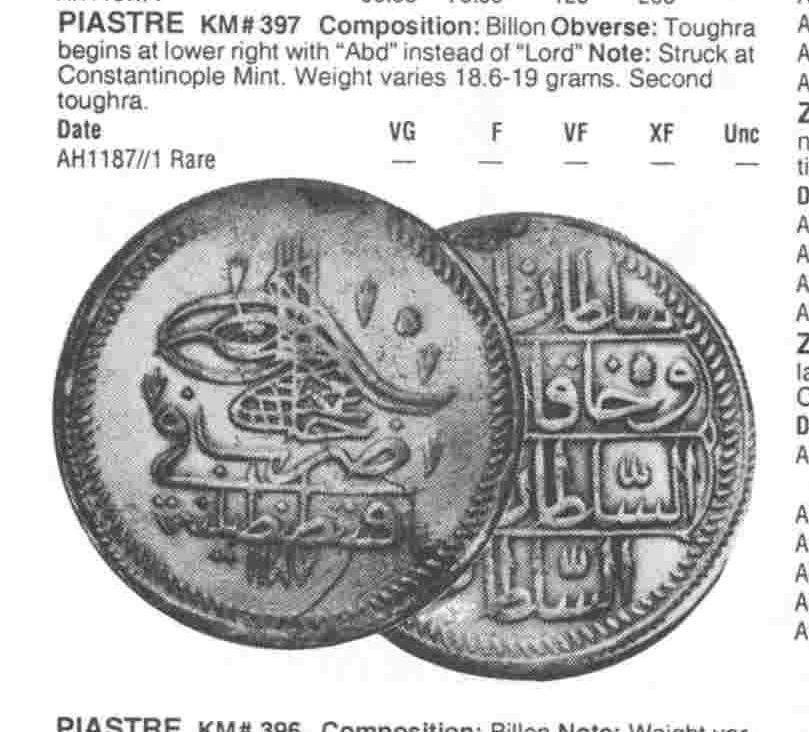 |
|
Pillar of the Community
United States
5362 Posts |
Yober Your coin is AH1187//2 which is NOT possible for the 397 it has to be the 396.
DCH You are right about the 2 in the date. I really can't say why I wrote that - guess I am getting senile.
|
|
New Member
Canada
15 Posts |
KM#386 doesn't look like my coin at all. 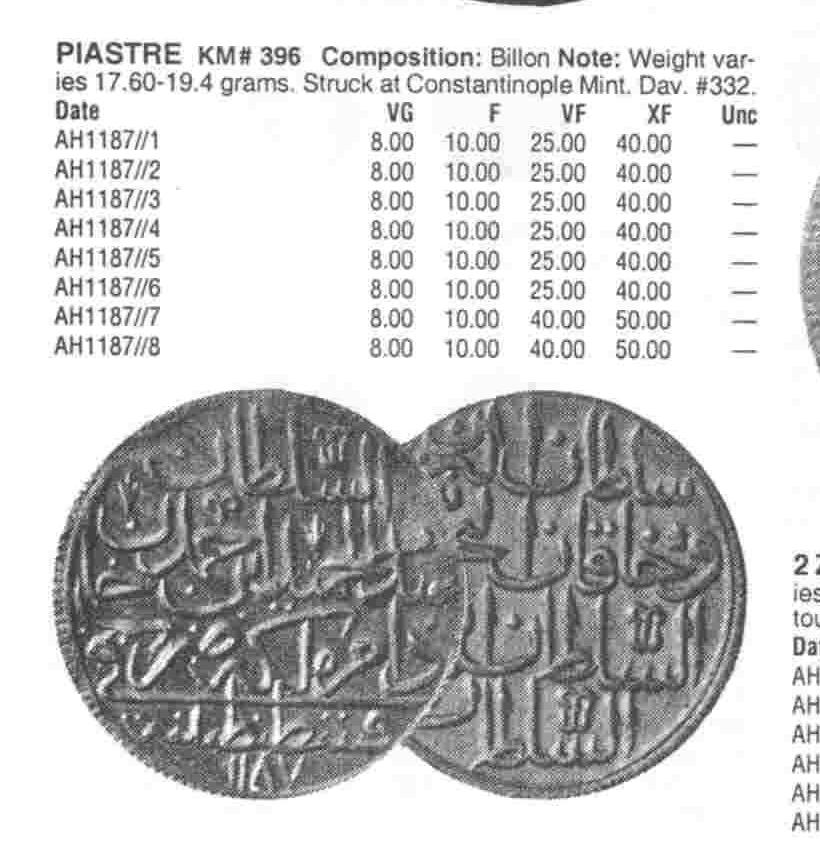 My coin is one of the rarest coins from Ottoman Empire which even KM catalog doesn't list yet. This coin was purchased recently on a private auction in Paris at a very high price. Hence I was surprised when you evaluated my coin at around $15  |
|
Pillar of the Community
United States
5362 Posts |
That picture you posted as a 396 is a totally different coin than the one illustrated in my Krause. My edition indicates that there are three varieties of the Piastre (1 Kurush or 40 Para) the 396, 397 (rare) and 398. All three feature a Toughra and all three designs that matche in most respects the picture of your # 397. In my edition of Krause all three varieties of the Piastre - 396, 397 and 398 use the same general design but the RARE coin the 397 comes in only ONE DATE 1187//1 and it has a variation (error) in the legend. The more common variety the 396 comes in numerous dates from 1187//1 to 1187//8 but uses the correct legend. The 398 has a flower branch added to the right of the Toughra and comes in dates from 1187//8 to 1187//16. The picture that you show as KM396 is the same coin that my edition of Krause calls a Zolota (30 Para) with a weight of 13.10 to 14.60 grams. It also comes in three varieties KM 391, 392 and 393. The weight shown with your picture of the 30 Para matches my edition exactly but is the weight of a Piastre (40 Para) not the weight of a Zolota (30 Para). The the Zolota (30 Para) is a lighter weight lower denomination coin. I am willing to bet that your edition has an error in the pictures. As far as I can ascertain, all of the Pisatres of Abdul Hamid I use a Toughra design. The rare one has to be dated regnal year 1 and your coin is clearly regnal year 2. It can not be the 397. I checked Google to see if I could find web sites to support my interpretation and there were many. Here is an ebay auction for a 1187//1 Piastre: http://cgi.ebay.com/ws/eBayISAPI.dl...130246317926Here is a site with two KM 396 coins listed under Abdul Hamad I http://www.rustypennies.com/catalog...h_coins.htmlHere is a website with three copies of the KM http://www.vcoins.com/world/copperp...dCategory=45 |
|
Pillar of the Community
United States
2669 Posts |
Swamperbob.. to enlighten those of us who have no clue what a toughra is and where to look for the date, would you mind pointing out where things are on the coin? Such as date, toughra, emperor's name, etc. (for example, "what looks like a line" on one of the sides of the given coin could be any of three different areas?) I'm really lost with these types of coins, so please bear with me. Any help appreciated!
|
| |
Replies: 35 / Views: 9,525 |










 Posted 08/13/2009 3:02 pm


