1857 was an amazing transition year for the American Cent. We saw the end of an era as the old, bulky Large Cent was replaced with a new, smaller "Flying Eagle" One Cent piece, (Note: Though there were about 750 circulation strikes of the Flying Eagle in 1856, the major transition year for the
Flying Eagle cent was 1857).
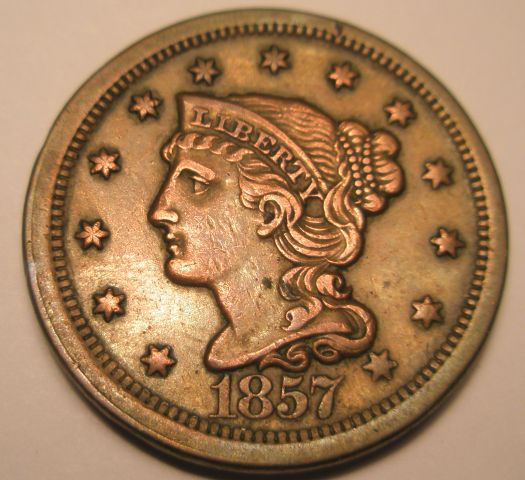
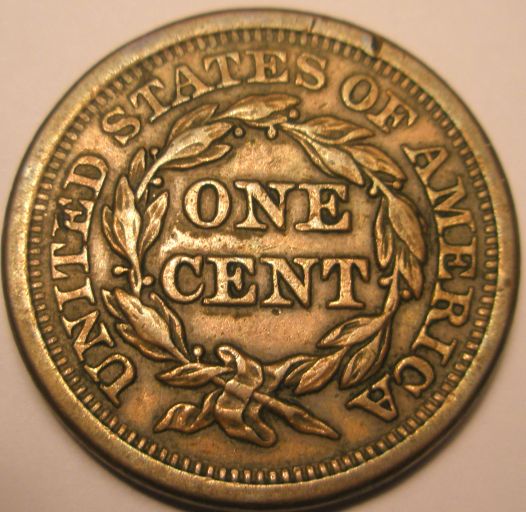
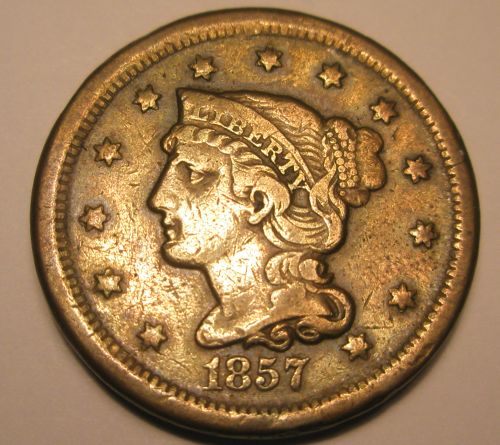
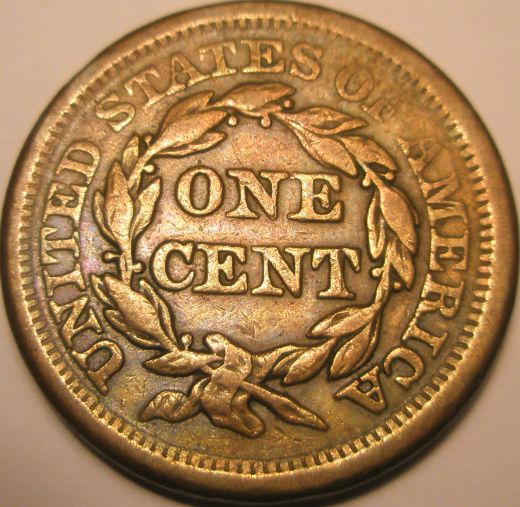
1857 Braided Hair Large Cent The Braided Hair variety of the Large Cent (1839-1857) achieved much greater uniformity than any of the earlier Large Cents varieties due to the introduction of steam power advances. The hubbing of the design into the dies and the use of "logotypes" (single four-digit punches) to impress the dates eliminated many of the varieties enjoyed by collectors of the previous types of Large Cents. 1857 Large Cent had two major variants (with 4 minor varieties), the Large Date and the Small Date. The mintage amount of the Large Cent in 1857 was the smallest amount of all the Large Cents and this year is considered to be the Key of this variety of the Large Cent.
The well renowned coin designer
Christian Gobrecht designed the Braided Hair variety of the Large Cent. The name of Gobrecht, the third person to occupy the post of chief engraver at the Philadelphia Mint, is well known to collectors today and is reflected in such popular terms as
Gobrecht dollar and The Gobrecht Journal, the latter being the publication of the Liberty Seated Collectors Club. Among pattern coins his contributions are at once important, beautiful, and extensive. Most familiar are his
Liberty Seated coins, first made in pattern form in 1836, and continued across the denominations of
Half Dime, dime, quarter dollar, half dollar, and silver dollar for years thereafter. Throughout the middle range of the last century, the Liberty Seated obverse as well as Gobrecht's perched eagle reverse were used as obverse and reverse dies for hundreds of different pattern varieties, often with the other die being the work of
James B. Longacre or one of the Barbers.
Separately, Gobrecht's flying eagle is an American numismatic icon. First used on the 1836 pattern dollar, it later appeared on many other patterns as well as regular issue 1857-1858 cents. Years later, on June 28, 1906, Augustus Saint-Gaudens, the famous sculptor who had been commissioned to redesign the entire American coinage spectrum, wrote to President Theodore Roosevelt, stating that for the reverse of the $20 coin he was going to use: "a flying eagle, a modification of the device which was used on the cent of 1857. I had not seen that coin for many years, and was so impressed by it that I thought if carried out with some modifications, nothing better could be done. It is by all odds the best design on any American coin."
Not only did Gobrecht's designs stand on their own, but they spawned many later versions by others, including Liberty Seated figures created by Longacre,
William Barber, and possibly even by J.A. Bailly.
Christian Gobrecht was born in Hanover, Pennsylvania, on December 23, 1785, the son of the Reverend John C. Gobrecht who had come to America in 1755 from Germany. Gobrecht's mother, Elizabeth Sands, traced her lineage to Plymouth colony as far back as 1642. He married Mary Hamilton Hewes on May 31, 1818. After serving an apprenticeship in Manheim, Pennsylvania, he became an engraver of ornamental clock works in Baltimore, later moving to Philadelphia in 1811, joining the banknote engraving firm of Murray, Draper, Fairman, and Company, circa 1816. In 1817, Gobrecht made improvements to his 1810 invention of a medal-ruling machine by which a three-dimensional medal or bas-relief object could be converted to a two-dimensional illustration for use in a publication using a linear process. In 1824, he prepared dies for the Franklin Institute medal of the same date, signed GOBRECHT F. below the bust of Franklin.
He furnished dies to the United States Mint as early as 1826 and in September 1835 was accepted as an assistant engraver to
William Kneass. Shortly before, on August 27, Kneass had a debilitating stroke, and all pattern and die work from that time onward was done by Gobrecht, including the creation of the 1836
Gobrecht dollars and, most probably, certain 1838 pattern half dollars (that have been called Kneass heads for many years). From December 21, 1840 until his death on July 23, 1844, he served as chief engraver. He is most famous for his silver dollar design of 1836, featuring the Liberty Seated obverse, which would soon become a staple in American numismatic history. This coinage design was based on sketches prepared by
Thomas Sully and Titian Peale. The obverse design remained on all silver coins for many years, including the half-dime (to 1873), dime (1891), quarter (1891), half dollar (1891), and silver dollar (1873). He also created the Liberty Head (or Coronet or Braided Hair) motif that was first used on the $10 gold coin of 1838, and soon thereafter on the
Half Cent, cent, and gold $2.50 and $5.
1857 LARGE CENT
Mintage:
Circulation strikes: 333,456
Proofs: estimated 200
Designer: Christian Gobrecht
Diameter: ±27 millimeters
Metal content:
Copper - 100%
Weight: ±168 grains (±10.89 grams)
Edge: Plain
Mintmark: None (Philadelphia)1857 Large Cent (Large Date)(From my collection)
 1857 Large Cent (Small Date)
(From my collection)
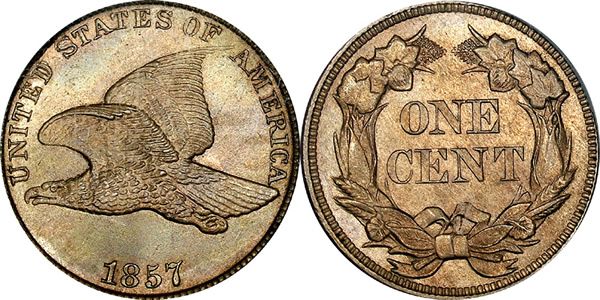
 1857 ONE CENT - FLYING EAGLE
This short spanned Cent (minted only in 1857 and 1858) was designed by
James Barton Longacre.
James Longacre was appointed chief engraver of the United States Mint on September 16, 1844, after the death of
Christian Gobrecht. He served in the post until his death on January 1, 1869. Although others assisted him from time to time (most notably, Anthony C. Paquet), most new pattern designs made during his tenure were from his hand. He leaned heavily on certain work of his predecessor, as in his use in 1854-1855 of the flying eagle design Gobrecht had used on 1838 half dollars and his use in 1856-1858 of the flying eagle design first employed on Gobrecht's 1836 silver dollar. Also, Gobrecht's Liberty Seated motif furnished an inspiration for certain Longacre seated figures.
However, much of Longacre's work was strictly his own, such as the Liberty Head used on the 1848 gold $1 and $20, the Indian Princess gold $1 and $3 of 1854, the lovely Indian Princess pattern silver coins of the late 1860s (also used by
William Barber after Longacre's death), the two-cent piece, the
Shield nickel and the vast array of pattern five-cent pieces of the 1860s, and, most famous of all, the
Indian Head cent. This is but a short list, and many other items could be added. In total, Longacre's dies were used on hundreds of different pattern coins and trial pieces.
Much of his work is of a high order of excellence, and he seems to have had an excellent sense of proportion. Walter Breen has condemned Longacre for ineptitude, including the creation of many blundered dies, but more likely workmen supervised by Chief Coiner Franklin Peale, not by Longacre, did these date-punching and other errors.
James B. Longacre was born in Delaware County, Pennsylvania on August 11, 1794. Young Longacre served as an apprentice to bookseller James F. Watson of Philadelphia for a short time, then continued his apprenticeship with George Murray, prolific banknote engraver of the same city who at one time also employed
Christian Gobrecht. Longacre set out on his own in 1819 and engraved metal plates for bank notes and book illustrations, including for a work on signers of the Declaration of Independence and another on stage personalities. S.F. Bradford's Encyclopedia, 1820, contains his work. In 1830, Longacre and James Herring laid plans for a series of biographies of famous men in the military, political, and other fields. This took form in the National Portrait Gallery of Distinguished Americans, of which the first of four volumes was published in 1834. This last work was published in multiple large print runs, was widely circulated, and brought great fame to Longacre and others whose work was included.
Through the influence of John C. Calhoun, Longacre was appointed as chief engraver at the Mint on September 16, 1844, to succeed the late
Christian Gobrecht. While Gobrecht had been a medalist and coin engraver of high repute, Longacre's experience in the medium of struck pieces was limited or nonexistent. However, he was a talented artist, seems to have learned quickly, and by 1849 created his first major new coinage design, the Liberty Head for the gold dollar and double eagle, this project being quite complex and bringing criticism to the engraver when problems were found with the high relief of the portrait. However, adjustments were made, and the design endured on the double eagle until well into the following century, to 1907.
At the Mint during his tenure, particularly in the late 1850s and through the 1860s, various local engravers assisted him, these including
William Barber and Anthony C. Paquet-both of whom became well known-and, less well known, P.F. Cross and William H. Key. The latter had an active business in Philadelphia and produced many store cards, tokens (including many connected with the Civil War series), and medals. Neither Cross nor Key are remembered or cited in the annals of pattern coinage, although no doubt they did some of the work on dies we associate with Longacre.
The chief engraver seems to have had little patience with certain of his associates and superiors in the Mint and thus became involved in several notable disputes. In particular, for a long time he was opposed by Chief Coiner Franklin Peale, who ran his own private business using Mint facilities and who was involved in many shenanigans, until he was fired by President Franklin Pearce in December 1854, after which point Longacre had an easier time.
In 1867, Longacre and Anthony C. Paquet (who worked as an assistant engraver at the Mint, but who was now back in the private sector, but doing contract work for the Mint) redesigned and/or modified certain coins for the government of Chile. None of these motifs bear any resemblance to contemporary American coinage, however. Longacre did other commission work from time to time, quite possibly including certain dies for private California coiners (Dubosq is a strong possibility; the principals of that firm left Philadelphia to seek their fortunes in the Land of Gold).
Longacre remained chief engraver until his death on January 1, 1869. On January 4, at the Mint at noon all the officers, clerks, and workers gathered to pay tribute to the late engraver. Dr. Henry R. Linderman delivered an address,
William Barber eulogized, and William E. Dubois presented resolutions. On January 21, 1870, Thomas & Sons, 139 and 141 South Street, Philadelphia auctioned coins from Longacre's estate. Included were patterns, Chilean coins, regular issues, etc. Longacre's books, art objects, etc., were scheduled to be sold at a later date.
Small Cent collecting is enjoyed by perhaps more coin collectors than any other field of coins other than
Morgan silver dollars. Most are easy to find and, with the exception of some key dates, values are generally modest. Small Cents begin with the
Flying Eagle cents of 1856 to 1858, a short but surprisingly challenging series.
Small Cents are a transition in several respects. Large Cents were still struck through 1857 and the metal composition of the
Flying Eagle cents is not the same as what was used on later issues. Even the thickness and weight of our smaller 1-Cent coin has changed since the first ones appeared. The Large Cent was increasingly unpopular by the 1840s and since the denomination was not legal tender (only silver and gold coins were legal tender in the United States), many merchants and banks refused to accept the coins. Others accepted the Large Cents at deep discounts. What was worse, by 1851, it was costing the Mint $1.06 to strike a Dollar's worth of 1-Cent coins. A negative seignorage was at hand (seignorage is the profit the Mint makes between the cost of manufacturing a coin and its face value)!
The diameter of the Large Cent was modeled after the British Penny denomination. As early as 1837, a New York dentist, Dr. Lewis Feuchtwanger, proposed a Small Cent of what he called "argentan" or "American silver" (actually German silver composition). Feuchtwanger Cents are collectible in their own right, but are generally not included in a collection of U.S. Small Cents. As the cost of producing Large Cents exceeded their value, experimental Cent patterns and various proposals for a practical metal composition for a Small Cent began to be explored. As Large Cent blanks became not only expensive, but almost unavailable, Mint Director James R. Snowden decided to strike a Small Cent of 88 percent copper and 12 percent nickel at a weight of 4.67 grams (Large Cents have a weight of 10.89 grams and are composed of pure copper beginning in 1795).
Snowden didn't choose this mix at random. He was being lobbied heavily by Joseph Wharton (and his monopoly of nickel mines) to use an alloy including this Nickel. The flying eagle design appearing on the reverse of the
Gobrecht silver dollars of 1836 to 1839 was adopted by Snowden for the new Small Cent. The wreath on the reverse of the new Small Cents was borrowed from the reverse design on the Gold Dollar and the $3 coin denominations designed by
James B. Longacre. It is interesting to note that initially, the Secretary of the Treasury (rather than Wharton) had the decision -making power regarding the coin design and that there was no Act passed by Congress in 1856 authorizing a Small Cent.
Snowden ordered about 1,000 1856
Flying Eagle cents struck without official authorization. Therefore, from a legal standpoint, all 1856
Flying Eagle cents may be considered to have been illegally struck and issued (as with the 1804 Silver Dollar and the 1913 Liberty Head Nickel). However, the Secret Service probably never will, but would have the legal right to, seize these coins.
It is difficult to determine how many 1856-dated
Flying Eagle cents were struck. At least 634 were given to politicians and other well connected people. During 1858 and 1859, more were restruck using the original dies. Not all restrikes can be differentiated from the original strikes. It is known that collector George W. Rice at one time owned 756 of the 1856
Flying Eagle cent. Considering that many of the Rice specimens came from circulation, there were undoubtedly more struck. Collector John Beck accumulated 531 coins of the same date.
The 1856
Flying Eagle cent is usually divided into three main varieties: 1) the original pieces struck for Mint and government purposes in 1856 and early 1857, 2) the first restrikes of 1858 sold to collectors, and 3) the questionable second restrikes of 1860.
Most collectors will be content with a single 1857 example, however there are several varieties of this date also to consider. These are the rare "Style of 1856" variety (with a squared O in OF and other diagnostics), and the so-called regular variety. Other minor varieties also exist. These can be identified through specialized coin catalogs on the subject. Proofs as well as Uncirculated business strikes exist.
The 1857 issue was struck following the Act of Feb. 21, 1857 authorizing Small Cents. Unlike the 1856 issue, that of 1857 is officially authorized. The 1857
Flying Eagle cents were very popular with the public and saved in large quantities. The coins were so popular, the Mint set up booths in the Mint yard to sell the coins to the public. The coin is available in many grades at reasonable prices. Clashed die specimens may be the result of night watchmen at the Mint illegally experimenting with coin dies (these same watchmen were responsible for some 1804 Silver Dollar restrikes).
There are two popular major varieties of the 1858
Flying Eagle cent often collected alongside the 1856 and 1857 coins to complete a set. In fact, there are other minor varieties, but these are for the specialist. The two major varieties, Large Letters and Small Letters, are reasonably easy to identify. The difference in the lettering in the AM of AMERICA is obvious. As in 1857, there are Proof and business strikes of the date to be collected. There is also an important 1858/7 overdate rarity only discovered in recent years. This overdate is believed to be a refurbished 1857 die with the 8 added later.
Like the Large Cent, the Small Cent was not legal tender, so it should have come as no surprise that it, too, would be rejected by bankers and merchants.
No one knows for certain why Snowden quickly changed from the Flying Eagle to the Indian Head design, but the difficulty of getting good strikes of the former may have been a factor. Collectors today will find a typical weakness on the eagle's tail feathers even on Mint State specimens and regardless of the date. Fully struck tail feathers are exceptions that often command significant premiums.
The metal composition was changed from nearly pure Copper to a Copper-Nickel mixture that gave added strength and a noticeably lighter color, earning the coins the nickname "White Cents." To ensure widespread distribution, the Mint produced over 17,000,000 of the new Small Cents, nearly six times the production of Large Cents in the previous year. The "new" design of the
Flying Eagle cent was actually an old one, borrowed from the reverse of
Christian Gobrecht's Silver Dollars of 1836-1839.
1857 ONE CENT - FLYING EAGLE
Mintage:
Circulation strikes: 17,450,000
Proofs: estimated 500 (see notes)
Designer: James Barton Longacre (using Christian Gobrecht's eagle design)
Diameter: ±19 millimeters
Metal content:
Copper - ±88%
Nickel - ±12%
Weight: ±72 grains (±4.7 grams)
Edge: Plain
Mintmark: None (all examples of this date and type were struck at Philadelphia)1857 Flying Eagle Cent(Staff Photo. Mine is kind of funky)






 Posted 09/16/2009 07:27 am





 and I did.


 I have thouroghly enjoied this project and have learned ouite a bit about a series that I really enjoy. More to come as I manicure this post before the deadline!


