| Author |
 Replies: 9 / Views: 4,782 Replies: 9 / Views: 4,782 |
|
|
New Member
United States
11 Posts |
I have a bunch of junk and I mean junk, coins that I hadn't looked at for awhile. I gave a closer look at this old coin that is just a little larger than our new gold colored dollars. The reverse is not in the best condition, but you can make out the date of 1787. Any opinions? Thanks for all the input, but I now know that this coin is a fake. DARN. 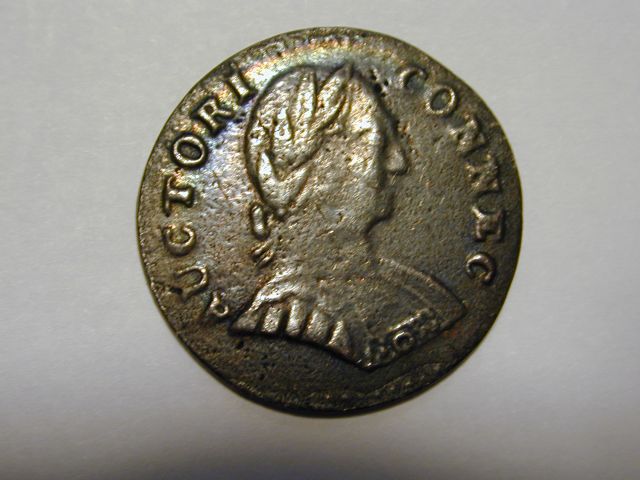 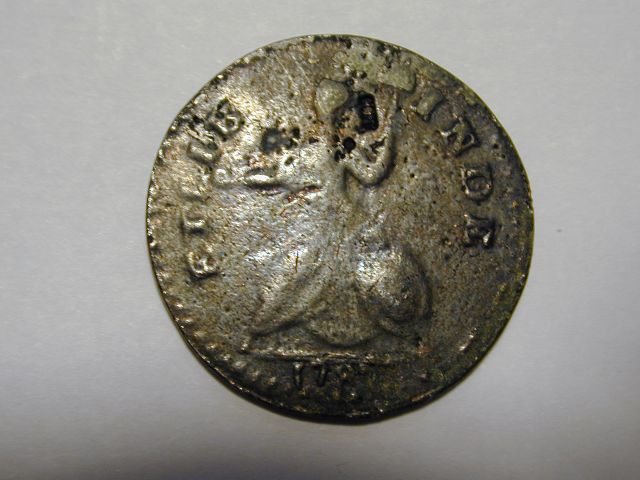 Edited by carlanddarla
01/09/2010 11:51 am
|
|
|
|
Bedrock of the Community
United States
10045 Posts |
Thumbing through my RedBook, this resembles the 1787 Connecticut copper specified as "small head, facing right ETLIB INDE" Value given is G $120, VG $200, F $400 I'm not good with these to tell real from copies--but I'm going to hope it's real.  Edited by DVCollector
01/08/2010 7:16 pm
|
|
Pillar of the Community
United States
8904 Posts |
I'm not familiar with this type of coin but the "pock-marking" looks to be genuine for the age and quality of metal used during the time. Good luck and I hope it's a good one!  |
|
Valued Member
United States
220 Posts |
Below please find an excerpt from the Department of Special Collections, University of Notre Dame Libraries at http://www.coins.nd.edu/ColCoin/Col...per87-1.html The website provides good information about the colonial tokens. (I am trying to learn more about the Washington Pieces here.) "1787 Miller 1. 2 - C mailed bust right "Mutton Head" - Bailey counterfeit CT copper Obverse: AUCTORI CONNEC Reverse: INDE . ET LIB 1787 Weight: 124.3 g (8.05 grams) Diameter: 29.4 mm Reverse die alignment: 200° Comments: Miller 1 is the only mailed bust right copper produced in 1787 (with the exception of the backdated Miller 52, of which only two specimens are known, see Breen item 787). The variety 1.2 can be distinguished because it has the largest head used during that year, known as the "Mutton Head" or "Bradford Head" variety (interestingly variety 1.1 has the smallest head). The initial A is very close to the shoulder while the final C is somewhat further away from the bust. This variety is a lightweight counterfeit that has been attributed to the mint of John Bailey in New York City. The thin but rather large size planchet was imperfectly annealed and is porous. This is a very nice example from an intermediate state of the die after regrinding. Apparently the regrinding was done to make the die shallower so the coins would appear to look worn from the time of minting. Notice in the legend that the right half of the first O, the left half of the second O, the final horizontal of each N as well as the entire final E have been ground off the die. The reverse is easily distinguished as type C in that it is the only bare breast variety in the Connecticut series. It also has a very large stop after INDE and a single exergue line with a small sized date below. Also Liberty leans forward and holds a short branch with three leaves. This example is a good strike that has not been worn from circulation. The porosity of the planchet and the weak strike on the front were intentional to give this counterfeit coin a worn appearance and thus make it easier to put into circulation. Gary Trudgen has recently analyzed Nova Eborac coins for punch linkage and has discovered the 1787 Miller 1.2-C used some of the same punches, namely, the same numeral punches (1, 7 and 8) as were used on all of the Nova Eborac series and the same "E" punch as used on the medium head, figure right (Crosby 1-A) Nova Eborac copper (listed as the third of three E punches found in the Eborac series). See the Nova Eborac section for further information and bibliography. Provenance: From the Robert H. Gore, Jr. Numismatic Collection. " |
|
Pillar of the Community
United States
505 Posts |
I found on e of those in a junk box yesterday and posted about it here...yours look a tad better than the one I found.. https://goccf.com/t/57873Whoa...how did the pics get so big! Edited by Frazzle
01/09/2010 03:28 am
|
|
Moderator
 United States
16709 Posts |
Your coin is a counterfeit. The diagnostics of the devices are not right for Mailed Bust Right MH. dollarcoins nailed it! BTW, Notre Dame has some fantastic information on Colonials.
swcoin.ecrater.com
|
|
Pillar of the Community
United States
731 Posts |
Am I missing something? I do see some pits in the specimen, but other than that: In my opinion it meets diagnostics pursuant to Breen 785, Miller 1.1-A; a Machin's Mills issue. Moreover, it meets diagnostics pursuant to Bowers, Miller 1.1 Small Head, incl. that the reverse is showing roughness in the center. Breen reports that this specimen should weigh 6.74 - 7.52 grams. Measure of the specimen's weight would confirm. References used: - Walter Breen's Complete Encyclopedia of U.S. and Colonial Coins, Walter Breen, (c)1988; pg.71, Breen-785
- Whitman Encyclopedia of Colonial and Early American Coins, Q. David Bowers, (c)2009; pg.111 Miller 1.1 - Small Head; pg.129 Miller A - ETLIB INDE; pg.141 W-2700.
And as far as what I gleen from DollarCoins' posting, I believe the text in his post is describing a Miller 1.2-C, not the one shown (Miller 1.1-A). So, to the folks who have averred that this specimen is counterfeit, please kindly advise as to what am I missing here? And yes, if it was indeed a legitimate Miller 1.1-A, it would be a post-Colonial, or a Pre-Federal. Thank you, CheetahCats Edited by CheetahCats
04/04/2010 06:15 am
|
|
Valued Member
United States
161 Posts |
In my opinion, it is a cast copy. It has a lot of bubbles in it; look to the right of Britannia's head on the rev; there is a large hole with a blob of metal in the bottom. To me, that is a high-probability marker of casting. All of the lettering has a 'ballooned' look to it as well, not something I would expect to see on a struck coin.
|
|
Valued Member
United States
312 Posts |
Don't forget that Conn. coppers were crudely struck on imperfect planchets.
|
|
Pillar of the Community
United States
731 Posts |
TDColl -> Indeed what you said, the pitting as I mentioned can be an indicator. Verification of weight, as well as closer examination of the rims, could possibly help. Quote:
AMFCook said: Don't forget that Conn. coppers were crudely struck on imperfect planchets. Yes, and that fact was made note of, for this particular issue, in the references I cited above. |
| |
Replies: 9 / Views: 4,782 |
|







 Posted 01/08/2010 7:24 pm


