| Author |
 Replies: 13 / Views: 9,539 Replies: 13 / Views: 9,539 |
|
|
New Member
United States
12 Posts |
|
|
|
|
Valued Member
United States
266 Posts |
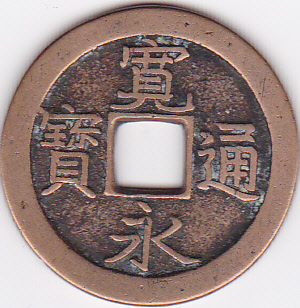
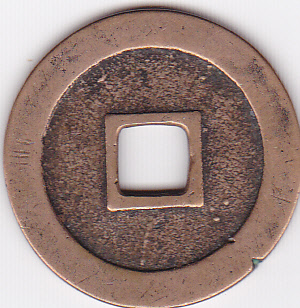
the first one is actually a Japanese 1 mon, minted from the 1760 to the late 1860s with no date.
|
|
Valued Member
United States
266 Posts |
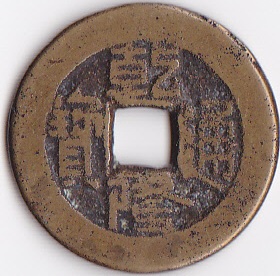
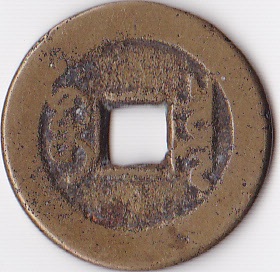
The second is Chinese, Emperor Chien lung 1736-1795 one cash
|
|
Pillar of the Community
United States
3499 Posts |
Gnelson87- Rdwarrior is quite right that the first one is Japanese, but I fear that it may be a reproduction. There is just something about it that just does not look quite right.
|
|
Pillar of the Community
Thailand
1509 Posts |
Hi Gnelson87
I'd certainly agree with Archaz and probably extend the opinion to the Chinese coin as well. I think they are produced in some quantities now but sold (in Asia anyway) as good luck charms or whatever. I have purchaced several sets out here as examples of various Chinese dynasty coins but they were sold as reproductions. They certainly make them to look old but I only bought them to use as comparisons with any single ones I might come across.
|
|
New Member
 United States
12 Posts |
Thanks for the replies. I would be willing to take your word that they are reproductions, not having any idea myself.
Thai-vic, are these mass reproductions in Asia a recent trend or have they been going on for a long while? The reason I ask is that these coins came out of my great-grandfather's collection (just an old Lucky Strike tin box filled with coins), which probably hasn't been touched in 50 years. It contained a number of coins (all in poor condition) from the early-mid 19th Century and one at least from the late 18th. So if they are reproductions they would likely have to be from the first third of the 20th Century.
|
|
Moderator
 Australia
16964 Posts |
The Chinese one is genuine, I think, and the Japanese one probably is, too. The Japanese one does look a bit odd, but it could be merely the way it scanned. It may also have been polished a long time ago, giving it an odd appearance.
For these two coins in particular, they're both very common types; in one sense, it doesn't really matter if they're genuine or not, since both genuine coins and fakes would sell for just a few cents each.
As for the possibility of old counterfeits, certainly. These coins were somewhat crudely made to begin with, being cast, not machine-struck. Counterfeiting them was easier than counterfeiting a "Western-style" coin. Additionally, ever since the end of the Empire, ethnic Chinese people living throughout Asia have wanted to use cash-style coins for ritual purposes; if there weren't enough to hand, they simply made some copies themselves.
Don't say "infinitely" when you mean "very"; otherwise, you'll have no word left when you want to talk about something really infinite. - C. S. Lewis
|
|
New Member
United States
12 Posts |
You're right that it doesn't matter much to me whether they are genuine or fake. I have no intention of selling them, just putting them back in the tin box.
I'm just happy to be able to identify them now, and that I will no longer mistake Japanese for Chinese. Thanks to all for the info.
|
|
Pillar of the Community
Thailand
1509 Posts |
Here are illustrations of two coins (one from each set) of Coins of Ten Emperors of Qing Dynasty that I have. I suspect they are reproductions because each coin in each set, one brassy and one coppery, are of the same colouring and quality. Anybody have any thoughts on this? 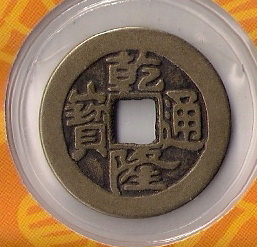 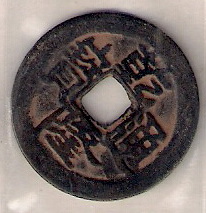 |
|
Moderator
Australia
16964 Posts |
I have to say, my instinctive reaction to the bottom one is "fake", simply because there are bucketfuls of fake cash coins around here with that exact same burnt-orange colouration. I think they literally toss them in a fire to make them look like that (some of the ones around here may even have actually been used as "funeral coins"). I see "tourist copy" fake ancient Greek coins from Turkey with the exact same colour. The first one suffers from the comparison, mainly because of it's almost-exact matching appearance down to the brush-strokes with the second one; if I saw it "by itself", I might not take a second glance at it. Quote:
I suspect they are reproductions because each coin in each set, one brassy and one coppery, are of the same colouring and quality. Yeah, that's pretty suspicious. The Qing Dynasty covered a long time (over 250 years) and the coinage naturally changed in size, style and fabric over that period. Older coins are generally larger, for example. They may have gone to lots of trouble to search through millions of coins looking for exact matches in size and colouration, but I doubt anyone would go to all that bother just to sell some cheap souvenirs to tourists. What's on the backs of them? Are they all the same on the reverse, too? Don't say "infinitely" when you mean "very"; otherwise, you'll have no word left when you want to talk about something really infinite. - C. S. Lewis
|
|
Pillar of the Community
Thailand
1509 Posts |
Here's the reverse of the two coins Sap. Each coin in each set has a different design but I've no idea if they match up with genuine examples. A bit of research on my part to do. 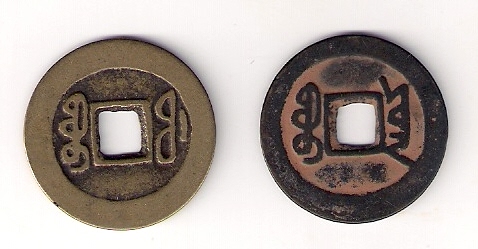 |
|
Valued Member
Canada
480 Posts |
The first two could well be genuine, while I would expect the last 2 to be fakes. They are not the regular "fakes" which were machine struck, anyways. The mints on the last 2 are Fukien(L)_and Yunnan(R). It is unusual to have the exact same obverse strokes on 2 different provincial coins, and the Yunnan ones tend to be more crude, so this one is almost too good.
|
|
New Member
United States
8 Posts |
Glad I found this post. The collection I got from my grandpa after he passed included one of the coins shown (the 2nd one) and I was just curious if anyone has an idea of its value? I figured it can't be much but I was pretty excited to see how old it is.
|
|
Moderator
Australia
16964 Posts |
As I said in my first post, Qian Long cash coins are extremely common - they're probably among the most common coin types in history. Book value for most mintmarks is just a few cents, but around here you can find genuine examples and fakes tossed together into a coin dealer's "Chinese Cash coins - $2 each" tray.
Don't say "infinitely" when you mean "very"; otherwise, you'll have no word left when you want to talk about something really infinite. - C. S. Lewis
|
| |
Replies: 13 / Views: 9,539 |
|









 Posted 01/14/2010 6:36 pm





