| Author |
 Replies: 16 / Views: 3,902 Replies: 16 / Views: 3,902 |
|
Pillar of the Community
United States
1450 Posts |
|
|
|
|
Pillar of the Community
United States
677 Posts |
Wow! Very nice! Thanks for sharing your find, hockingzig!
|
|
Moderator
 United States
195203 Posts |
That is a good link. I have added it to my numismatic bookmarks.  |
|
Pillar of the Community
United States
628 Posts |
|
|
New Member
Paraguay
19 Posts |
Thanks for the link! I remember having seen it some years ago but couldn't find it again. Now I'll bookmark it ;)
|
|
Bedrock of the Community
United States
20753 Posts |
Interesting for sure. I've seen this around for a long time now and keep forgetting to make a link or just copy the thing.
|
|
Pillar of the Community
Philippines
1156 Posts |
VERY interesting subject matter on that link! thanks hockingzig! there are about 60 metals there, looks like a great way to start a new collecting thread!   and my new coin album, still empty, can accomodate 80 flips, just right! |
|
Pillar of the Community
United States
1882 Posts |
Quote:
Nickel
Usually used in an alloy with copper (see cupro-nickel) or iron (see stainless steel), although the pure metal has been (and is) used a great deal, notably for the coins of Switzerland and Canada. It was first used in this form by Switzerland in 1881. The pure metal is magnetic, and is noticeably yellower than some of the silvery metals such as chromium and aluminium. just carl, do you disagree with this statement from the website? I'm not asking to prod or poke you, because I do know you are from a scientific background. I know nothing about the subject, and find it interesting that there could be disagreement on the subject of whether an element is (in its natural state) magnetic or not. |
|
Pillar of the Community
United States
677 Posts |
Yes, I'm intersted too. I thought nickel was the reason (most) stainless steels aren't magnetic?
|
|
Moderator
United States
195203 Posts |
I want to say it is because the iron and the nickel will "cancel each other out" but I am sure there is a more accurate way to describe it. Time for some research.  Edit: I found several mentions that the combination affects the way electrons are able to align, therefore affecting the effect of magnetic fields. |
|
Pillar of the Community
Philippines
1156 Posts |
That got my curiosity, like a cat, if nickel's magnetic or not. here's the pics, test made now during breakfast (I just couldn't wait  ) the coin is the Philippine 10Peso 100% Pure Nickel 1988 36mm commemorative coin. Magnet is a strong Torroidal type used on Audio speakers (this one pulled from a base woofer). Yes! Nickel's highly magnetic  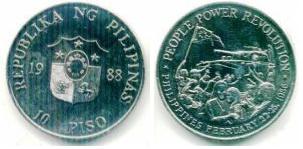 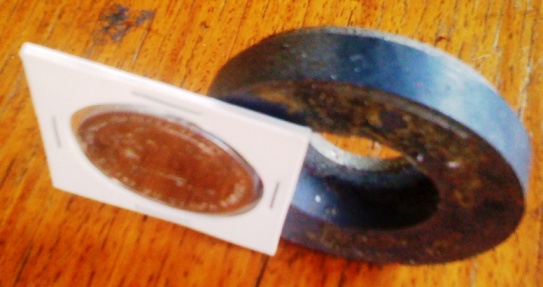 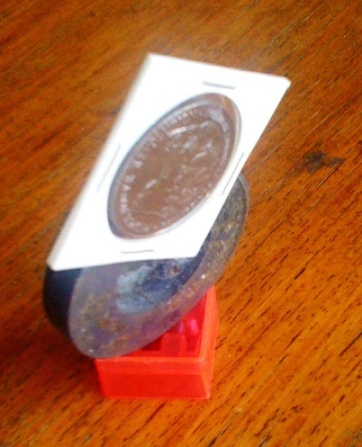 |
|
Pillar of the Community
Australia
3841 Posts |
Here are my some fanciful metal-related coins: Japan 1945 1 sen (clay) 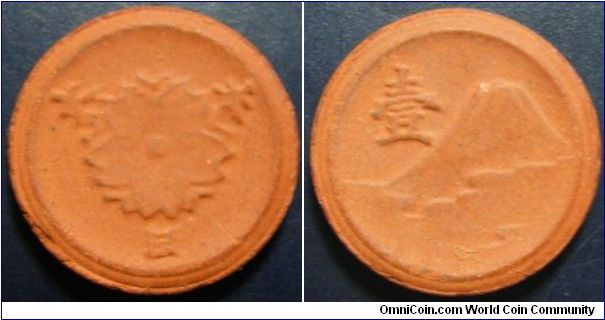 Kazakhstan 2006 silver-tantalum 100 tenge 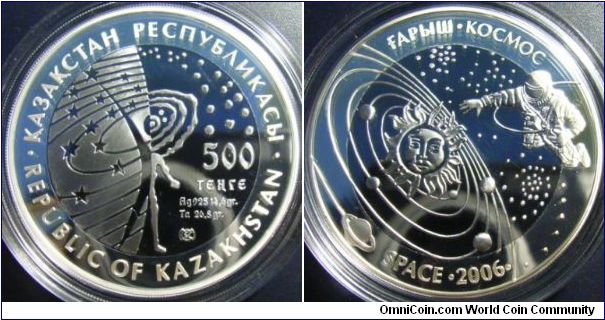 Russia 1978 platinum 150 ruble 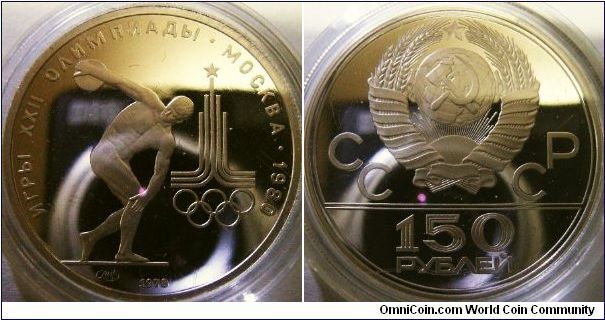 Russia 1991 palladium 25 ruble 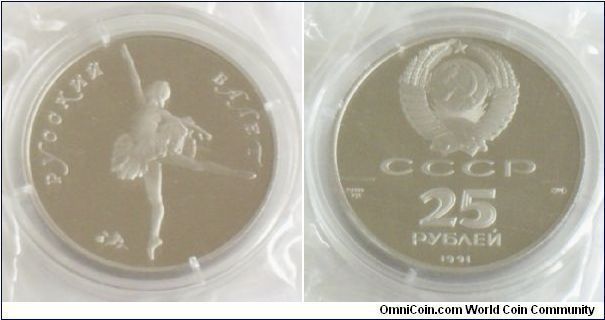 |
|
Pillar of the Community
United States
1882 Posts |
Nic, thanks for showing that, pretty cool. Quote:
Yes! Nickel's highly magnetic The question isn't whether nickel *can* be magnetic. It is whether nickel is naturally magnetic. This topic started in another thread, but I don't know where it is... |
|
Pillar of the Community
Australia
3841 Posts |
Pure nickel is magnetic. Alloyed nickel however is not.
|
|
Moderator
United States
195203 Posts |
Quote:
This topic started in another thread, but I don't know where it is... It started right here. |
|
Pillar of the Community
United States
1882 Posts |
Quote:
Alloyed nickel however is not. As just carl was saying in the other thread, one of the strongest magnets is a nickel alloy: AlNiCo |
| |
Replies: 16 / Views: 3,902 |






 Posted 02/17/2010 11:38 am





