| Author |
 Replies: 29 / Views: 3,112 Replies: 29 / Views: 3,112 |
|
|
|
Pillar of the Community
 United States
1551 Posts |
The ones I posted are not and are now very destroyed. I was just seeing if they could be created. It took me 15 minutes to make a punch, had I taken any real time I think I could make solid home made ones and was just letting everyone know BUYER BEWARE.
|
|
Bedrock of the Community
United States
10045 Posts |
Nothing ventured--nothing gained.  |
|
Valued Member
United States
335 Posts |
Am I missing something? I see no similarity at all between the coins twohawks made and the ones from the original post.
|
|
Pillar of the Community
United States
1551 Posts |
My point was not if they are real. And had said that I did not know if they where. My point was that in 15 minutes I had made a punch that did not hit the relief of the coin, and had I truly been trying to make one that was a dead match it could be done. I most likely could of done it in under 2 hours, using the right tools.
|
|
Moderator
 Australia
17006 Posts |
The key difference between the bogus "errors" made by twohawks' method and a genuine broadstrike would be the relative thickness of the two areas of the coin. On a genuine broadstrike, the central struck area is much thinner than on a normal coin, and usually thinner than the "broad rim" because the material normally contained within the collar die has squirted out the sides. On twohawk's "press job", the extra rim width has been produced by flattening and thinning the material of the rim, while the central portion is still at full coin thickness. Perhaps this picture will demonstrate: 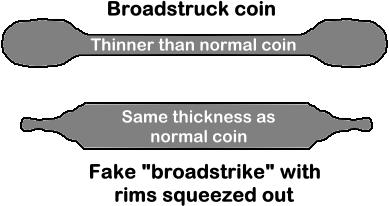 Further, the press jobs will always (presumably) be exactly centred; a broadstrike often is off-centre and oddly shaped, because there's no collar holding it in place. Finally, there will be no trace whatsoever of the reeded edge on a broadstruck dime; I can clearly see some reeding on some of twohawk's dimes. My broadstruck Virginia quarter shows all these features: 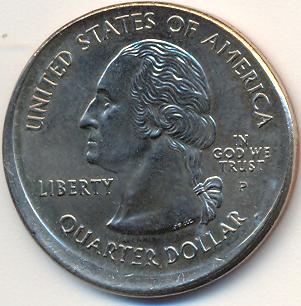 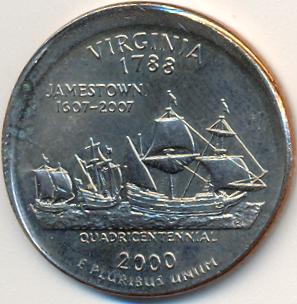 These pointers may not help you purchasing such an error off ebay (I can't really tell what the rims are like from the pics those seller has), but should help you tell bogus from fair dinkum once you get it in hand. Don't say "infinitely" when you mean "very"; otherwise, you'll have no word left when you want to talk about something really infinite. - C. S. Lewis
|
|
Bedrock of the Community
United States
10045 Posts |
that's a useful diagram there Broadstrikes remind me of hammered coins, where the coin metal continues to spread after the initial strike. This results in some distortion of devices along the periphery of the strike--or am I just making that up?  |
|
Moderator
Australia
17006 Posts |
Broadstrikes are indeed very similar, except that ancient and mediaeval coin dies usually took the lack of a collar into account, and had extra width built into them to compensate for a slightly off-centre strike. Modern machine dies don't need this.
Don't say "infinitely" when you mean "very"; otherwise, you'll have no word left when you want to talk about something really infinite. - C. S. Lewis
|
|
Pillar of the Community
United States
1551 Posts |
Thanks I did no understand this. So the die's meet at a closer point or compress the planchet future do to the lack of a collar?
|
|
Moderator
Australia
17006 Posts |
The dies in a modern coin press don't have a set distance apart where they stop at; indeed, if there's no blank coin at all in between them when they strike together, they'll actually smash into each other, creating the "clashed dies" error on subsequent coins that are struck by them.
Rather, the change in thickness is all about high applied pressure over a short space of time. A broadstruck coin puts up less resistance to the dies coming together, because the metal that should have been there stopping the dies coming together has squeezed out the sides rather than being compressed. So the dies travel further through the metal (and come closer together) than they would for a normal, collar-restrained coin. Theoretically, if the high pressure kept being applied, a broadstruck coin would eventually become paper thin in places as the dies smash into each other, with almost all the metal between the two dies squeezed out - but a modern high-speed coin press applies full pressure only for a brief instant before they pull up again ready to strike the next coin.
Don't say "infinitely" when you mean "very"; otherwise, you'll have no word left when you want to talk about something really infinite. - C. S. Lewis
|
|
Pillar of the Community
United States
2752 Posts |
Sap, your analysis is not correct. In a properly functioning press, the dies do not contact each other in the absence of a planchet. They are designed to approach each other closely without actually touching. This prevents a clash from occurring in the event of a complete planchet misfeed. Clashes occur when the dies fall out of adjustment so that the minimum die clearance is reduced to zero (or less than zero) Think about it. If the dies smacked together with a force of tens of tons per square inch, they'd be destroyed every time. At the very least, the clash marks would be monumentally strong.
The size of a broadstrike has little to do with differences in ram pressure. It's mostly due to differences in minimum die clearance. When the clearance margin is small, the broadstrike is large. When the clearance margin is close to planchet thickness, then the broadstrike is small.
Error coin writer and researcher.
|
|
Rest in Peace
United States
1943 Posts |
I often wondered how die clashes occurred when the dies are set at a defined stroke so they don't hit each other. At first I thought it was just an occurance of the setup process. But considering how common slight die clashes are it sounds to me like the presses can fall out of adjustment rather easily.
|
|
Pillar of the Community
United States
3507 Posts |
They are indeed real broadstrikes.
Thanks,
Bill
|
|
Bedrock of the Community
United States
10045 Posts |
This was a very good read--I appreciate the expertise.  |
|
Bedrock of the Community
United States
17884 Posts |
How to get a broadstrike with a reeded edge.
It is actually a double strike. The coin is struck once normally. The anvil dies rises pushing the coin out of the collar but then either does not retract or the collar gets stuck and retracts with the anvil die. No planchet is fed in so the struck coin remains on the anvil die and is struck a second time, this time out of collar. A centered double strike once in collar and once out of collar. Result a "broadstrike" with a reeded edge.
|
| |
Replies: 29 / Views: 3,112 |






 First Page


 Posted 02/19/2010 1:30 pm





