| Author |
 Replies: 20 / Views: 4,939 Replies: 20 / Views: 4,939 |
|
Pillar of the Community
United States
2669 Posts |
Hi All, I'm in the middle of a web project (running late, as usual, too) and would like to pick y'all's collective brains before I set the search interface in stone.. basically, when you are searching on the internet to try to identify a coin or token you have, how do you search? What comes most natural or is easiest? Many coins' legends have dots, dashes, spaces, fleur-de-lis, etc between the letters... how many of you search with those included (ok, the fleur-de-lis would probably be a bit difficult to input  )? Do you run the lettering all together, put a space between them all or put a colon or dot where it appears within the letters? Do you try to search on the animal/thing/symbol/person on the coin as well? How about the size or metal composition? Do you search on all the text you see or just some, and do you ever try to search a phonetic or visual representation of a foreign alphabet (like Greek &alpha could be represented by a, &beta by B, &gamma by Y, etc)? Methods as well as tips/tricks would all be deeply appreciated. I'm trying to make it as easy to find stuff as possible.. but I know if I base it on just my own search habits then nobody will be able to find a thing  thanks for any help! |
|
|
|
Pillar of the Community
United States
1523 Posts |
I google the date,origin and denomination all in one line. Seems to work well enough.
|
|
Valued Member
United States
347 Posts |
foremost, keep it simple! The key words to stick to are - Date, - Mint mark, and a short on or two words that will direct you to many less unwanted options for you and the computer.
Then, if you don't quite get the options you wanted, you can add, delete, or change the order of your search words. You will save alot of unnecessarily wasted time. Remember - keep it short and to the point. Happy hunting!
|
|
Moderator
 United States
6563 Posts |
Simple....Google Images |
|
Moderator
 Australia
16957 Posts |
I only use a Google search when all else fails, or if I have no idea where to start looking. If you're aiming to construct a search engine or searchable database to allow novice collectors to find coins, you should make it as flexible as possible. With the alphabet, for example, it should be able to help both those that can read the alphabet (and will therefore transpose the letters into English) and those who can't read the foreign squiggles and therefore convert them into the closest possible English letter based on shape. For scripts that are completely alien to Westerners like Arabic or Chinese, the pattern-matching thing isn't going to work well; you'll need to fall back on descriptions like "four letters square hole" for Chinese cash coins, or "round squiggly thing" for Ottoman coins. Be flexible in the descriptive thing, too. Both "fleur-de-lis" and "flower" should work; not everyone knows what a fleur-de-lys is. One thing that might be helpful is wildcards, if a character is unclear or not easily translatable. "BBALAPNR" and "CTOTNHKN" should work for this Bulgaria 10 stotinki coin, based on "closest English letter" transposition pinciple, but it would be helpful if "?AP?" and "CTOT?HK?" also worked as well. Partial inscriptions are also helpful. One of the most useful sites I use regularly for ancient coins (and my usual first stop when encountering an unknown ancient) is the Wildwinds partial inscription search. Don't say "infinitely" when you mean "very"; otherwise, you'll have no word left when you want to talk about something really infinite. - C. S. Lewis
|
|
Pillar of the Community
 United States
2669 Posts |
Good points... Date is a biggie... mint mark and denomination, definitely, if you can tell what those items are. ..and thanks for the wildcard reminder, Sap.. I didn't have that down for some reason. I love wildwind's partial inscription search. Sometimes instead of wild cards, I search just on what I see, placing a space between. I guess spacing is my wildcard, since most places I search don't have such a great search engine as wildwinds. Flexible naming is a good point, too. The languages are indeed going to be a dilemma. What I was thinking of doing is having expandable areas (example font then a click here > to expand if that's what it looks like on the coin) containing picture buttons that would place the character in a search field. That might be alright as long as it looks simple. The Google Images thing is interesting.. I had not thought about how that keys off the image name. Filenames would probably be extremely long if I tried stuffing all the search params into the image file name.. I could auto-name them based on a subset of already entered info at the time of upload. That would get results over there and make it easy for contributors, too. Ok... so far we have search by date, mm, origin, short description, keep it simple, search-able image filenames, flexible object descriptions, wildcards. How would you try to find out more about these: 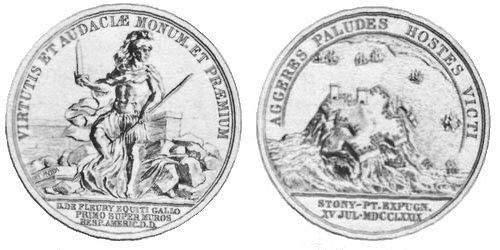 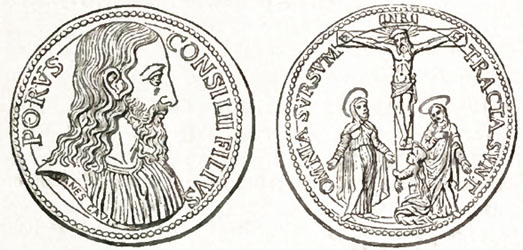 thanks guys, this is a big help so far |
|
Moderator
Australia
16957 Posts |
Top one: not much to do there except type in the entire Latin phrases into Google. The AE ligature I would put in as AE, and leave out the full stops. I'd try it with quotes (exact phrase matching - which didn't work too well) and without quotes (which did work - it's an American revolutionary medal). But failing that, I would try to find specific names, dates, etc and enter them into Wikipedia. In this case, "Stony Pt" shows up several locales by that name, and "1779" indicates to me it's likely to be a reference to the American Revolutionary war; sure enough, there's a Battle of Stony Point listed there on Wikipedia that occurred on that date. I'd then check Wikipedia to find out which side won that battle (The Americans won it; if the Brits had won it, this would probably be a British medal).
Bottom one: Try the Latin phrases again. If a literal transcription doesn't help, try substituting the "V"s with "U"s. In this case, the literal words do help - a CoinArchives hit. The source auction listing is in Italian, so ram the text through Google Translate to find out the story behind this piece: an Italian religious medal.
CoinArchives used to be for me a major source of info on medals, mediaeval coins, etc.. But now that they charge a humongous fee to access their old database, I rarely use it anymore, and no longer expect it to be helpful like I once did.
Don't say "infinitely" when you mean "very"; otherwise, you'll have no word left when you want to talk about something really infinite. - C. S. Lewis
|
|
Pillar of the Community
United States
588 Posts |
So what is that bottom coin, its very interesting.
|
|
Pillar of the Community
United States
1523 Posts |
Google coin with porus and jesus on a cross for bottom coin and virtutis premium for the first.
|
|
Pillar of the Community
United States
2669 Posts |
:::adds "ram the text through Google Translate" to growing list::: Coin Archives used to be a treasure trove of information.. I'm not sure what their reasoning was behind such HUGE fees but they cut most people out when they did that. Podoprigora, info and picture for the 2nd coin is from this document : http://www.archive.org/details/meda...ni00lawriala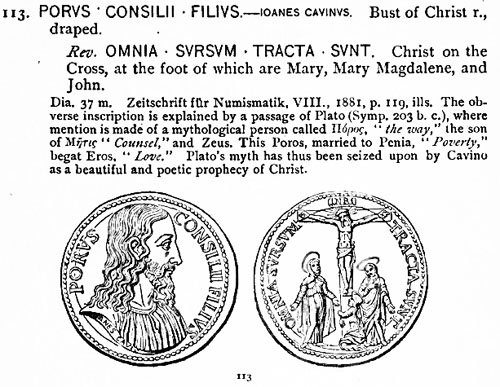 |
|
Pillar of the Community
United States
2669 Posts |
The main point of this site is to tell you what things like PORVS CONSILII FILIVS might stand for or mean. But first you gotta be able to find the coin itself when searching.
Have you ever thought "I wish this search engine could ________" or "I should be able to search by _______"? What would it be?
|
|
Pillar of the Community
Australia
3838 Posts |
Just post it in a coin forum like here and chances are someone here knows the answer |
|
Moderator
Australia
16957 Posts |
Quote:
Coin Archives used to be a treasure trove of information.. I'm not sure what their reasoning was behind such HUGE fees but they cut most people out when they did that. As I understand it, "cutting most people out" was the reason. Some of the contributors of the information on the site - specifically, some of the photographers that work for the auction houses - were kicking up a stink that having their pics copied onto a free general-access website wasn't part of the deal they signed with the auction house. The money raised (assuming there actually are people that pay those exorbitant fees) goes mostly toward copyright fees to keep those contributors happy. Quote:
The main point of this site is to tell you what things like PORVS CONSILII FILIVS might stand for or mean. Latin seems to be one of the trickiest languages for an automatic translator to handle - I've never found one that worked well, despite there being the demand for it. It doesn;t help that most Latin inscriptions on coins are abbreviated. All the easily findable sites are those with real-world Latin-speaking human translators behind them - "submit the text, and we'll look at it and translate it for you". You'd probably need a huge database of inscriptions and meanings, kind of like what you find at the back of the 1600's and 1700's Krauses. Don't say "infinitely" when you mean "very"; otherwise, you'll have no word left when you want to talk about something really infinite. - C. S. Lewis
|
|
Pillar of the Community
United States
2669 Posts |
Quote:
The money raised (assuming there actually are people that pay those exorbitant fees) goes mostly toward copyright fees to keep those contributors happy. Wow.. you would think at least a few would think of it as free advertising. Quote:
Latin seems to be one of the trickiest languages for an automatic translator to handle - I've never found one that worked well, despite there being the demand for it. It doesn;t help that most Latin inscriptions on coins are abbreviated. And that's the main trouble - the abbreviations. Especially in different eras or countries, the same one can be different things, or the one thing will be abbreviated different ways. Some medals just plain created their own abbreviations depending on available space.. etc. Quote:
You'd probably need a huge database of inscriptions and meanings, kind of like what you find at the back of the 1600's and 1700's Krauses. That's pretty much what I'm working on.. covering not only coins, but medals, tokens, jettons, and anything else you can find remotely related. I'm not the only one that's going to be filling it, though (hopefully!) - I'm just building the foundation and starting off the main dataset. So hopefully at some point, someone will be looking for what D G REX BRIT stands for and means, and be able to find D[ei] G[ratia] (By the grace of God) REX (King) BRIT (of Britain), what coin(s) the abbreviation(s) are on, and so on. I've pretty much come to the conclusion that this will be a lifelong endeavor, as it will never be complete, but that's ok, too  |
|
Pillar of the Community
United States
2669 Posts |
|
|
Pillar of the Community
United Kingdom
2838 Posts |
That sounds like a huge project if you intend to use / update your own data tables with all the info for known coins / medals etc!
Could you not just write a very clever search engine designed specifically to search for coins etc in know catalogues and on larger websites for specific refs to what is input?
I've just read the above a few times and even though I wrote it its not too clear! - will try to explain.
Its usually possible to find a ref to any coin / medal on the net using a good search engine - however this is sometimes very time consuming as you have to keep trying slightly different info until you give up or get the result you want.
Could you write a search program with multiple inputs eg
Obverse Legend:
Obverse Picture:
Reverse Legend:
Reverse Picture:
Date:
Material:
The program then searches all inputs and slight variations of inputs and returns hits ordered by the most matching inputs?
|
| |
Replies: 20 / Views: 4,939 |










 Posted 02/19/2010 11:38 pm


