| Author |
 Replies: 29 / Views: 5,449 Replies: 29 / Views: 5,449 |
|
|
|
Pillar of the Community
United States
4433 Posts |
Hi delaner. Prior to collecting c/s's, I was and remain interested in Civil War tokens. The Civil War Token Society has a website and has published journals and books for many years now. What with the sesquicentennial fast appoaching, I expect that interest in that period's exonumia will heat up. Personally, I don't much relish the modern exonumia like tax an bus tokens, but there are certainly folks out there who do. The religious medals can be most artistic in design and execution. The ANA has a lending library, and one can certainly garner much info from articles written in the Numismatist for over a hundred years now. I'd suggest that you attend some of the larger coin shows and seek out the exonumia dealers who are among the most gregarious of collectors, themselves. They often will take the time to share knowledge and point someone in the right direction. They'll tell you where you can subscribe to exonumia pricelists and are likely to know of some organizations in the area you may want to explore. Also, there are some book dealers who set up shop at the big shows - used, out-of-print - from whom you may purchase books and monographs on particular areas of exonumia. The Atwood book on transportation tokens comes to mind, but there's no history therein to speak of. It's a well organized listing and general price guide that assigns catalogue numbers to all known transportation tokens. There is a booklet about tax tokens, but the name and author elude me. There's a new book out on school lunch tokens, books on Hard Times tokens ... the list goes on. There's ever so much that has yet to be written, and exonumia offers a vast frontier for study. |
|
Pillar of the Community
United States
4433 Posts |
Hi biokemist6. Appreciate the welcoming acknowledgement. It's funny how two or more folks can look at something and notice different things. When I first looked at my unicorn, I never noticed the cigar within the design.
Back in NY, I was on a coin club grading committee. Each month, we'd pass members' auction consignments around the table. Committee members would spot different characteristics about the same coin. That process generated many an interesting discussion. At the end of the night, many of us would be shaking our heads over some such coin, thinking, "How'd I miss that?"
|
|
Pillar of the Community
 United States
3284 Posts |
Again Exoguy, Thank you so much for the insightful remarks. I did think this coin was junk
when I purchased it and was embarrassed for having done so. Now it is my most interesting
piece and I look forward to expanding my knowledge on the subject.
|
|
Pillar of the Community
United States
4433 Posts |
I recently spotted one of these <b>UNICORN</b> counterstamps getting bids on ebay and was reminded of this early thread on the subject. Here's a link to the current listing .... https://www.ebay.com/itm/266635039019 Going on fourteen years now, since my last post in this thread, I've since done some in-depth research on this issue and since penned an article for <i>Talkin' Tokens</i>, journal of the National Token Collectors' Association, NTCA. In a nutshell, my theory is that this issue emanated from the Unicorn Tavern which was a landmark establishment outside Philadelphia. It was located on what was then known as the Conestoga Turnpike; hence, the <b>CT</b> c/s that appears below the <b>UNICORN</b> pictorial. I've developed what I believe to be compelling circumstantial evidence for this admittedly tentative attribution. For starters, a large number of early counterstamps, circa 1830 to 1850's, had their roots in the Philadelphia. I can cite numerous merchant c/s examples to show this. It's easily understandable that this first "mint city" would be a central location for counterstamping coins in those early days. The Unicorn Tavern was established in 1747 and continued in business until February 14, 1872 when it was consumed in a fire. Tavern names were often associated with animals (e.g. - lion, ram, boar, etc.) and their artful signs often displayed images of same. Coincidentally, there were early mile markers along the Conestoga Turnpike that displayed images. But one of these was known to have survived, bearing the image of another legendary animal, a griffin. The mile marker near the Unicorn Tavern was destroyed, circa 1800. The unicorn stamp is quite similar to tavern-like signage of the era which sported designs of animal heads, and a nearby, replica milestone displays that artfully etched mythical griffin. The roadway along which the Unicorn Tavern resided was commonly known as the Conestoga Turnpike. This would explain the CT stamping, directly below the unicorn image, literally indicating the name and location. There was a "Little Conestoga Turnpike Company as early as 1812. Record of an 1821 Governor's voucher for $127.67 was payable to this company which was referenced as the "CT'k" (Conestoga Turnpike) company. Later, in 1853, a "Unicorn Turnpike Co." was formed; this, suggestive of the historical significance of the tavern. Thus, we see a continuous mingling of the terms Conestoga, turnpike and unicorn for over five decades. The unicorn turnpike marker has long been missing, but one was reported to have existed. Whether it displayed an image of a unicorn is unknown, but it's a logical assumption, given the known marker that bears the griffin image. The below pictured sketch of the Unicorn Tavern was drawn by Dr. Isaac Johnson. He was a resident therein, circa 1850 to 1870. Note the corner sign; perhaps, also a mile marker. Might a unicorn have then been displayed upon it? My guess is that the original wooden sign was likely destroyed many years prior. 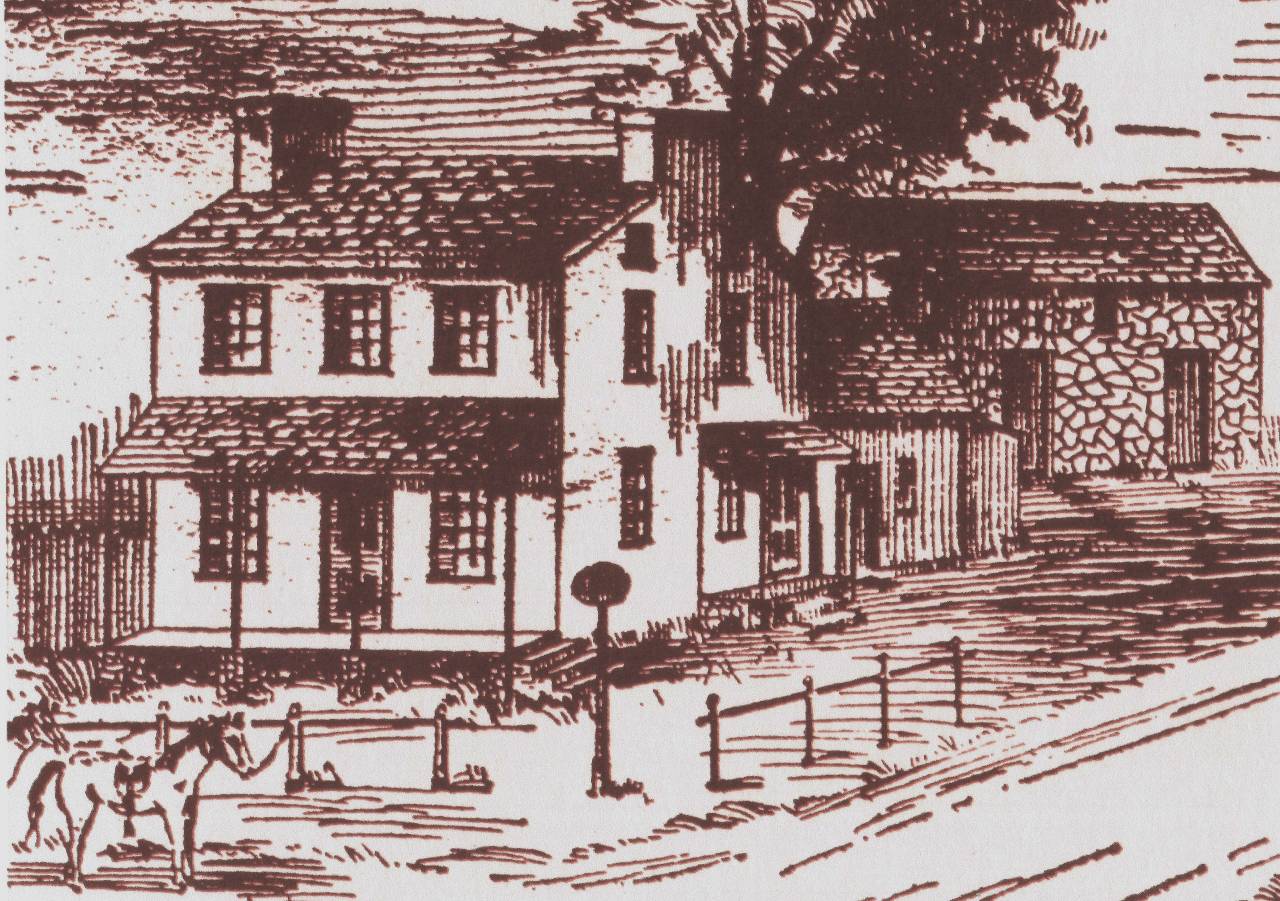 The Unicorn experienced a succession of owners and name changes over the years, but it was frequently rechristened as the Unicorn. This Irish tavern served as a landmark establishment near mile marker fourteen. Frequented by Tories or Loyalists, the Unicorn stood near to the Spread Eagle Tavern which was contrastingly a venue for patriots. Local historians noted that fist fights often broke out between these sparring factions. Local history has it that English troops made the Unicorn their headquarters, whereas Washington's troops had boarded at the nearby Spread Eagle Tavern when enroute from Valley Forge to Philadelphia.. The Lancaster highway followed the wilderness path of early Indian trails. In the middle 1790's, it became the first stone turnpike in the country, extending 62 miles. Its completion made travel for the Conestoga wagons much smoother. The turnpike became commonly called the Conestoga road, given the continual wagon traffic, and it hosted a good many taverns that served travelers thereon. The Little Conestoga Turnpike, authorized in 1812, diverged to the northwest off the Philadelphia and Lancaster Turnpike in East Whiteland Township, Chester County and continued on to Reading. As the highway was extended westward, it was no longer "little" by the 1830's. These <b>UNICORN / CT</b> c/s's, typically appearing Turban Head Half Cents, appear to date into the late 1830's. As evidenced by newspaper articles at that time, the Unicorn Tavern was a meeting place for the local militia which was probably somewhat of a fraternal gathering. The notice below appeared in the <i>Lancaster Intelligencer and Journal</i>, dated May 2, 1837. Militia members of the 65th Regiment were therein commanded to meet on May 8 at the Unicorn Tavern in Drumore Township; this, for training and exercising.  Might the militia members have been issued these c/s'd Half Cents as passes for the turnpike when they met at the Unicorn Tavern? Or perhaps, these stamped coins were merely fraternal ID's of sorts; this, akin to masonic pieces? Questions abound as always with pieces like this. Subsequently, notice of a citizen's meeting appeared in the <i>Lancaster Intelligencer and Journal</i> on September 3, 1839; this, to be held at the house of John Watson, the Unicorn proprietor. Its purpose was to choose three township delegates. So, these c/s's may possibly have served other Unicorn patrons? Prior researchers of this c/s issue have suggested it was connected to a brand of Unicorn cigars. This cigar supposition, having been published many years ago, has since morphed into a "gospel" attribution of sorts. While this unicorn image certainly appears to be emanating from a smoky cigar, no true evidence to support that supposition has as yet surfaced. Consequently, that loose cigar attribution presently remains "up in smoke."  ....  |
|
Bedrock of the Community
 United States
27514 Posts |
Fantastic article, ExoGuy! Thank you for sharing this wealth of information with us.
Note - I read this topic from the beginning. Brunk for $40?
Inordinately fascinated by bits of metal with strange markings and figures
|
|
Pillar of the Community
United States
4233 Posts |
It's always interesting to read your research, but I wonder if this counterstamp is not merely a generic promotion of Connecticut tobacco. It seems too obscure to put CT on a coin to refer to the Conestoga Turnpike and a specific pub - who outside the region would understand the reference? Wikipedia says "By 1700, tobacco was being exported via the Connecticut River to European ports. The use of Connecticut Valley tobacco as a cigar wrapper leaf began in the 1820s" and also "It [broadleaf tobacco] was in such high demand that during the Civil War the Connecticut Valley yielded up to ten million pounds per year." Clearly it was a big business. One thread I found says that 20 out of 40 coins are 1829. One reference says that in 1829 "Cutting British import taxes in half put cigars in the reach of a great many more English smokers. Importation of cigars multiplies eight-fold." The impact on the Connecticut tobacco industry of that event in 1829 must have been huge. Celebrate it with a counterstamp?
The connection of the general CT tobacco industry to a unicorn is hard to guess, but it's clearly a cigar with smoke forming a unicorn, so what's the connection between cigars and the Unicorn Tavern? What did unicorn mean in the early 1800s? Did it also mean desirable but difficult to obtain?
|
|
Pillar of the Community
United States
4433 Posts |
Quote:
Note - I read this topic from the beginning. Brunk for $40? Thanks for the kind words, Hondo. The $40 price referred to the 4th edition Rulau book, circa 2003, not the Brunk book. Quote:
- who outside the region would understand the reference? @kbbpll .... To my experience, these 19th century merchant c/s's were rarely, if ever, generic. They were typically quite specific as to a LOCAL person and/or business. The world was much smaller back then. Counterstamps were made to attract local business and serve local interests. There are around five dozen or so of these unicorn c/s's known, and they are among the most artfully designed, pictorial c/s's I've seen. The Irish are noted for their whimsical and artful creations, be they on a canvas, in a book or lyrical poetry/music. It may well be that the creator of this c/s envisioned the unicorn's mane as smoke emanating from the unicorn's cigar-like collar. Also, consider that taverns were dining places, wherein smoking was a traditional pastime. Try finding any USA brand name, cigar ads that date to the 1830's .... and. please let me know if you do! You say it's "obscure" to connect the unicorn to the CT which could be Connecticut. Note the space between the two letters. To me, that's not an abbreviation for one word, but for two words; and quite likely, the Conestoga Turnpike. Other earty coppers were used along toll roads during that era. There were many c/s'd coppers issued for the National Toll Road. Note that I didn't pull the Conestoga Turnpike possibility out of a hat. It simply kept popping up in many news articles and other research avenues. The Unicorn Turnpike Company even evolved from the Conestoga Turnpike, CT, Company as noted. To me, the circumstantial evidence is quite strong, but it surely doesn't make for a slam-dunk attribution. My hope is that another collector in the years ahead, perhaps then finding this thread, may pick up the trail I've left and ultimately prove my suspicions right on this issue. I managed to do that with a piece that Rulau conjectured about. It was his suspicion that drove me to pursue specifics about another c/s issue. Ultimately, it's the attribution that matters. As for the cigar connection, I'd welcome seeing any circumstantial evidence that points to a credible issuer. Edited by ExoGuy
02/02/2024 12:26 am
|
|
Pillar of the Community
United States
4233 Posts |
Hope I didn't sound too critical of your research. I looked up "Connecticut cigar" and to this day they're still promoting expensive cigars with Connecticut-grown wrappers. So I wondered if it was a generic promotion, like from a coalition of tobacco growers, instead of a very specific tavern, which seems difficult to discern from the counterstamp. Maybe it wasn't hard to understand in the wider region during that time. From your posts I'm used to thinking of these as readily identifiable, like "so-and-so mercantile, Boston MA" instead of a mysterious logo with a giant turnpike abbreviation. For what it's worth, I have a hard time seeing that as a "unicorn's cigar-like collar" - to me it's clearly a cigar. 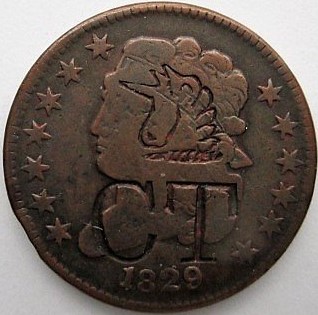 |
|
Pillar of the Community
United States
4510 Posts |
You both make strong arguments for the counter stamp coin. There are cigar companies that use the unicorn as the logo, but I could not find anything that went back to Connecticut.
|
|
Pillar of the Community
United States
4433 Posts |
Quote:
Hope I didn't sound too critical of your research. No problem. I welcome healthy criticism. I'm really surprised that you can't discern the unicorn's image .... two ears, long snout with a nasal cavity and a sharp, protruding horn. Beyond the whimsical unicorn image, itself, I've yet to see one iota of circumstantial evidence that connects this to a cigar company, I'd LOVE to see that, and that's in part why I resurrected this thread. I'm hoping that someone will eventually find some concrete info, such as I've done, to build a bridge to a solid attribution. As for the CT representing Connecticut, I've yet to see an early c/s that provides simply a state location; this, absent a town or city. Many an early c/s will show a NY location following the name. In all such cases that I've researched, the NY always translates to NY City, The state location was far too broad for advertising back in the 1830's. If "Unicorn Cigars" were a statewide product in the 1830's, why isn't such a popular product to be found on the map, so to speak? One other thought .... Cigars are products. If indeed, these unicorn c/s's were intended to promote a product on a state-wide basis, why is there no advertising to be found? It simply doesn't make sense that all but a few handfuls of Half Cents would serve as an ad campaign, does it? Most of the earlier c/s's, prior to the 1850's, it seems, served utilitarian purposes more so than as a means of advertising. The "little billboard" fad that Brunk referenced, tended to bloom in the 1850's. And, those pieces typically bore a specific address so that the merchant could be found. If one wanted a Unicorn Cigar, just where in CT would he find one? Edited by ExoGuy
02/02/2024 9:41 pm
|
|
Pillar of the Community
United States
4233 Posts |
I definitely discern the unicorn image. What I disagreed with was your interpretation of a "cigar-like collar." To me it has nothing to do with a collar - it's a cigar. Keep in mind I'm only coming at this from a layman's critical viewpoint. I find these things intriguing. The elements I see are a cigar, what seems to be smoke from the cigar forming a unicorn (definitely a unicorn), CT, a preponderance of these being on Half Cents, and seemingly a high frequency of them also being 1829. So I'm admittedly a bit stuck on the Connecticut tobacco connection. Below is from The Memorial History of Hartford County Connecticut 1886 https://www.cga.ct.gov/hco/books/Me...l_1_1886.pdf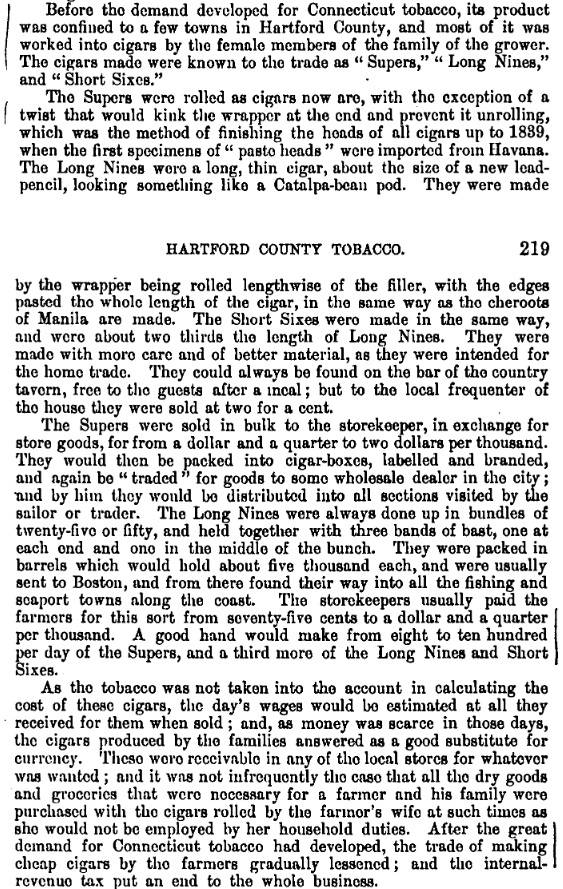 Lots of interesting stuff about early tobacco in Connecticut. One quote that stands out is "They [cigars] could always be found on the bar of the country tavern, free to the guests after a meal; but to the local frequenter of the house they were sold at two for a cent." So, a single cigar would then have been a Half Cent. With the preponderance of these being on Half Cents, the counterstamp seems to be saying "good for one cigar at" ... unknown. Another thing I noted from this one reference is that the cigars were rolled as a side gig by the housewives, then exchanged or sold at the local store seemingly as generic cigars. Only then were they "packed into cigar boxes, labelled and branded", and then those traded onward. So if the "unicorn" was indeed a brand of cigar, perhaps we need to be looking for some sort of shopkeeper. I was also intrigued by the tavern references. There were a LOT of taverns. "Suffice it to say they were many in number, and were located conveniently in and about Hartford" and "There were twenty roadside taverns between the old Goodwin Tavern on Albany Avenue and New Hartford, a distance of twenty miles" are some quotes I pulled out. A tavern every mile! I'm sure a lot of those tavern names are lost to history. Lots of the hits on "tavern" in this publication are generic, but I noticed that a large number of them were associated with someone's name. Adams Tavern, old Lunt Tavern, Ogden's tavern, Bartlett's tavern, Flagg's Tavern, Woodcock's tavern, etc. So could the T in "CT" stand for tavern, the C being the proprietor's name? If so, that would remove the connection to Connecticut. |
|
Pillar of the Community
United States
4433 Posts |
Quote:
I definitely discern the unicorn image. What I disagreed with was your interpretation of a "cigar-like collar." To me it has nothing to do with a collar - it's a cigar. @kbbpll ... The way I see it, the cigar appears as a collar on the unicorn image as a whole, and the smoke, rising from the right end, forms the unicorn's head. Thus, the cigar appears as collar on the unicorn's neck. The main problem I have with accepting your premise is that it's totally built upon the presumption, not a fact, mind you, that C_T represents Connecticut. Note the space between the letters which strongly suggests the abbreviation is two words. The only fact we have for starters is the unicorn image. The way I approached this attribution problem was looking for connections to this one fact. Searching "unicorn" in newspapers and books, thhe Unicorn Tavern kept popping up. The fact that it was located in the greater Philadelphia area caught my attention as well; this, given the large number of early c/s's that were punched in that region. Then too, we have the fact of the coins, dated prior to 1840. This fact helps narrow the time during which these were stamped, 1835 to possibly as late as 1850 when the Braided Half Cent had been introduced. As you pointed out, cigar making was a cottage industry, a mom and pop operation at the time. Taverns were a likely place for these makers to peddle their cigars. Find a Unicorn Cigar factory with an ad image like the one on the coin, in Connecticut mind you, circa 1840 or so, and I'll personally send you a free Unicorn-stamped Half Cent. Summarily, while I don't wholly dismiss the cigar maker, I see far more circumstantial evidence pointing toward the Unicorn Tavern. Key to this is the noted C_T (Cumberland Turnpike) location as opposed to a nebulous, statewide location. Meanwhile, I hope you find that Unicorn Cigar Company! |
|
Pillar of the Community
United States
4433 Posts |
For those who may read this thread in the future, the recent UNICORN c/s realized $73. It was a slightly lower grade coin than the OP's piece. The c/s was strong and appeared on both sides of the 1829 Half Cent host. |
|
Moderator
United States
196751 Posts |
Quote:...the recent UNICORN c/s realized $73. It was a slightly lower grade coin than the OP's piece. The c/s was strong and appeared on both sides of the 1829 Half Cent host. Excellent!  |
| |
Replies: 29 / Views: 5,449 |
To participate in the forum you must log in or register.
Disclaimer: While a tremendous amount of effort goes into ensuring the accuracy of the information contained in this site, Coin Community assumes no liability for errors. Copyright 2005 - 2026 Coin Community Family- all rights reserved worldwide. Use of any images or content on this website without prior written permission of Coin Community or the original lender is strictly prohibited.
Contact Us | Advertise Here | Privacy Policy / Terms of Use
|
| Coin Community Forum |
© 2005 - 2026 Coin Community Forums |
| It took 0.57 seconds to rattle this change. |
 |
|





 First Page


 Posted 05/10/2010 3:19 pm


