| Author |
 Replies: 15 / Views: 1,448 Replies: 15 / Views: 1,448 |
|
|
New Member
United States
14 Posts |
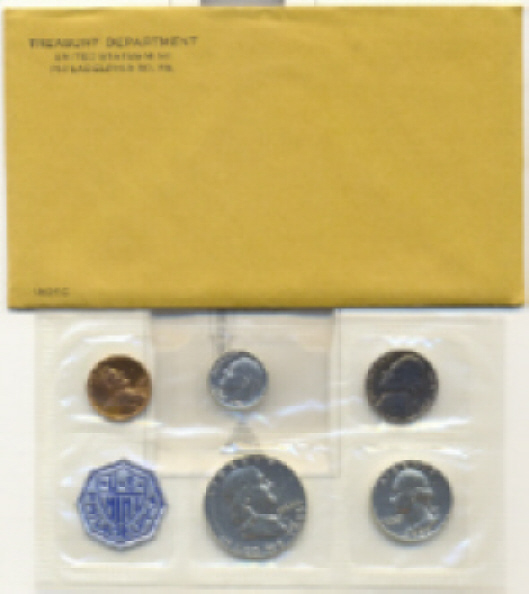
Hello, As a novice to coin colleting, I have what may be an off-the-wall question, that if anyone could help me with would be greatly appreciated. I recently purchased several U.S. Mint Proof sets from the 1960's. The coins do not have a proof mirror-like appearence,(such as my sets from recent years), but look more like "Uncirculated Mint" coins. Is this due to the age of the sets? My question is...Using the "1962 Franklin half dollar" as an example, and using the 2006 RedBook as a price guide. Do I have a "PF" coin @ PF-65/$25.00 or a "MS" coin @ MS-65/$200.00? How do I, in the future, know if the coin is "proof" or "mint"? If it were not for the coins being in the "proof set", I would have guessed they were, high grade uncirculated raw coins. Thanks in advance to anyone who can help me out with this. God Bless, Simple_man |
|
|
|
Pillar of the Community
Australia
3838 Posts |
I'm not too sure how early proof coins were minted, but usually proof coins are supposely scarcer than uncirculated coins, and hence higher value because it is just more costly to mint such. But on the other hand the reverse can happen as production of proof coins CAN be over uncirculated coins for various reasons.
I'm not too sure if you really do have proof or uncirculated coins there, but if you are sure that they don't have such "proof" like surfaces, i.e. very reflective that you can see yourself in it "clearly".
Perhaps someone else can help you - I am not too sure about US coinages.
|
|
New Member
 United States
14 Posts |
Hello,
For whatever reason, my scan of the 1962 proof set will not load. Thought it might help, but I cant get it to load. Sorry.
|
|
Rest in Peace
United States
3730 Posts |
Just wanted to say welcome to the forum!
Hope you get your questions answered.
When I was in college I bought 10 1963 proof sets. I still have them, and as an investment they didn't increase all that much.
They definitely have a different appearance than today's proof coins.
|
|
Pillar of the Community
United States
4589 Posts |
to answer your question in thiscase the unc is worth more, the 60's proof sets were in cellofane like the minte sets are .. alot of these proofs do not have the same look a modern proof does, If you are knew at this it might be hard to distinguish between them the surface should almost be like a metalic glass like appearance or in some lower grade proofs almost satiny the surface may not be mirror like but still not pourous like circulated coins. I am not really sure how to explain it so I hope that made some sence to you, good luck and welcome to the forum
|
|
Pillar of the Community
United States
751 Posts |
Hi, Simple, welcome to the forum.
You are absolutely correct--proof coins from the 60's do not look like modern proofs. If I cut my 63's out of their wrapper (OGP=original government packaging), I don't think I could pick them out of a line-up of business-strike coins.
From 1968 on, proof sets have been made in San Francisco and encased in hard, acrylic(?) holders. They got new equipment and improved their process. Even so, they really only put out the brilliant cameo coins with any consistency beginning in the mid-80's.
From 1964 going backward, proof sets were made in Philadelphia. The were put in "flat packs" like yours beginning in 1954, I think.
Proof coins, even if the untrained eye can't tell are made differently. Using polished planchets, polished dies, more pressure, and struck multiple times. It may be that one or more of these things were not true for the old process in Philly.
|
|
Pillar of the Community
United States
2283 Posts |
Proof coins will usually have flat surfaces like a piece of glass and they will be highly reflective. The best tip off is usually the rim. On the second proof strike the dies are using a struck coin for a planchet rather than a blank disc with raised edge. This allows the metal to flow into every part of the die. The rim will be struck up fully and be square in cross section all the way around.
It can still be pretty tough to tell sometimes because there are a some BU coins that are very PL. There are numerous steps in preparation of dies and sometimes business strike dies will receive some of the treatment given to proof dies. Some of the modern PL cents are hardly distinguishable from proofs. '88-D's come extremely PL and even have a vaguely cameo effect. Many '92-D cents in the mint sets will even have square rims and it even appears on quarters! The SMS coins were struck from proof dies.
Modern proofs are struck under more pressure than business strike coins but not more than mint set coins. The mint set coins receive only a single strike though.
Time don't fly, it bounds and leaps.
|
|
Pillar of the Community
Belgium
2078 Posts |
I think a modern proof should have
- highly polished dies
- high pressure
- multiple strikes
but what really sets apart a beautifull proof is when the blank has been polished as well
|
|
Pillar of the Community
United States
7123 Posts |
Hi simple_man
are you looking at these coins through the film that they came in ?
if so the film tends to flatten the shine on the coins ,, proof coins from the early 60's are definitely different than Business strike coins . they are also different than the more recent proof coins in that they are not all going to have the cameo frosted devices.
Rick
|
|
Valued Member
United States
458 Posts |
Hi Simple-man Welcome to our great Forum--
Altho most of what has posted so far is true, my point is even if it is in the OGP, you should be able to see the "mirror" finish in the field, even thru the cellophane--(unless it is in real bad shape, which then tells me it was not stored very well over its life) BUT, even so, if not toning and if in reasonable shape you should be able to se the mirror finish. Granted, in those days if was hard to get a "frosted finish" or Cameo as most are labled, or ultra cameo it still did happen. Another way to tell if it a legit proof, it will not have the blue or red stripes, or in some cases the white strpes along the top and bottom of the cellophane (I don't remember the colors off the top of my head right now cause I do not collect MS coins, I only collect the proofs). If it is striped by a color it is a mint state package. If not it is proof--it also should of come in a brown envelope with its COA--
CiScO
|
|
Pillar of the Community
United States
590 Posts |
Sorry, I don't have an answer. Welcome to the forum.
|
|
New Member
United States
14 Posts |
Hi everyone,
Thanks to everyone for the help. Ive tried again to load a scan but it just wont load. I though it may help if I could show a pic.
I dont have a '62 Uncirc. Mint coin to directly compare it to. I do agree with everyone...The set probably hasnt been stored properly, resulting in some toning, the surface is somewhat mirrored but not as in modern proof coins, through the cellophane it looks more like a Uncirc. Mint coin compared to the only other Uncirc. Mint set I have, which is a ('89).
Thanks again to everyone. I just didnt want to misrepresent the coin, should I remove it from the set and sell it.
Thanks,
|
|
Pillar of the Community
Australia
1262 Posts |
Welcome to the CC forum, Simple_man.
Hope you have a great time here with us.
Sorry I cannot help with you question.
|
|
New Member
United States
14 Posts |
Image:  62PROOF942.jpg 62PROOF942.jpg82.58 KB I think I finally got my scan to load. FYI- scan has to be 1000KB or less. Thanks,
|
|
Valued Member
United States
458 Posts |
quote:
Originally posted by simple_man
Image: 62PROOF942.jpg
82.58 KB
I think I finally got my scan to load. FYI- scan has to be 1000KB or less.
Thanks,
Yup, looks like a proof set, IMHO--Altho hard to tell cause of the image being so out of focus, still tho I believe I am correct. CiScO Edited by CiScO
07/13/2006 12:39 pm
|
|
Bedrock of the Community
United States
12437 Posts |
The proof set will have an octagonal mint token in it while the mint set will have a round token.
|
| |
Replies: 15 / Views: 1,448 |
|










 Posted 07/12/2006 01:22 am


 62PROOF942.jpg


