| Author |
 Replies: 71 / Views: 11,143 Replies: 71 / Views: 11,143 |
|
Pillar of the Community
United States
1285 Posts |
I am trying to find general info regarding clashed dies and die cracks as it relates to Morgan's. Can someone point me in the right direction? I checked vamworld and could not find anything. May be I am typing some wrong in the search criteria.
Thanks
Peace
|
|
|
|
Pillar of the Community
 United States
1551 Posts |
There is a clash chart in the 4th Edition, and as far as cracks they have mapping of them on a few type the 1921-D's is one. Light cracks in the dies are normal for the most part and need upward metal flow or displacement in them to be listed.
|
|
Pillar of the Community
United States
2797 Posts |
Ceylon62, Here's a clash overlay (where the reverse shows through to the obverse). The 3 circled areas are where to look for prominent obverse clashing. You can also determine reverse clashing from this. 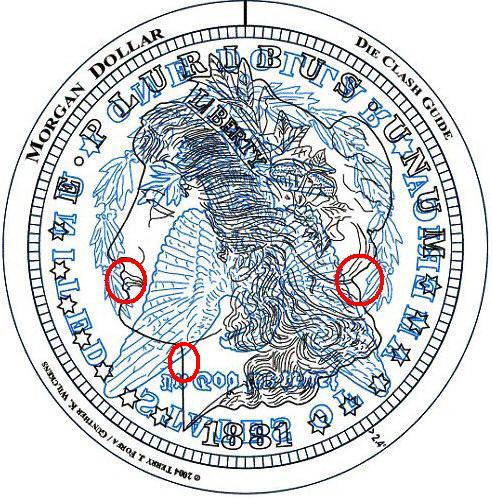 Clashing 101 - clashed dies are created when the obv and rev dies come together in the press without a planchet in between them. The force makes reverse impressions on the obverse and vice-versa. The highest points of the die are the first to appear. On the obverse these are the eagle's right wing leading edge appears as a diagonal line from Liberty's neck along with the 'n' in In. The S and T of Trust will appear in the hair V. The wreath will appear at Liberty's lips and nose, behind the hair ribbon and between Liberty's hair bun and wheat leaf. All of these clashes are in the fields and not on the devices of the obverse. On the Reverse, look for clashing of Liberty's profile between the wreaths and wings. Also, the 'E' in LIBERTY shows up often between the wreath bow and tail feathers. Finally, that pesky designer initial 'M' from the base of Liberty's neck likes to show itself just above the 'd' in God on the reverse. It's hard to see unless you are able to rotate the coin in the light. What does all this mean? Collectors covet letter transfers. Clashes without the letter transfer are cool, but the money is in the letters. Normally Leroy VanAllen will not award a separate listing for these clashes w/o a letter transfer. There's big money in 'E' transfers between the wreath bow and tail. Some of these are common, like the 91-O VAM 1A, and some are exceedingly rare and hard to spot (weak E). Find an 1887-P weak E clash ( VAM 1B)in AU and head to the bank ($6000). As twohawks pointed out on die cracks, the real interest is in die "breaks". That's the natural progression from a crack to a field break that allows the metal to flow into the void and creates a raised line on the surface of the coin ... the bigger the break the bigger the blob. If allowed to continue, these actually show displacement of the field (one side higher than the other). Die breaks at the rim are called " Cuds". |
|
Pillar of the Community
 United States
1285 Posts |
Thanks you 2. I saved the pic and the text off as a doc. I learnt more from those 2 posts in an hour than all my reading upto this point. Just to clarify - I found this on VAM world. So the BLOB is the break and the rest is the Crack? http://www.vamworld.com/message/vie...565#21662647Also When there is a die crack would there be a "break" on that same coin somewhere or just the "crack" and the "break" happened on a previous coin. Thanks again. Peace |
|
Pillar of the Community
United States
1551 Posts |
Cracks are from die fatigue. If left in service they sometimes become breaks. And in some very rare cases also result in full Cud's. Look up the 1882 CC Vam-3d and the 1884-O 37a both started off small and in later states became what they are. |
|
Pillar of the Community
3660 Posts |
Fourteen months after first holding a coin in my hand and actually looking at it, I feel that I have achieved my numismatic goal of learning about the people, machines and processes that created these coins and paper money that I had inherited. This site, this post, seem a good point to conclude that quest. |
|
Pillar of the Community
United States
2797 Posts |
Quote:Fourteen months after first holding a coin in my hand and actually looking at it, I feel that I have achieved my numismatic goal of learning about the people, machines and processes that created these coins and paper money that I had inherited. This site, this post, seem a good point to conclude that quest. Say What? |
|
Pillar of the Community
United States
1285 Posts |
I checked that and liked the 84-O pictorials. The 82 CC is beyond me.
In general how much of a premium should die crack that run through the lettering command? OR should they even have a premium? Thanks
Peace
|
|
Valued Member
United States
314 Posts |
Generally speaking, Die Cracks are so common on Morgan dollars that they do not bring a premium. They are very common around the obverse stars and around the lettering near the edge on both the obverse and reverse. They usually have to be very prominent, uncommon, and referenced in a VAM variety book. The 1888-O "Scarface" VAM would be one example of a die break VAM for which someone would pay a premium. Check the "Top 100 VAM Variety" pocket book by Fey and Oxman. You'll note that over mintmarks, overdates, and doubled dies are the more commonly "valued" coins. The 1889-P "Barwing is a die break VAM. Likewise the 1889-O "E on reverse" is an example of a clashed die variety where the "E" from E Pluribus Unum was clashed onto the reverse die showing up near the bottom of the eagle's tail feathers. If you are going to collect VAM's you'll want to also familiarize yourself with the various "Rarity factors" for each variety. This is a way to judge the overall potential value of the coin based on how commonly it is found among Morgan dollars of that particular date. Hope this helps. |
|
Pillar of the Community
3660 Posts |
Quote:
Say What? I say that Boones Farm and CCF are incompatible.  |
|
Moderator
 United States
23522 Posts |
Quote:
I say that Boones Farm and CCF are incompatible. When I was in AIT at Ft. Devens some 30 years ago, we had a thing called the Apple Club. Mind you, being Military Intelligence, it wasn't like, real Regular Army - we were responsible for getting to and from school on our own. Nobody marched anywhere. The rite of initiation, and the regular habit, was to procure a bottle of Boone's Farm Apple from the on-base liquor store right next to the school. Membership in the Club required that one established the habit (not a one-time thing) of killing the purchased bottle before reaching the barracks a mile away. That liquor store probably sold more Boone's Farm Apple than any other outlet in the country. I am a proud member of the Club. |
|
Pillar of the Community
3660 Posts |
Speaking of clashing (of obverse and reverse dies, of wine and MI), while attending post secondary school in Cambridge, I recall sitting outside the main gate at Ft. Devens on Saturday nights waiting for my friend usually carrying Strawberry Hill (probably from that same class VI store). (CIC)?
|
|
Pillar of the Community
3660 Posts |
Notice the circles that SeatedNut has illustrated. They are all about the same relative distance to the rim. The reason for this is the convex curvature of the dies. There is no clashing in the center, because both dies are in relief of hub transferred engraving there. There is no clashing near the peripheries because the fields are of lower profile there. Clashing takes place where the field on one die meets device drop off on the other die (nearest the center of the dies). I have added another area to look for clashing, and this is the area of LIBERTY (specifically the area around the E. The E sometimes will show as clashing on the coin reverse because LIBERTY is at field profile height on the die (it is the headband that is the device on the die, not the letters), and will correspond to the field between wreath and bird (on dies that have not been rotated). Cracks are predominately located near the periphery of a die, and this is not generally due to clashing (since dies will not touch there) or from die wear (as the area that receives the greatest amount of wear is the center of the die, as planchet metal flows (or actually is displaced) from the center outward. The cracks near the periphery are inherent in the die are generally due to the annealing of the die. As a metal cools, molecular crystallization occurs at the edges and surface of the metal causing it to be harder, yet more brittle than that of the center. Rapid cooling methods will increase this phenomena. Liken this to cookies that have cooled after being removed from the oven; soft in the center, harder on the edges and surfaces. Breaks are actually cracks that have deteriorated to the point that when a planchet is struck, its metal is forced into the crack. Liken this to a crack in your sidewalk. When the crack first starts, it is just a crack, but each progressive year, that crack gets wider and seems to open up to the point where weeds begin to grow in the crack. Consider this crack now as a break. The side walk is still intact, but after a couple more years, a corner actually breaks off, and grass grows where the corner was. A Cud is where the edge of the die has actually broken off of the die, and planchet metal is pressure forced to fill that area, resulting in an ugly blob on the edge of the coin. Grass grows in breaks and areas of missing pieces of sidewalk, but planchet metal fills the area of a die where the crack widens or a piece of a die is broken off of an edge. Chips in a die will show as lumps and blobs on a coin. 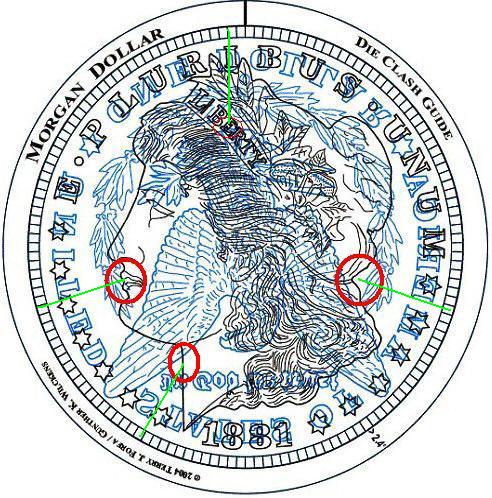 Edited by zeewool
07/03/2010 06:38 am
|
|
Pillar of the Community
United States
1285 Posts |
Ok, so now after about a month I get the hang of it and appreciate the input. Question as it relates to clashing. Which side (obverse or reverse) is rarer or common and vice versa? And technically, which side carries more weight towards being a VAM? So far I am coming to conclusion that it's the obverse and wanted to double check (except for the clashed E that I know of), based on my readings and "R" value. Thanks Peace |
|
Pillar of the Community
United States
2797 Posts |
Quote:
So far I am coming to conclusion that it's the obverse and wanted to double check (except for the clashed E that I know of), based on my readings and "R" value. It's all in the letters! Letter transfers normally generate more interest and value. The obverse will show the "In", "W", and "st" of In God We Trust from a hard clash. The reverse will show the "E" from LIBERTY and the designer initial M. To reiterate though from this comment Quote:And technically, which side carries more weight towards being a VAM? All Morgan and Peace dollars are VAMs. Remember that the characteristics that distinguish one die from another (clashes, die cracks/breaks, polishing) are not VAMS. They are the distinguishing features of the die. The VAM is a catalog number for that specific die pair (Obverse/Reverse). Fresh dies with no alterations from wear, tooling, etc., still get a catalog number. If you were to pose that same question like this ... "And technically, which side carries more weight towards rarity/value?" I wouldn't be writing this.  My answer to that question would be ... it depends. |
|
Pillar of the Community
United States
3076 Posts |
another great thread...Cracks and breaks are seen in all years. Always when the die has produced many coins..as noted by the above, cracks are not of interest as far as a VAM, yet can attribute a known VAM...when the crack has become overgrown as Zee illistraights its fat and juicy, way beyond a crack line. Brakes are the final stage...showing thicker "cracks" more metal showing...this is the time where dies would be retired.. so they carry a better premium.. |
| |
Replies: 71 / Views: 11,143 |








 Posted 06/30/2010 09:47 am


