| Author |
 Replies: 354 / Views: 19,518 Replies: 354 / Views: 19,518 |
|
Pillar of the Community
3660 Posts |
Hi VAM gurus.....Is the King dead or what? It has been pretty quiet around here lately. I would like to put the topic term to the test yet again if you all don't mind. These questions apply strictly to Morgan dollars and the Morgan Orr press used to strike them: 1. Can anyone here explain how a collar is made? 2. Are there any known revisions attributable to the 3rd die (collar)? |
|
|
|
Pillar of the Community
United States
2797 Posts |
I was kind of enjoying the peace and quiet.  Can't answer the first but there are numerous examples of wide-reeding imparted by non-standard collars. 1878 7TF rev of 79 VAM 224 (168 reed count) comes to mind as the first. There are also numerous 1921-P examples. Forgot to add picture. I've heard these posts are worthless without pictures.  The Morgan & Orr Press  And a Reeded Collar 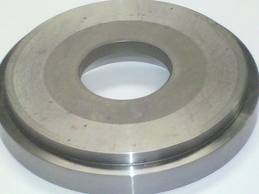 Edited by SeatedNut
07/21/2010 3:17 pm
|
|
Pillar of the Community
 3660 Posts |
Thanks very much for the reply and the pictures Dave. Although 1886(P) and 1884CC are the specific years I had in mind, the 1878 VAM 224 that you mentioned comes close in a way. Are some 224 known with normal reeding, thereby assigned as 224A? My questions could (should) culminate in revisions for someone. |
|
Pillar of the Community
 United States
2448 Posts |
I'm always awed by photos of old presses. It's hard to believe they could apply the pressure to cause metals to almost melt and flow into the dies. Thanks!!
|
|
Pillar of the Community
3660 Posts |
Yeah carmykle, that 'would' be pretty hard to believe until you take a hammer and smash a coin. The coin metal moves, but it is actually 'displaced' by the pressure of a harder material, no melting or flowing involved. That is just one example of the many terms used in numismatics that are highly misleading and cause misconceptions about how things actually happen.
|
|
Pillar of the Community
United States
3076 Posts |
Having heard of the collar so often its nice to see one, and find it unusual to think that it could break, having the reeding within the interior walls... I see there are no moving parts, SO....am I to assume that the planchet in a sense is "sheared" edges cut away as it is pressed into the dies? or is the planchet slightly smaller than the collar and expands under the die pressure?(seems a likely guess)
Never had to think about that, or think for that matter......
|
|
Moderator
 United States
23522 Posts |
Planchets are cut smaller in diameter and thicker than the final coin, and flow into the collar. It'd be too difficult to recover the silver, or keep it from gumming up the works, otherwise.
There are also VAMs characterized by overlapping reeds, indicating a problem producing the collar.
|
|
Pillar of the Community
3660 Posts |
Yes Gene.....You have successfully pierced one half of the crux of my questions. If you look closely at the collar, it is not actually as thick as it seems...the photo shows it sitting on its base. The pupose of the base is to act as a spacer allowing upward movement of the lower die's main shank as only the neck and face will fit through the collar. For a Morgan dollar, the business part of the collar is approximately 1 1/2" in diameter by 1/4" thick. The collar was made in a similar fashion to a coin die. The steel plate is annealed, while soft, a hole punch is used to punch an approximately 1 1/2" hole through the metal plate. Just as hubbing required repetitive stikes, so does this punch require repetitive strikes for successful blowout through the other side of the plate. (Remember that). After the hole is all the way through the plate, another tool similar to the hole punch is used in the same fashion. It is called a swag, and is centered over the hole left by the hole punch. The swag is slightly tapered from a larger top to a smaller bottom. It is also toothed, so as it enters the hole left by the hole punch, it leaves (or shears) mirror image teeth into the hole in the collar plate. Since the swag is also tapered, it leaves the collar plate not only with teeth, but with a bottom that is slightly smaller in diameter than the top (swag entrance site). At completion, the collar is toothed, and its inner diameter is tapered down from top to bottom. The reason for this tapering is to allow the lower die to raise and eject (push) the newly struck coin approximately 1/8" up and out of the collar in which its circumference was formed. Quote:
I see there are no moving parts, SO....am I to assume that the planchet in a sense is "sheared" edges cut away as it is pressed into the dies? or is the planchet slightly smaller than the collar and expands under the die pressure?(seems a likely guess) Correct Gene, breaking of the collar would be a very unusual event. It would require the fracture of the press' main arch, which actually did occur on at least two separate occasions that I am aware of. Correct again Gene, no moving parts to the collar. It is fixed (screwed using three screws to the strike table of the press). Wrong, 2 out of 3 isn't bad though, and you were certainly on the right track. The diameter of the planchet is slightly smaller than the diameter of the collar. The feeder fingers push the planchet over the top of the collar, the planchet falls into the collar, and lands on the face of the lower die which is completely surrounded by the inner walls of the collar. The drop is about 1/8". The upper die (acting as the hammer) is slammed down onto the planchet, (which acts as a buffer for the lower die which acts as the anvil). Upon strike, the lower die is at its maximum retraction, but immediately after strike, it raises approximately 1/8" to eject the coin from the collar, and then retracts to anvil position again. I'm getting way off topic here....The planchet is not sheared by the collar, nor does it expand. It is pressure 'squished out' (like playdough) to fill the toothed area of the collar. Edited by zeewool
07/21/2010 10:02 pm
|
|
Pillar of the Community
3660 Posts |
Yes, thanks for that SuperDave, I didn't see your post or else I could have been more brief. I guess it took me over an hour to type all of that crap that everyone probably already knew. Actually, What my question was meant to be was not 'are there any different types of reeding', and not 'are there any vams designated for such', but rather are there any "revisions" known for a VAM with both a normal edge, and an edge that is abnormal (other than reed count)? |
|
Pillar of the Community
United States
3076 Posts |
I having some knowledge of machining grabbed the digital micrometer.. About 1/1,000 taper....Not that I am doubting your analysis, but rather I am familiar with the making of molds, where something is made and without some kind of taper you just can't get the article out of the mold, even if it has mold release.. Another interesting point is how the color was made...they didn't have the lazer or high pressure water cutting systems back then, but to the basics of punching through metal , they would not have taken more than one punch in my mind, as the metal would be soft steel, "swagged" and milled to the proper thickness and then hardened by temporing techniques..so I don't believe they needed more than one punch, ....So I am thinking your question would be addressing, IS there a known VAM, where the COLLAR..which is in a sense. a "DIE" and therefore subjects to abnormalities.....equal in VAM designation as any other die........as in perhaps a collar was improperly prepared and used.... |
|
Moderator
United States
23522 Posts |
Quote:but rather are there any "revisions" known for a VAM with both a normal edge, and an edge that is abnormal (other than reed count)? To the best of my knowledge, no. "Railroad rims" (I'm guessing you're familiar with the term) aren't considered to be die varieties but production varieties, and therefore don't get VAM numbers in the same sense that strikethroughs don't (shouldn't; yeah, I know of at least one). |
|
Pillar of the Community
United States
3076 Posts |
Yet are not strike thru's on the surface or reverse? something caught or material pressed into the coin in the striking process? not collar related?
|
|
Pillar of the Community
3660 Posts |
Right Dave, we see things the same way there. I guess that you know by now that I am beating around the bush at instant identifications of 'seamed' edges as being automatic counterfeits.
Well Gene, it seems that our understanding of annealing, molecular structure of steel, and mechanical processes may be at odds. So, as you say " to the basics of punching through metal", are you saying that only one punch from the hole punch would be needed to punch all the way through 1/4" of annealed steel, or are you saying that the swag could act as the hole punch?
|
|
Pillar of the Community
3660 Posts |
Yes, you are correct about the strike thru not being collar related Gene.
Dave was not inferring that.
Railroad rims are not actually collar related either. They are caused by the failure of the lower die to fully retract from the ejection of the previous coin, and the planchet is not completely deposited in the collar, but only at partial depth.
|
|
Pillar of the Community
United States
3076 Posts |
I am simply saying that in producing anything, it does not need to go through 7 processes to make something. the one punch thru the only gets the item into close enough tolorences in order that the Swag be the final stoke/shape and dimentions, much like a "reamer" a drill like tool, that finalizes the exact dimention(sorry can't spell).. the fact is you cant punch the finish on the first try... like the reamer, the first hole must be close enough so the final proceedure can be accomplished with minimum effort must be close to the final size and then one tool finishes the proceedure, remember this is about production, not hand made which requires more steps....
|
|
Pillar of the Community
United States
3076 Posts |
by the way, as I re-read...the final thickness was 1/8th of an inch or the thickness of the dollar/collar, it would not make any sence to anneal the collar before its dimentions were finalized. So shaping/sizing or punching should have been done before before the hardening and placement into production....
|
| |
Replies: 354 / Views: 19,518 |









 Posted 07/21/2010 4:16 pm


