Coin Community Family of Web Sites Join Thousands of Coin, Bullion, & Money Collectors
Specializing in Modern Numismatics Shop for APMEX Bullion on eBay!Join Thousands of Coin, Bullion, & Money Collectors 300,000 items to help build your collection! Royal Canadian Mint products, Canadian, Polish, American, and world coins and banknotes. Vancouvers #1 Coin and Paper Money Dealer Coin, Banknote and Medal Collectors's Online Mall


Username:
Password:
Save Password
Forgot your Password?


This page may contain links that result in small commissions to keep this free site up and running.

Welcome Guest! Registering and/or logging in will remove the anchor (bottom) ads. It's Free!

Trade Coinage Definition / List Help

To participate in the forum you must log in or register.
Author Previous TopicReplies: 11 / Views: 5,668Next Topic  
Rest in Peace
Learn More...
jgfindring's Avatar
United States
1380 Posts
 Posted 07/24/2010  8:05 pm Show Profile   Bookmark this topic Add jgfindring to your friends list Get a Link to this Message Number of Subscribers
Among my too many coin collecting goals is a trade coinage type set.
My current list of what I wanted in it was:
AUSTRIA M.T. THALER
BRITIAN Trade dollar
FRENCH INDO-CHINA PIASTRE
JAPAN Trade dollar
JAPAN TRADE YEN
MEXICO 8 REALES
MEXICO LIBERTY CAP PESO
SPAIN PILLAR $ ,<1773
SPAIN PORTRAIT $ >1772
UNITED STATES Trade dollar

(I only currently have five of these.)

Then I found a thread where SAP was talking about an Italian Thaler to compete with the Maria Theresa. I have also seen reference to the early 1900's US minted Philippines One Peso as a Trade dollar. Was it really used as a Trade dollar, or did it just circulate in the Philippines? I am interested in coinage that was used at least some what as Trade dollars, i.e., not in it's country of origin and relatively widely recognized and accepted in it's area of use, be it China, South-east Asia, Africa or Middle East.

What coins am I missing on my list?
Pillar of the Community
svslav's Avatar
United States
2605 Posts
 Posted 07/24/2010  8:54 pm  Show Profile   Bookmark this reply Add svslav to your friends list Get a Link to this Reply
There were some trade ducats circulating in Europe. A few countries issued those. You could look into that.
Rest in Peace
Learn More...
jgfindring's Avatar
United States
1380 Posts
 Posted 07/24/2010  9:12 pm  Show Profile   Bookmark this reply Add jgfindring to your friends list Get a Link to this Reply
I should qualify that I am looking for silver coinage. I thought that the Ducats were generally gold, but I've been wrong before and I'll be there again.
Pillar of the Community
svslav's Avatar
United States
2605 Posts
 Posted 07/24/2010  9:23 pm  Show Profile   Bookmark this reply Add svslav to your friends list Get a Link to this Reply
OK, much more recent. Still European, and silver, issued by a Belgium, France, Gibraltar ... just to name a few. Ecu!
Rest in Peace
Learn More...
jgfindring's Avatar
United States
1380 Posts
 Posted 07/24/2010  9:27 pm  Show Profile   Bookmark this reply Add jgfindring to your friends list Get a Link to this Reply
Years issued and areas circulated in?
Pillar of the Community
svslav's Avatar
United States
2605 Posts
 Posted 07/24/2010  9:40 pm  Show Profile   Bookmark this reply Add svslav to your friends list Get a Link to this Reply
Looks like it was prelude to euro.
Belgium issued 2 through 20 ecu (I'm staying with silver) 1987 - 1998.
France - 15 ecus, 1990 - 1995.
Gibraltar - 2.8 - 35 ecus, 1991 - 1995.

Funny, these were the first (European) three countries I checked. Now, I see, maybe they are the only ones that struck ecu coinage.
Rest in Peace
Learn More...
jgfindring's Avatar
United States
1380 Posts
 Posted 07/24/2010  10:13 pm  Show Profile   Bookmark this reply Add jgfindring to your friends list Get a Link to this Reply
Nah, thanks but I'm not sure they fit my goal. Maybe I should have said historical trade coinage. Though there do seem to have been some silver ducats as you suggested, particularly Netherlands. Trying to search out more on them right now.
Moderator
Learn More...
Sap's Avatar
Australia
16809 Posts
 Posted 07/25/2010  07:55 am  Show Profile   Bookmark this reply Add Sap to your friends list Get a Link to this Reply
There are two earlier " Trade dollars" issued by Britain. The earliest, the "portcullis dollars" of 1600, are extremely rare and expensive.

The "anchor money" coins (1/16, 1/8, 1/4 and 1/2 dollars) of the 1820s are usually filed in the catalogues under "British West Indies" or some such. Anchor money is relatively cheap and obtainable.

Both were intended as colonial trade currency to compete with the Spanish dollar, and both were failures in the sense that they were never really accepted as trade coins in the lands intended for their use; none of the three Britsh attempts at a " Trade dollar" came close to supplanting the Spanish dollar as the trade coin of choice.

I don't know how far back in time you want your collection of silver trade coins to go, but some other silver "trade coins" I can think of are:

- the Indian rupee - the old "Mughal-style" with Persian-Arabic on both sides, not the British Colonial types. They circulated through much of the Indian Ocean, carried by both European and local traders. The Indian rupee was mentioned alongside the British shilling, the Dutch guilder and the Spanish dollar on the "Proclamation of 1800", as silver coins commonly in use in early colonial Australia.

- The Bohemian pragergroschen - ancestor of the thaler and the first large silver coin to be issued in quantity in Europe. Not as large as a thaler, it circulated far beyond the borders of the central European kingdom that issued it.

- The Islamic dirham - while not as popular as it's gold counterpart the dinar, the dimensions of the dirham were stipulated by the Quran. As such, it was an accepted coin throughout the Islamic world, and beyond. Hoards of them have even been found in England; the Vikings seemed to prefer them to the small, debased silver coins prevalent in Europe at the time.

- The Roman denarius - it circulated not just within the Empire, but was well accepted by the barbarians beyond it, and as far as Roman traders ventured. Hoards of Roman denarii are found as far away as Russia, Scandinavia, India and Ethiopia.

- the Athenian "owl" tetradrachm, the world's first silver trade coin. They were such a popular and well-trusted coin that even as artistic techniques advanced to allow more lifelike designs and portraiture, the "owls" were kept deliberately archaic. Hoards are found throughout the Mediterranean (they seem to have been especially popular in Egypt, which had no coinage of its own) and down the Red Sea coast.

Many of these coins are quite cheap for their age, simply because they were extremely common trade coins and frequently hoarded.
Don't say "infinitely" when you mean "very"; otherwise, you'll have no word left when you want to talk about something really infinite. - C. S. Lewis

Rest in Peace
Learn More...
jgfindring's Avatar
United States
1380 Posts
 Posted 07/25/2010  10:11 am  Show Profile   Bookmark this reply Add jgfindring to your friends list Get a Link to this Reply
Thanks Sap. Looks like I'm adding the Italian Thaler, some "anchor money", an Islamic dirham, and a Bohemian pragergroschen. What about the Philipines Peso? Was that ever really intended as a Trade dollar?
Valued Member
Philippines
80 Posts
 Posted 07/25/2010  10:44 pm  Show Profile   Bookmark this reply Add fireandice556 to your friends list Get a Link to this Reply
@JGFINDRING - I have seen some Philippine Peso with chopmarks... but these US Admin Philippine Peso were only issued in 1903-1906, afterwhich (1907 up) their size and weight were reduced because of it became overvalued.

@SAP - would the newly-independent Central / South American coins of 1820s (and up) also qualifies as Trade coinage, since they circulated legally in the Philippines after the termination of countermarking/stamping in 1839?

Pillar of the Community
Australia
3831 Posts
 Posted 07/25/2010  11:16 pm  Show Profile   Bookmark this reply Add gxseries to your friends list Get a Link to this Reply
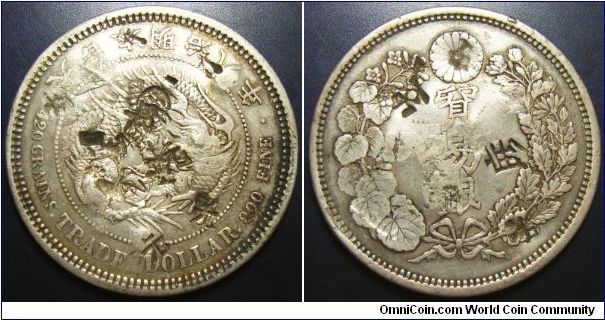
Here's the Japanese Trade dollar:

Trade-Coinage-Definition-/-List-Help

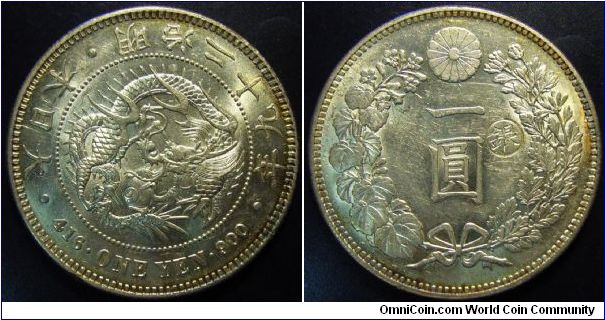
And then a counterstamped "gin" Japanese yen to be used overseas:

Trade-Coinage-Definition-/-List-Help

The only coin rarer than them is the counterstamped Mexican 8 reales as shown here:

http://www.vcoins.com/world/clarksm...dProduct=320
My partial coin collection http://www.omnicoin.com/collection/gxseries
My numismatics articles and collection: http://www.gxseries.com/numis/numis_index.htm
Regularly updated at least once a month.
Moderator
Learn More...
Sap's Avatar
Australia
16809 Posts
 Posted 07/25/2010  11:40 pm  Show Profile   Bookmark this reply Add Sap to your friends list Get a Link to this Reply

Quote:
@SAP - would the newly-independent Central / South American coins of 1820s (and up) also qualifies as Trade coinage, since they circulated legally in the Philippines after the termination of countermarking/stamping in 1839?

I would agree with that.

Any of the post-independence coins that were struck to the same size, weight and fineness as the old Spanish colonial dollar were presumably intended by the new countries to replace the Spanish dollar in both oriental and domestic trade. The 8 reales coins of Mexico, Central America, Colombia, Peru and Chile, as well as the 8 soles of Bolivia, all qualify as the successors of the Spanish dollar and would have been accepted as such, though only the Mexican coins seem to have actually been exported to Asia in quantity. The Mexican 8 reales doubly qualifies as a trade coin because Mexico continued to strike them specifically for foreign trade long after the 8 reales had been supplanted by the peso for domestic use.

With no trade fleets of their own, the new South American countries would have seen the widespread usage of their coins as trade coins as more a forlorn hope than an actual government policy. There would have been reduced trade between the Americas and Asia once the Spanish no longer controlled the entire trade route; the occasional visiting foreign merchant ship could not have matched the sheer numbers of coins the Spanish treasure fleets could carry.
Don't say "infinitely" when you mean "very"; otherwise, you'll have no word left when you want to talk about something really infinite. - C. S. Lewis

  Previous TopicReplies: 11 / Views: 5,668Next Topic  

To participate in the forum you must log in or register.


Disclaimer: While a tremendous amount of effort goes into ensuring the accuracy of the information contained in this site, Coin Community assumes no liability for errors. Copyright 2005 - 2026 Coin Community Family- all rights reserved worldwide. Use of any images or content on this website without prior written permission of Coin Community or the original lender is strictly prohibited.
Contact Us  |  Advertise Here  |  Privacy Policy / Terms of Use

Coin Community Forum © 2005 - 2026 Coin Community Forums
It took 0.33 seconds to rattle this change. Forums