| Author |
 Replies: 56 / Views: 13,500 Replies: 56 / Views: 13,500 |
|
|
|
Moderator
 United States
56855 Posts |
That's a great find. I am surprised no one commented on your excellent photos. What did you use to take the pictures? Thanks,
John1 
|
|
Pillar of the Community
 United States
1027 Posts |
All of the images posted so far were scanned on an HP ScanJet 4890. I use a calibration scale to make sure that I am reproducing both color and gray scale correctly and normally scan my coins at 7200 DPI and then use those images to make pictures suitable for publishing by scaling them down and cropping as needed. The 4890 has an optical resolution of 9600 DPI in both directions but the HP software causes some artifacts at that scale and 7200 DPI produces just about the largest files that my other software can handle, especially with SAEs.
|
|
Pillar of the Community
United States
1027 Posts |
I should point out that the scanner has one major limitation and that is the inability to modify the light source. I have had some limited success with adding outside light during scanning but it is not easy and the results are often not desirable. This is most problematic on modern proof coins with ultra flat mirror fields (like the quarter in this thread). The scanner light source is only slightly off axis to the image detector but is enough that the mirror field sends all of the light away from the detector and fields go completely black. I have had some success at getting better images of mirror fields by tilting the coin so that some light is reflected back into the detector but this is a real exercise in patience to get it right. This can also cause slight distortions in the resulting image (my scanner is normally ultra square for items placed flat on the glass, virtually no H/V distortion, round is round). I have also used a Canon PowerShot A1100 IS 12.1MP camera with some success. This camera has a decent macro ability that can produce about 1000 DPI images with good focus. The quarter in this thread was actually discovered with the scanner. I had not noticed anything when I viewed the coin in the mint lens or even when I removed it for scanning. It was when I was cropping the scans that I saw the crescent line on the obverse and thought it to be a scanning anomaly (hair, reflection, etc.) so I rescanned the coin with similar results and then pulled out my loupe and realized that the coin itself was the source of the "imperfect" images. When viewed straight on as the scanner does, all that is seen is a very fine line at the edge of the raised portion of the field. In the right (or is it wrong) light the line disappears from view. I then examined the coin under higher magnifications and varied angles and lighting and saw all of the details like the incomplete reeding and the fact that the line (that I initially thought was a scratch) was in fact an edge. At first I thought that the coin was scratched, and then I realized that the "scratch" went right up to the edges of letters but not through them, so it did not happen after being minted. Then while trying to determine whether it was a planchet or die scratch I discovered that it wasn't a scratch at all but the entire field above the line was raised a fraction of a millimeter. I proposed and shot down many theories of what caused the coin to be as it is, first trying to play devil's advocate and find a way that it was PMD, then planchet flaw, then strike anomaly, etc. Only die anomaly remained as a viable cause, all other explanations had something that prevented them from explaining the coin. Then I tried to figure out how a die like this was ever used. I don't think there is any way that a proof die with a defect like this would have made it into the press without being noticed so that meant that the damage occurred either while being inserted or during use. My first thought was that the press had miss fired ant the die had struck a coin slightly off center and hit the some part of the reeding collar (a form of clash), and then correctly struck a series of coins like mine before being discovered as damaged. The problem with this idea is that there is no apparent damage to the reverse die and that the obverse damage seems far too light to have been caused by a proof force strike. The only thing that makes sense to me now is that the die was dropped (perhaps only a few inches) and it impacted some piece of flat hardened metal with a hole in it (again, perhaps part of the reeding collar) about the size of a golden dollar (~1.04 inches) and only the very edge of the field portion of the die impacted the other surface, with the majority of the die face landing over the hole. This is all educated guessing and I have spent the last 15 months both trying to find another coin like mine and inviting others to find viable explanations for the coin. This process has led me through many refinements and modifications to my theories and I am grateful to the many people that have expressed their opinions and offered their expertise. The exciting thing about this coin is that it made it out of the mint at all. This anomaly is so great (like a thousand die cracks) that it should have been caught at several points. Mint workers must have made an effort to expunge all of the coins produced as soon as the die damage was discovered. Perhaps only a few handfuls were minted and someone miss counted and they thought they had them all (did you count five or six shots, punk!). Well, I got lucky and this coin found its way to me, perhaps my reward for more than a decade of purchasing coins directly from the mint website. |
|
Pillar of the Community
United States
1027 Posts |
Mike Diamond, Et al., I was just checking out the extensive error glossary page on the CONECA website and it does look like the closet thing to his coin is a collar clash with the exception that this die did not hit the reeding (actual collar die). Whatever it did hit was of a larger radius than the reeding, about 13.25mm as opposed to the 12.15mm of the quarter itself. Additionally, what the die struck was smooth. Perhaps there is some part of the reeding collar that sits above the reeds or some other shield that has the larger radius opening when quarters are in the press. I am seriously leaning toward the dropped die theory but in any case this coin seems to point to a new kind of error. The fact that the reeding collar and the reverse die both appear to be undamaged make the collar clash definition a loose fit at best, even though it is the closest in your list. I certainly don't think that this error warrants a new definition, unless it is a misc. die damage sort of thing, as it is not likely to happen again. I also tried to find some history info on proof coin die errors and quarter die errors and both seem fairly scarce and none are in recent (the last 30 or so) years (the Wisconsin & Minnesota anomaly quarters are more like varieties than errors). The coin is at PCGS for authentication, grading, and slabbing now and while it is there I will get my membership for CONECA sent in and once the coin comes back I can make arrangements to get it to you for an in person review and possible write up. I really think that this coin has the potential to be of significant value. That potential will most likely depend heavily on the amount of publicity the coin receives so I won't hide the fact that I have ulterior motives for having the coin written about. Beyond that, this does appear to be something far outside the ordinary, totally uncommon, hasn't happened in most of our lifetime's kind of error. Major proof die errors are almost non existent, quarter die errors are uncommon, throw in the fact that this is a silver proof U.S. territory quarter and it becomes just plain freaky. I do wish there was some way to get the folks at the mint to pony up the info on this coin's origins, but that is just not something that they do. There must be some log somewhere in the San Francisco mint that details the retirement of the die and explains what happened to it. It probably even says how many coins were minted and mistakenly claims that they were all recovered and destroyed. That said, I still think that if one got out, then more might have and continue to encourage everyone to take a close look at all of their 2009 Northern Mariana Islands Silver Proof Quarters and to look closely at any you see at shops or shows. Mine came in a full proof set but there is no reason that others could not be in the quarters only sets. While I still cannot find any way to explain this coin other than to say that I believe it accurately reflects the die that minted it, a second example would unquestionably confirm that assumption. PCGS is currently quoting 25-35 business days turnaround for mint error coins, so it is possible that the coin will not be back in my hands until the first of the year but I hope that they do better with this one.
|
|
Pillar of the Community
United States
1027 Posts |
PCGS has finally started processing my coin. They have had it in their system for 3 full weeks without any action and today the coin finally has a grade and they are certainly harsh. It has been given a grade of PR67DC which is at the bottom end of what I was expecting, I was pretty sure it would not get a 69 because of a fairly good nick above the S in TRUST but I didn't think that alone would push it past a 68. I suppose if it wasn't an error coin it would get a PR61 because of the damage caused by the die so maybe 67 isn't so bad. They don't have any details about the certification up yet so I don't know what they called the error. http://www.pcgs.com/MEMBERSHIP/Shar...010&Month=12and http://www.pcgs.com/MEMBERSHIP/shar...rNo=20451906It looks like I am the first order to be certified in December (last month they had over 680 orders with many times that many coins). http://www.pcgs.com/Cert/18538106.htmlThis is the certification lookup page. It does not have any information yet but this is the normal link for looking up any PCGS coin. As soon as I know more about how they are classifying the error I will post again. I mailed the coin on October 30 via priority registered mail and it took until November 5 to get to PCGS which is 4 days longer than USPS estimated, then it took until November 9 for PCGS to enter the coin into their system. I hope it doesn't take quite as long to find its way home. |
|
Pillar of the Community
United States
1027 Posts |
Holey Moley! I just got off the phone with PCGS and their "expert" claims that this coin is struck as the mint intended! I made them put it back into grading by telling them that I would hate to publish an article pointing out that PCGS did not see anything wrong with this coin! I know that I did not see the problem when I looked at it with my naked eye but I assumed that someone would examine the coin closer than that, especially when I paid for error service. I will post again as soon as I know more.
|
|
Bedrock of the Community
United States
12437 Posts |
IMO, you would have been much better off if you had accepted Mike Diamond's offer or even sent it to Ken Potter for examination. PCGS has a very good reputation for grading but the weakest links for most TPGs are error/variety attribution and foreign coins. Sure, PCGS has Fred Weinberg as an error consultant but he does not attribute all of the error coins(he is also not a grader for them). Supporting research on your coin from CONECA would have "greased the skids" for proper TPG attribution. |
|
Pillar of the Community
United States
1027 Posts |
I was planning on sending it to CONECA after PCGS and will still do so. I wanted the coin slabbed to protect it if it starts getting sent around for examination. This will not only protect the coin but it will protect anyone I send it to from having to worry about damaging it in any way. I sent documentation of the error along with my submission but it does not look like anyone reviewed it. I do not see how anyone could look at the coin under a lens and believe that it is minted as intended. Since when does the proof image of GW on the quarter have a big arc running through UNITED STATES OF AMERICA? When is it ever OK for a proof quarter to have incomplete reeding? I paid enough that the coin deserved more than a quick naked eye look.
|
|
Bedrock of the Community
United States
12437 Posts |
Quote:
I wanted the coin slabbed to protect it if it starts getting sent around for examination And herein lies the problem- it is kind of hard to do a thorough analysis of a coin if it is entombed in plastic, especially if the error involves the reeding. If the documentation you sent to PCGS was the same info and drawings from your first post then I am not surprised that they ignored it and in fact, the graders probably never even saw it. Edited by biokemist6
12/03/2010 11:54 am
|
|
Pillar of the Community
United States
3640 Posts |
I have to agree with the other poster about having the coin examined before sending it off for a slab. If Mike or Ken offered to examine a coin for me I would jump on it. You can trust these guys 100% Everyone has their own personal choices also of TPG's. pcgs (after examination etc.) would of been my 2nd choice. Maybe you will get lucky and be able to work something out with pcgs. It would be worth their while/reputation in the long run. |
|
Pillar of the Community
United States
1027 Posts |
I just received the coin back from PCGS and I am happy to report that it is the same coin I sent out and it still has the massive die error showing on the obverse (which PCGS mounted backwards because it is a U.S. Territory quarter). After two times through the error graders at PCGS (the second time at my insistence) they contend that the coin is struck as the mint intended, that there is no error. I provided documentation with the coin and emailed additional images for the second review to no avail. I literally pleaded with them to have more people look at the coin but they insisted that the coin is as the mint meant it to be. "PCGS fails to spot major silver proof die error, TWICE!" 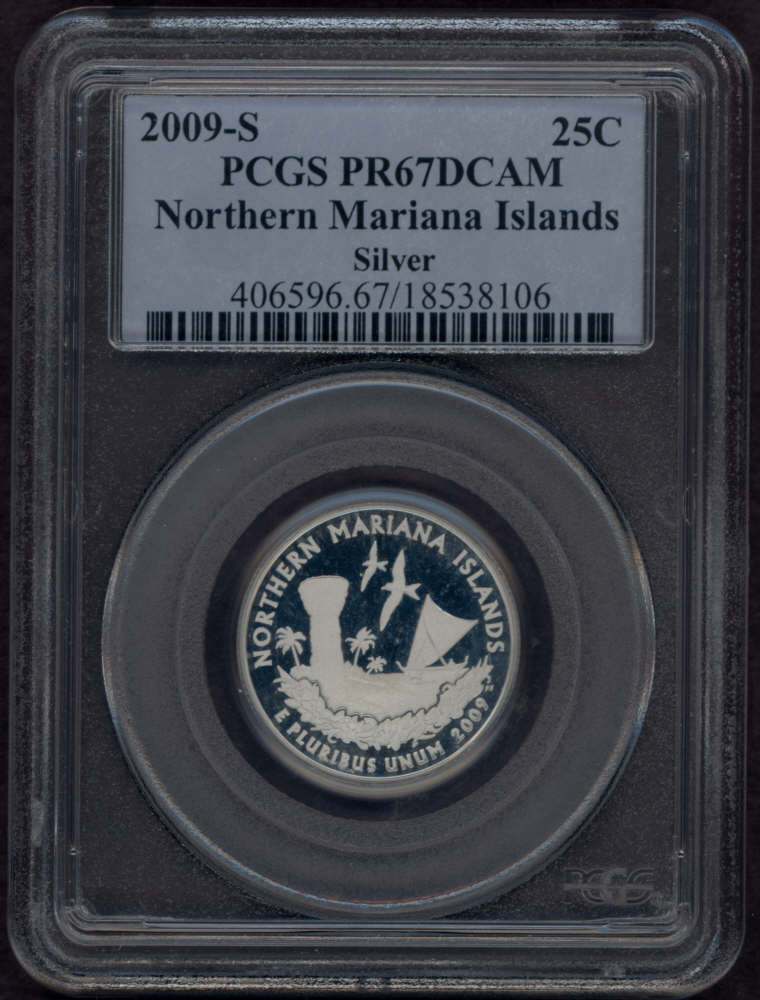 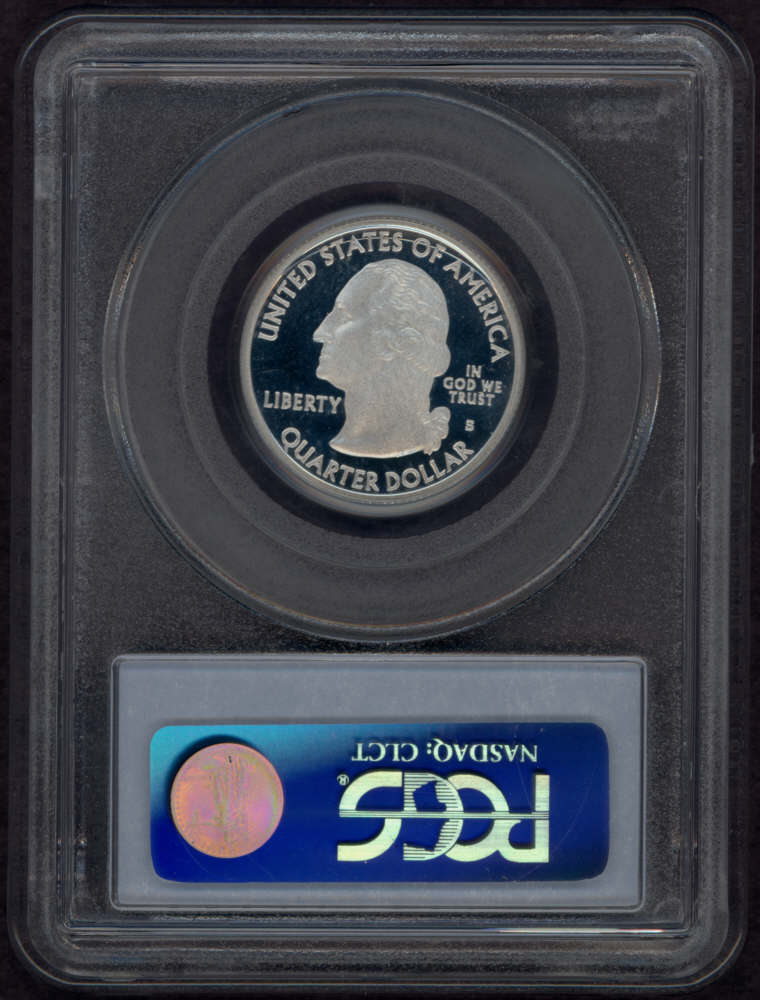 |
|
Pillar of the Community
United States
5699 Posts |
I have read this thread and would say, 1st, I agree with Ron, when Mike D offers to inspect/authenticate a coin and do a write up on his findings, like He offered me, I wasted no time in sending it directly to him.
I do not understand, I clearly see the crescent shaped arc on your coin in the slab and you were told the mint struck the coin as intended?
I would say there are more options than YOU feel, I for one do not see how this arc could not of been made prior to the strike of the coin, planchet damaged, possible?
I would suggest you take Mike up on his offer, It could of saved you a lot of $$$$$ and a lot of time wondering, good luck.........
|
|
Pillar of the Community
United States
1027 Posts |
There is no way that the raised area on the field could have come from the planchet. It could not have survived two strikes at proof force. A damaged die is the only viable explanation for the coin. The arc is not just a line, the entire crescent of the field above the visible line is elevated above the rest of the field. Look where the line meets the rim on the right side and you will see that it looks like the rim narrows all the way round until the line joins the rim on the left. this is because the bottom of the rim is higher all the way around the crescent portion of the field. There is no way that a normal die striking a defective planchet twice could have produced this result. I believe that the die struck a plate with a hole in it that is slightly larger than a quarter, like a feeder plate with many holes that feeds planchets into the press. Actually, what PCGS did may have been a very good thing for me and my coin. It should help the coin get publicity, and it may well help another TPG by allowing them to grade a coin that a competitor messed up on. I have emails from PCGS customer service stating that their graders say this is not an error coin and I think that this can only help me at this point. The coin is still perfectly viewable in the slab and now it is protected and traceable to me. |
|
Pillar of the Community
United States
958 Posts |
so they are saying the curved line happened before the strike , that the line was in the silver planchet
take the line you see and the curve it has at the top. The curve is not high enough and round enough at the top to match the profile of the curve found on the outside of the coins rim .
Atleast to me from the pics it does not appear they match the profiles. The " damage line " and rim line.
maybe its a " wrinkle " in the silver.
maybe the planchet was very uneven and the die's pressing almost leveled the metal out but not quite.
|
|
Pillar of the Community
United States
1027 Posts |
No, they are not acknowledging the line at all, let alone the fact that it is not a line but an edge. The radius of the arc (the line) is greater than that of a finished quarter, perhaps even larger that a quarter blank (before going through the upsetting mill), I estimate the arc radius at about 13.5mm, a finished quarter radius is 12.15mm. If there was extra metal on the blank, the coin should be overweight, which it is not. After going through the upsetting mill, the extra metal would have built up along the entire length of the arc. On striking, with that much extra metal, there is no way the coin could come out so clean across the arc boundary. The lettering would have been messed up and so would the rim. There would have been an air gap between the die and the field below the arc and there would have been evidence of the point where the die once again made contact with the planchet below the arc. At the arc itself (the line) there is a slight raised lip, indicating that the die hit whatever damaged it at a very slight angle. If the coin had been struck with a normal die, this lip could not have survived, it would have received excess pressure that would have flattened it out and left a less than clean edge. I am including a more accurate drawing, showing what I mean about the "lip". The drawing is my representation of the die, just mirror it to get the coin. 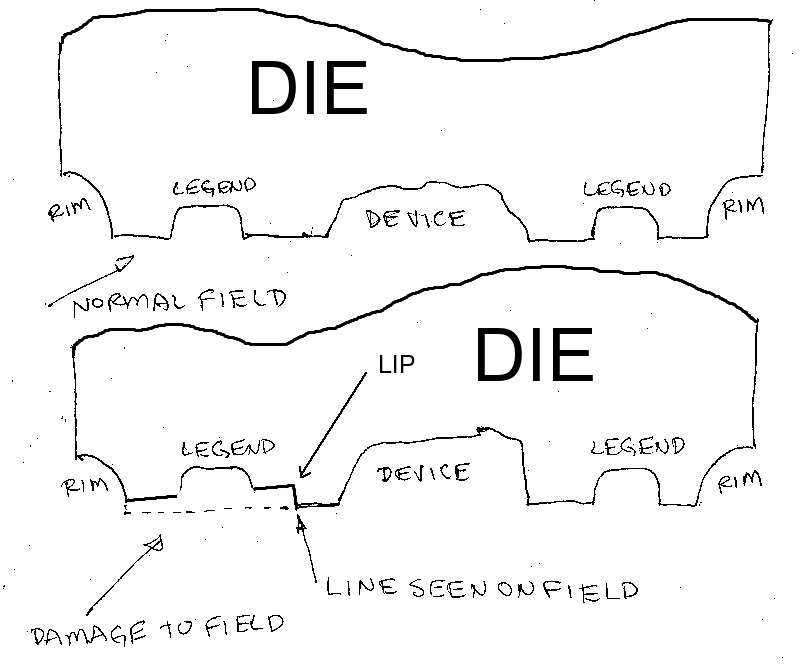 |
| |
Replies: 56 / Views: 13,500 |








 First Page


 Posted 10/30/2010 2:44 pm


