| Author |
 Replies: 90 / Views: 6,312 Replies: 90 / Views: 6,312 |
|
Pillar of the Community
3660 Posts |
Moderator edit: This has been split from another thread into one of its' own. Pretend you're being taken from the game into previously-scheduled programming.  How many times has someone asked 'What is that added metal on top of the rim'? What was your answer? Kinda neat how it sits so perfectly on top of the rim without spilling over into the denticles 'eh? 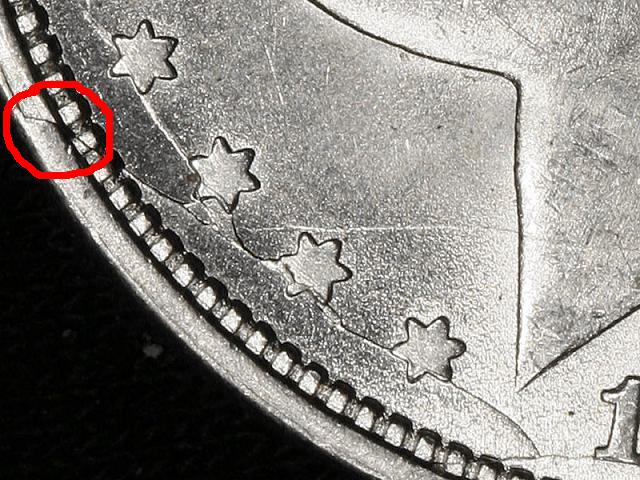
|
|
|
|
Pillar of the Community
United States
3076 Posts |
each time I look at that I do wonder if thats a Cud? |
|
Pillar of the Community
 3660 Posts |
Might depend on your definition of ' Cud'... (to some folks, that metal displacement at star #2 is a Cud). Have you seen this 'extra metal' on a coin with no associated cracks? Probably not a ' Cud' then 'eh? |
|
Moderator
 United States
23522 Posts |
VW considers it a Retained Cud, as do I (or, "just about but not quite a Retained Cud"). The progression of the crack from the star to the edge of the collar is too smooth for it to be anything else, IMO. Balancing that is the relative weakness of the crack (and non-involvement of the collar) at the date end of the Cud, when you compare it to the obvious displacement at the star end. This isn't the latest die state example known, but it's pretty close. It's a fascinating coin, one I'm unlikely to part with. For the record, the "star end" of the break has no reed involvement whatsoever - they're perfectly normal. Random question for the crowd: How might the condition of the reverse die affect the behavior of the obverse die? Edit: In the hope of increasing clarity, I'm dropping the full-face pic of the obverse into this post. It wasn't carried from the old thread.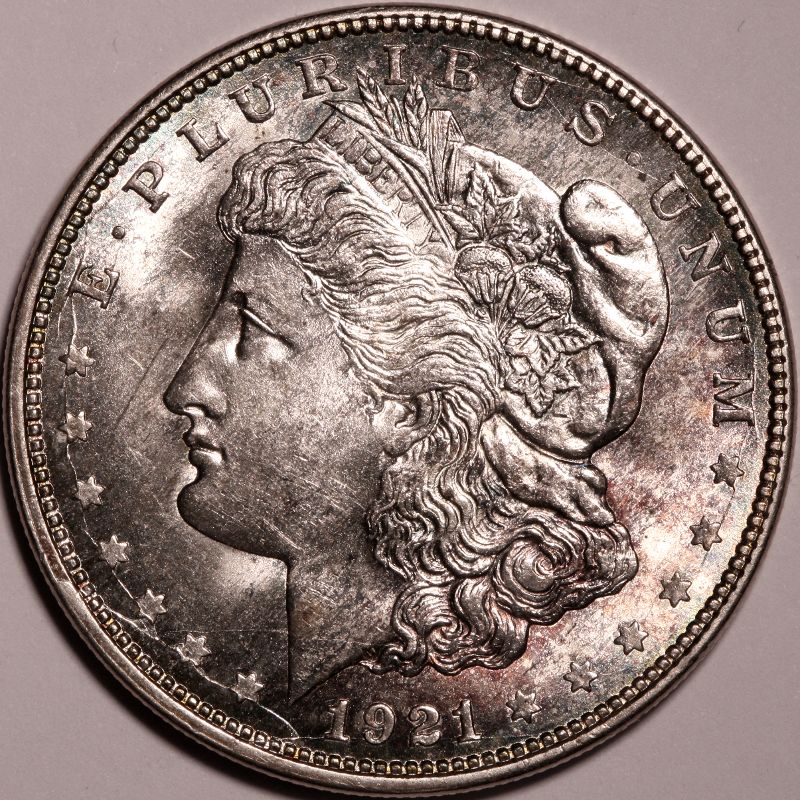 |
|
Pillar of the Community
3660 Posts |
Do you mean kinda like this field displacement with Cud, and associated weakness on the opposite side of the coin? (my buddy John Rocco's coin): 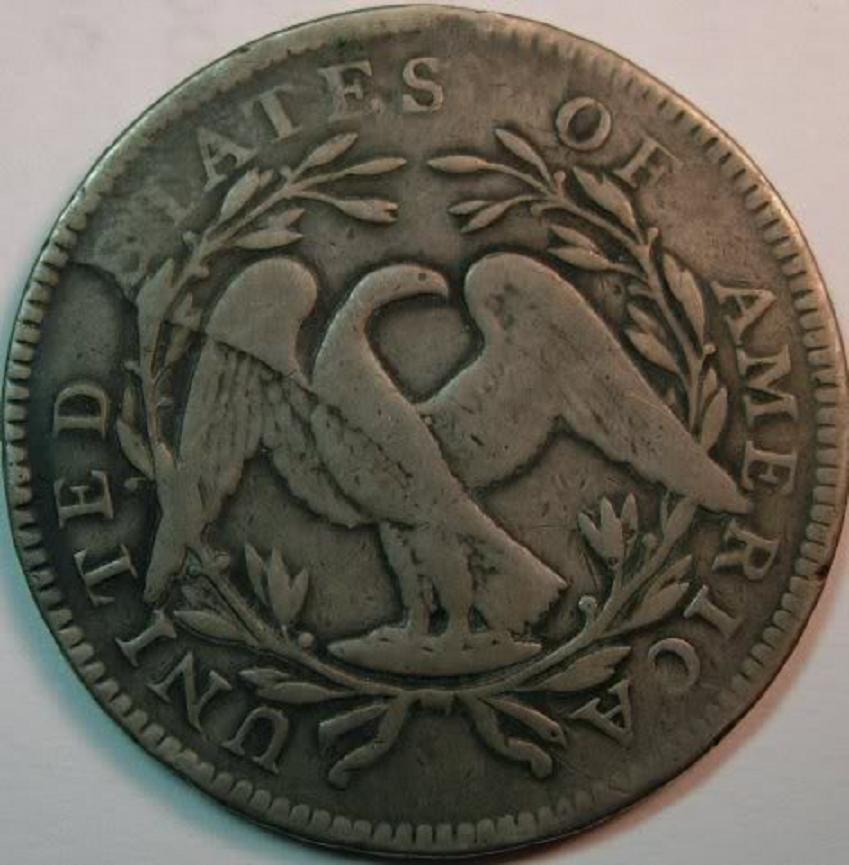 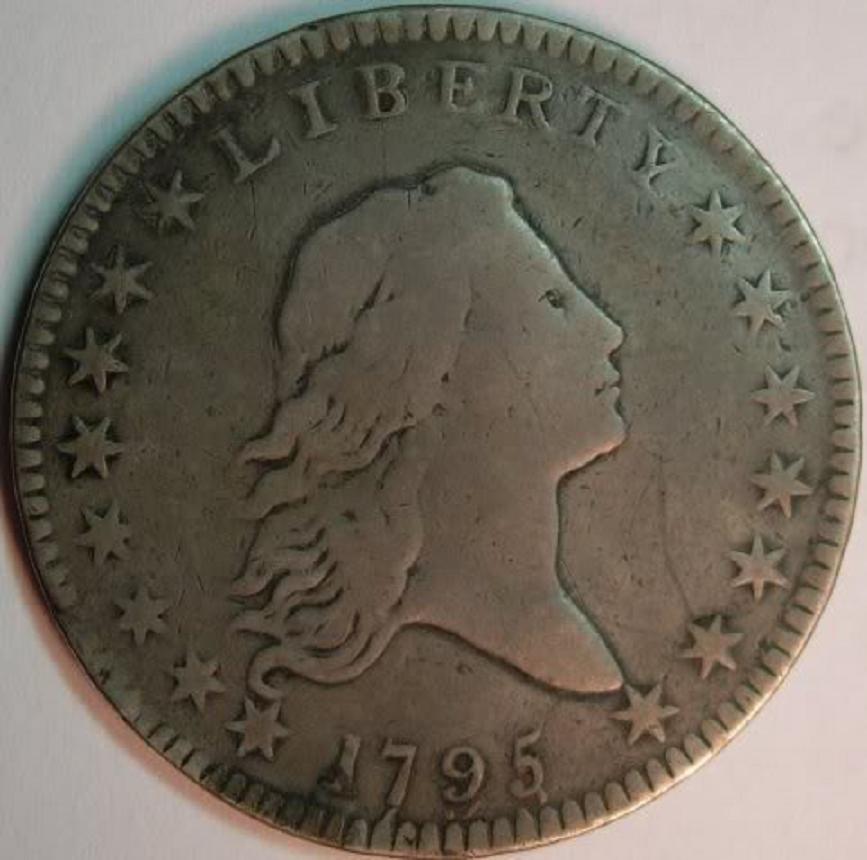 |
|
Pillar of the Community
3660 Posts |
Back to your coin though Dave.... does that crack really extend into the rim, (or is the effect of metal 'flow' over the rim merely a side effect of displaced fields)? I do believe that I have seen such extra metal on the rims of other coins that display no associated cracks.... so what is a ' Cud' again? |
|
Moderator
United States
23522 Posts |
Quote:Do you mean kinda like this field displacement with Cud, and associated weakness on the opposite side of the coin? To an extent, but factoring in the possibility of die sink on the facing die allowing one end of a displaced Cud to rise, while the other end, being held by a proper-height spot on the opposing die, does not travel as much. In the case of this particular coin, there is cracking close to but not exactly matching the obverse cracks on the reverse die (D->Wing->STA): 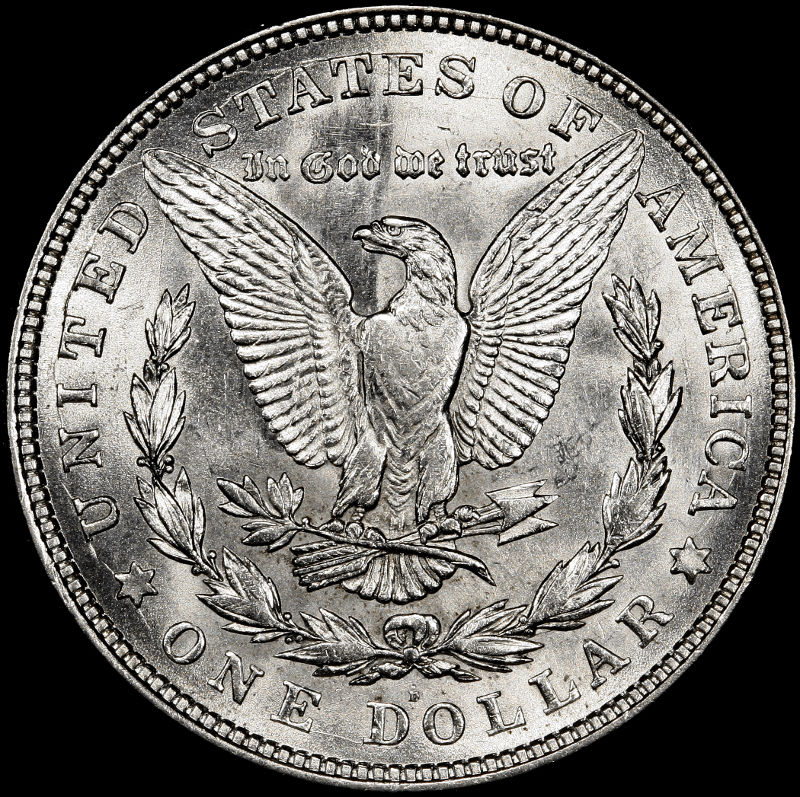 Quote:
does that crack really extend into the rim, (or is the effect of metal 'flow' over the rim merely a side effect of displaced fields)? A valid possibility. In this case, I think the progression of the line into the rim area is too "cute," too exact, to be anything other than the die cracking completely to the rim. Note the upper left of the red area you circled. See that thin raised line of metal right at the edge? That's the border between die and collar, I'm thinking. How can that line occur? Although I haven't searched my files exhaustively, it's the only line of that type I can ever remember seeing. Note the extent of the line in the full-face pic I posted. It begins gradually between star 5 and 6, and runs along the rim to an abrupt end below star 1 (tough to see in that image, but present. I contend that, from that point below star 1 to the break you circled is what we call a "retained Cud," a piece of the die which has broken entirely loose from the rest. Now is where the thinking gets speculative. If the die is completely broken, how is it still striking accurately? Because much of the metal of the die below it is still present, if broken. A true Cud, one where you see just a blob rather than design features, is to me possibly the result of die metal below the actual face of the die falling away - allowing the face of the die to "submarine" and then the collar forces metal back in towards the center, over top of the still-present but too-low die. The "thin raised line" I mention is due to die sink in the areas where it appears. Steel, even annealed steel, will bend before it breaks. This die failed below the annealed surface; metal gradually vaporized (or maybe there was a bubble in the casting?), allowing the face of the die to bend and sink until it cracked. |
|
Pillar of the Community
3660 Posts |
I'm making cookies right now (again), but I am thinking about all of that....most of which I agree with, (but I still don't buy the Cud thing on your coin).... please allow me a few minutes to finish and clean up, and then gimme a bit to do some more of that there ponderin' (as we say down here). |
|
Moderator
United States
23522 Posts |
|
|
Pillar of the Community
3660 Posts |
Anyway, after doin' some mighty powerful ponderin', I do agree with alla that ceptin' for the Cud thang... this is where I think that other variables like the processes come into play, which is what I was about to begin to start commencin' to talkin' 'bout on the VAM IT thread, but I finally figured that it was sorta outta place. The milling machine (upsetting machine) put raised edges on the planchets so that there would be full rims on the coin despite strike variances. The collar does wear, but at a rate much less than the devices on the die, and this is because there is very little relative pressure exerted on the collar.... a lot of folks envision the collar as sort of an inverted gear with shark like teeth, however, the teeth are not V shaped teeth, but rather short, thin, vertically elongated prongs jutting out from an otherwise smooth inner surface.... as the planchet is struck, the prongs wear naturally due to the planchet metal that is displaced between them. Some coins will show more prominent reeding than will others (due to wear)....Not unlike devices, which will also wear, but not nearly at the rate of wear to the field which absorbs the lion's share of the strike impact. The collar does not cut into the planchet, but the planchet seeps into the collar... A side effect of the planchet rim is that of lessened rate of displacement of the planchet metal into the collar crevices... This is because while the downward force of the upper die causes planchet displacement into the die devices of both dies (caused by the two fields closing), the planchet rim is not affected by this... it is forced horizontally into the collar as a secondary effect of the vertical momentum of the die closure, and the effect is lessened by the shape of the upset planchet edge. The die rim (on each die) sits at a level on the die neck that is slightly below field level.... While die fields may clash, the a clash of the rims is physically impossible... they, (as the devices) are lower than the die field. While the convex shape of the dies causes less striking pressure at the outer devices than the main ones, the rims are outside of the die field, so the planchet rims do not always even displace vertically to the die rims, because the planchet displacement that occurs outside of the die field is in a horizontal direction toward the collar... when the collar fills with metal, then additional metal is forced vertically toward the die rims.... depending upon the upsetting of the planchet, the rims may not completely fill.... but that is not really noticeable as the rim is already on the planchet. I think that what is looked upon as extra metal on top of a coin rim is actually only the partial effect of complete metal displacement. Neither planchets or die set ups were perfect, and a little wiggle room is necessary. In this particular case though, your coin, in your hand, may prove to be a Retained Cud.... it does look more like it the further away I stand.... You are the best person to make that determination though. Look again at the rim, all the way around this coin.... Online photos... they will be the death of me yet. 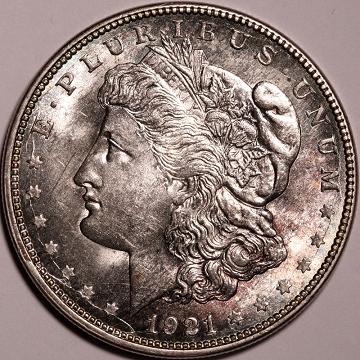 |
|
Pillar of the Community
United States
3076 Posts |
A very interesting topic and evaluations!!  |
|
Pillar of the Community
3660 Posts |
Quote:
A very interesting topic and evaluations Well, I just reread what I wrote, and found it more confusing and dry than 'interesting'.... I had a very difficult time wading through that again.... Very basic physical principles are involved, but I beat around the bush over-explaining it to the point of gibberish. Based on the whole obverse photo, I do believe that Dave's coin probably is a retained rim Cud caused by displaced fields, but I was really looking forward to being buried anyway... (preferably with contention rather than with silence). Whatever. |
|
Pillar of the Community
United States
1150 Posts |
All I gotta add to this is SD, that Morgan looks broke. You should send it to me for repairs. ;)
|
|
Pillar of the Community
3660 Posts |
Last attempt at making some sense out of that... (with some freehand sketches): 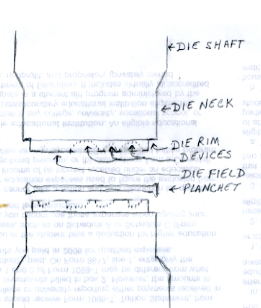 ------------------------------------------------------------------- ------------------------------------------------------------------- 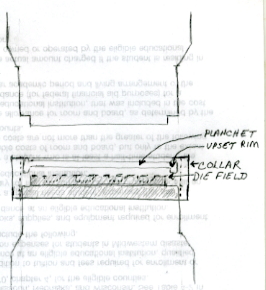 ------------------------------------------------------------------- When a die is worn, the device drop offs round over, causing a flat, less than sharp image transfer.... grind (polish) that die down to the dotted lines, and you have a die that will produce sharper coins than when the die was new.... (which coin is the EDS)? 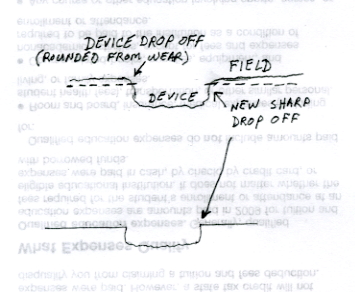 --------------------------------------------------------------------- Downward (vertical) pressure between the two die fields causes the devices to fill (follow the dotted lines with arrowheads).... since the planchet is being squeezed (compressed) vertically, its path of escape is naturally horizontal (all the way out of the area between the die fields and straight into the collar)....when it hits the collar, it changes direction (toward the path of now lesser resistance) which is again vertical toward the rim tops. 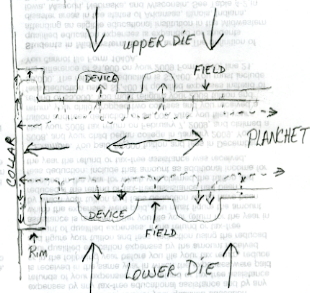 Yeah, I am not an artist. |
|
Moderator
United States
23522 Posts |
Forgive my absence - I'm fighting a losing battle with the flu, and have pretty much been asleep for the last 18 hours. Quote:
(which coin is the EDS)? That's important, right there. It's usually possible with Morgan Reverses to tell very quickly if a die has been polished - there are many shallow areas in the devices - but the Obverse is a different animal altogether. Appropriate answers will likely require 60-100x magnification and accurate knowledge of the original design. Your last two posts have been the prototypical explanation of some basic coining processes, zeewool, and I'm bookmarking them to send people to later. I'm thinking I will split most of this thread into a new topic. We've dragged poor Drsandman2 into the puckerbrush, and he deserves his own thread. Before that, though, I want to get some more serious optics onto the 1921 in question here. |
|
Pillar of the Community
3660 Posts |
Yes, I am quite the hypocrite.... I constantly hijack threads, and then lash out at folks when I see them doing similarly. Please accept my sincere apology Drsandman...  Quote:
I'm bookmarking them to send people to later. I really wish that you wouldn't... (unless you reconstruct it all into your own words and thoughts).... If I am associated in any way, you may be laughed off the edge of the earth...  Sorry about your present state of health Dave....  ... I hope that the situation is rectified quickly...  |
| |
Replies: 90 / Views: 6,312 |






 Posted 12/31/2010 11:54 am





