| Author |
 Replies: 160 / Views: 13,696 Replies: 160 / Views: 13,696 |
|
Pillar of the Community
United States
709 Posts |
We (myself and others) will make every effort to answer the question as concisely as possible.
If you have questions, let see them.
|
|
|
|
Pillar of the Community
United States
3076 Posts |
He OZ,  Glad to see you posting like your are...I have enjoyed our talk and it is full of knowledge, I do thank you....I have one question.... that is LUSTER BREAKS... its a definiton in many respects but it is so very important on the grading scheme...While I have some understandings on this subject.Can you give me some examples I can see......As many who observe coins and the grading senerio...WEAR and luster break are fore most in my mine that is needed to be addressed in a way we can see the differences... |
|
Pillar of the Community
 United States
709 Posts |
When grading Morgan dollars, always look for any break in the luster. A break in luster means your coin is not mint state or uncirculated. A break in luster is synonymous with wear. If you have the coin in hand, cartwheel it around slowly. On the obverse look at the hairline on the front of Miss Liberty. On the reverse, eagles right wing tip and the feathers on the breast are the places to look at wear and luster breaks. |
|
Forum Dad
 United States
24230 Posts |
Questions should really be posted each in its own topic with a clear title or they will be lost in one big topic for future visitors.
|
|
Pillar of the Community
United States
709 Posts |
Examining Contact Marks on Coins PCGS - May 24, 2000 Contact marks appear on the face of this Morgan $1. Reprinted with permission from Professional Coin Grading Service (PCGS). Excerpt taken from "Chapter 5: Elements of a Coin's Grade" from the book The Official Guide to Coin Grading and Counterfeit Detection CONTACT MARKS Contact marks can occur on coins in many ways. When business-strike coins are ejected from the coining dies, they drop into a container. In 1792, this was a small receptacle; today, large hoppers are used for this purpose. Most business-strike coins have contact marks before they leave the mint! After the receptacle became full, it was emptied, and the coins were placed into kegs or, later, cloth bags. Transportation to banks in kegs and later in cloth bags also accounts for some of the contact marks. Banks then opened the kegs or bags and placed the coinage into cash drawers, again allowing for more coin-on-coin contact. When looking through bags of coins, one may find a coin or two with almost no marks. This is a minor miracle, when one thinks of the weight (50+ pounds for a bag of 1,000 silver dollars) and the miles traveled in stagecoaches, trains, and later, trucks. Obviously, the heavy coins (half dollars, silver dollars, ten dollars, etc.) are more prone to these types of marks than are smaller coins. Also, the softer-metal coins (gold, silver, and copper) are more likely to receive these marks than are nickel coins. If a coin survived from the mint to the bank drawer relatively unscathed, and a collector obtained it immediately thereafter and preserved it, a high-grade coin existed. Most coins were not so lucky. There are other ways coins can survive with few contact marks. It was common practice to sell coins to visitors of the early Mint or present them to visiting dignitaries. The Lord St. Oswald coins discovered in England in the 1960s are examples of these. The Lord St. Oswald 1794 silver dollars are relatively free of marks and may have been caught in a glove from the coining presses. The coins saved from the melting pots by members of the annual Assay Commission are another way relatively mark-free coins may have survived. All of the mints had to send coins for assay to this commission, although usually only a random sample was destroyed in the assay process. Obviously, there were some Assay Commission members who saved certain of the survivors; many of the 1873 rarities are believed to have been rescued by the Assay Commission. The only 1893-S Morgan dollar graded MS-67 by PCGS is rumored to have survived in this way. Indeed, the coin is free of the contact marks seen when coins are placed in bags, and it and other coins may have survived relatively mark-free in this manner. J. M. Clapp started obtaining coins directly from the various mints in the late 1800s and his son sold his collection to Louis Eliasberg Sr. through Stack's, in 1942, for a reported $100,000. Mr. Clapp was a visionary, and some of the most mark-free coins, especially gold coins, come from this source. There are two basic types of coin contact that are encountered. The edge of one coin hitting the surface of another is one of these, causing what sometimes are referred to as Reeding Marks, although for plain-edge coins this would not be technically correct. These are also called bag marks, but not all of these marks occur in bags, so again this is not technically correct. These marks also may result from an object other than another coin hitting the surface of a coin. The second type of coin contact is sometimes called bag or roll friction. This is characterized by friction or contact, often just slight luster breaks, on the high points of coins, often confused with wear. (See the discussion of Wear in The Official Guide to Coin Grading and Counterfeit Detection for a more in-depth view of this.) There are other variations of coin "contact." These also are discussed under Wear and include hairlines, album slide marks/lines, cabinet friction, and flip rub. |
|
Pillar of the Community
United States
3076 Posts |
Just for general information...Most grades shown in any books or the photo grades ecetera...ARE AU and below....They are not MS....QUALITY
those "photo's" to grade by don't exist.... as they are subjective...
|
|
Valued Member
United States
175 Posts |
So if I'm understanding this correctly, the chances of finding a uncirculated Morgan with absolutely no marks on it are slim to none, yes? What is the highest grade that has been given to a Morgan? I love this place.  Edited by rlcbj59
01/23/2011 09:59 am
|
|
Pillar of the Community
United States
709 Posts |
The highest PCGS grade that has been given to a Morgan dollar is MS 69. There are two 1881-S with that lofty designation. One of which belonged to the late Jack Lee of Jackson, Mississippi. |
|
Valued Member
United States
175 Posts |
Thanks for the information, I really have gotten into learning about Morgans, they are a Beautiful coin. I'm studying the engravers now & finding information seems to be limited. Can you or anyone offer any assistance? Thanks Lee
Edited by rlcbj59
01/23/2011 12:33 pm
|
|
Bedrock of the Community
United States
14454 Posts |
Quote:The highest PCGS grade that has been given to a Morgan dollar is MS 69. There are two 1881-S with that lofty designation. One of which belonged to the late Jack Lee of Jackson, Mississippi. actually its MS-69PL and its 1880-S 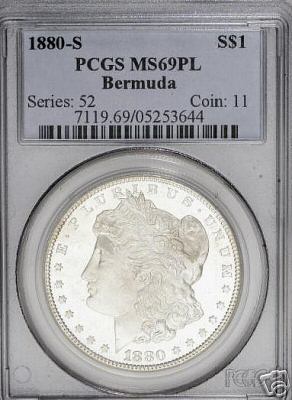 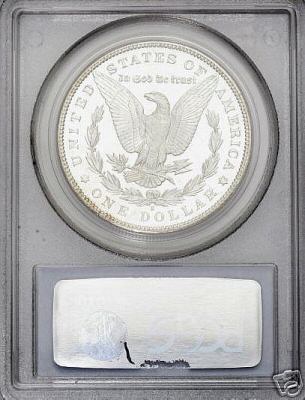 The highest graded PF Morgan is a 1890 by NGC and its PF-69UC with a star 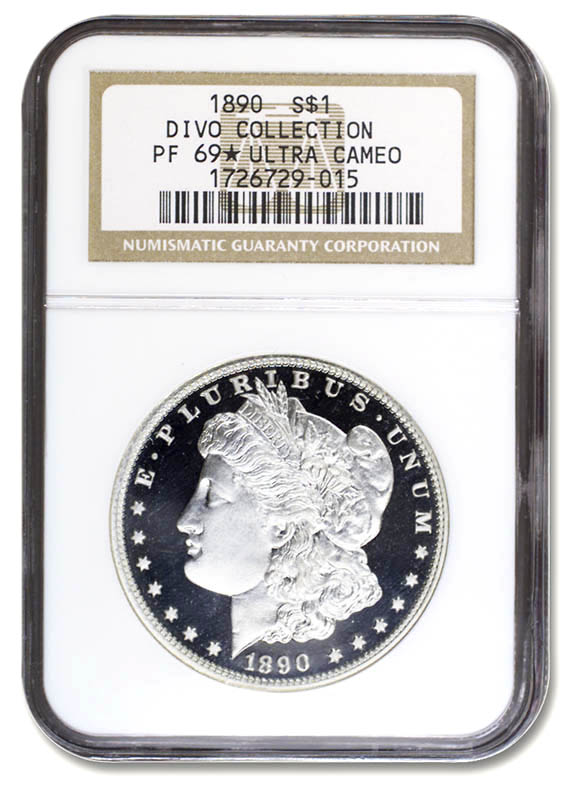 |
|
Pillar of the Community
United States
1418 Posts |
|
|
Valued Member
United States
175 Posts |
Edited by rlcbj59
01/23/2011 4:59 pm
|
|
Pillar of the Community
United States
5700 Posts |
OZ, I like the idea of your topic, is the 1893-S coin you speak of the same one pcgs labeled from the Eliasberg collection, which was toned beyond belief and sold for somewhere around 750,000.00,about a year ago? Then made its way to the Jack Lee collection?I always wondered how could any one see the details clearly enough to make a grade like that through the toning, I would also think the name involved could not of hurt !!
|
|
Valued Member
United States
287 Posts |
Dang, look at those 69's!
What kind of value do those coins have?
|
|
Moderator
United States
23522 Posts |
Permit me to mention The Coin. One expects early San Francisco mintages to be found in extremely high grades; there are a rare few between 1880 and 1881 which have been bestowed with the lofty grade of MS69. And then there is The Coin. 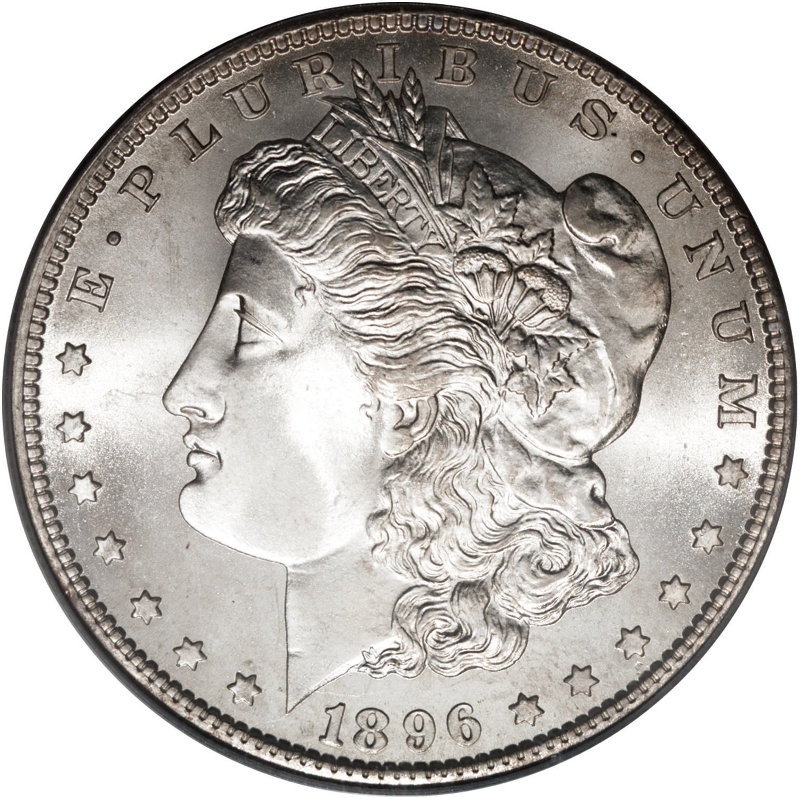 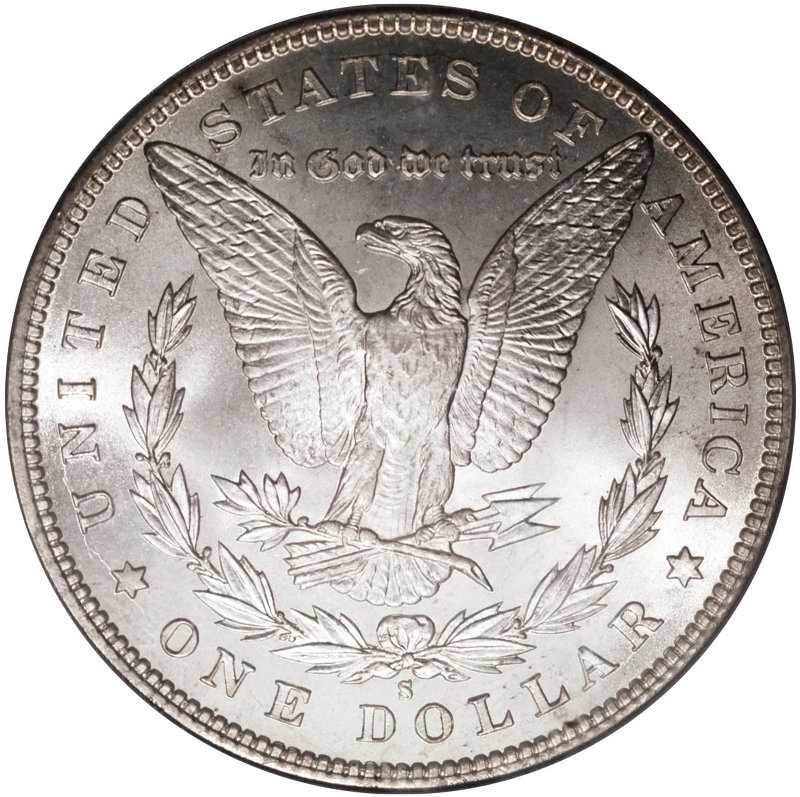 Jack Lee, the man who did it right the first time so well that any subsequent collection of Morgan dollars will always be compared against his, owned this coin and the slab bears his name. MS69 is worth $50,000 for an 1880/1881-S Morgan. If you can find one; there's only a handful and the owners ain't inclined to sell. The 1896-S MS69 Morgan sold for $402,500. You feel me? I have heard that there's an 1889 in MS69. I would give a kidney to see that coin; the selling price would reach 7 figures without a doubt. At least, I'd pay that kind of money for that coin, if I had the money to spend. |
|
Bedrock of the Community
United States
10982 Posts |
What is the best way to attribute VAMs? Websites, books, etc.? Thanks!
|
| |
Replies: 160 / Views: 13,696 |










 Posted 01/22/2011 11:51 pm


