| Author |
 Replies: 31 / Views: 4,145 Replies: 31 / Views: 4,145 |
|
|
|
Rest in Peace
United States
9104 Posts |
Proof is a method of manufacturing. Modern proofs are struck using polished blanks and polished dies, resulting in mirror surfaces on the coins. Most people prefer the appearance of proofs:
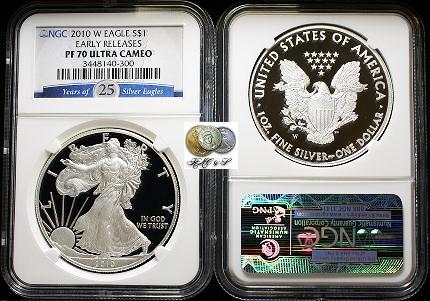 Quote:
most all I have purchased thus far has been bullion medals of silver or gold coins or bars, commemorative coins if you will, and that is totally different from a circulated coin correct? New term for you to learn: NCLT. Non-circulating legal tender. It's legal tender because it has a denomination, non-circulating because people aren't going to spend $40 on an ASE then spend it for $1. Quote:
Now then, I know I have some actual silver or gold coins, like the Liberia coins, or the Lunar coins, or a silver Panda, but I more confused about what makes a proof coin.... Basically, those are all NCLTs. Proofs (of whatever) are also called specimen or fleur de coin, and supposedly are the best example of the item. |
|
Pillar of the Community
 United States
4008 Posts |
Quote:HA just wait till you get a proof silver eagle ...its all down hill from there my friend...Im on the hunt for a reverse proof ASE that wont put me in the poor house. schmidtyss Yikes! Sounds dangerous. I'm looking at this like a soldier would a sign that says "DANGER! MINE FIELD AHEAD!". lol |
|
Pillar of the Community
United States
4008 Posts |
Quote:
ASEs are one of my favorites by far. I still wish they would introduce a new series for bullion, like what Canada is doing with the wildlife series, or Australia having the Kooks, Roos, and Koalas. In addition to the ASEs of course. - Ayejay
I agree that would be very cool. Maybe they could do that with their National Park theme? That would be sweet. There are something like 54 National Parks, so they could make quite a collection out of that. Animals would be good too, particularly animals that are native to North America... Grizzly Bear, Bison, Pronghorn Antelope, Jack Rabbit, King Salmon, Gila Monster, etc. That could be quite a collection too.  |
|
Pillar of the Community
United States
4008 Posts |
Quote:That's the beauty of it, tho. You don't have to buy proof sets. The ASE proofs are sold singly, and they are literally only a couple dollars more than the bullion versions. If you like the uncs, the proof cameos will knock your socks off. - biggfredd That is a real nice feature, for sure. Of course, even the regular uncirculated ASEs already have my socks 1/2 way off.  |
|
Pillar of the Community
United States
4008 Posts |
Quote:I am failing to understand the difference between the two you speak of Fredd, is a proof coin uncirculated dead mint, or what makes a proof ASE better for the lack of a better word, and what were they intended for? Like a template perhaps for others, this is where I need a stronger understanding of how coins are made and minted perhaps, stupid question I am sure to most, but I will never figure it out if I don't ask? - Silverhawk I was hoping someone would ask that. I'm in the same boat as Silverhawk on this one. I keep seeing "proof" coins on-line and they are indeed gorgeous but I do not know what makes them look so nice and be so special. To this question, I would add... are all "proofs" equal to an "MS grade 70 coin"? Or is that something else altogether? Can a coin, for example, be a proof but not be an MS 70 or be an MS 70 but not be a proof? |
|
Pillar of the Community
United States
4008 Posts |
Quote:
Proof is a method of manufacturing. Modern proofs are struck using polished blanks and polished dies, resulting in mirror surfaces on the coins. Most people prefer the appearance of proofs:
biggfredd
Thanks, BiggFredd. That clears the air quite a bit on that subject. Being on this web site is a great benefit to everyone but especially to those of us who are just starting to get into coin and bullion collecting. I learn several new things every time I get on here and it IS fascinating. |
|
Rest in Peace
United States
9104 Posts |
Quote:
are all "proofs" equal to an "MS grade 70 coin"? No, in fact, a just saw a recent posting of a 1964 Canadian cent in PR20. MS grades 60-70 refer to circulation strike issues, even if they were NCLT issues like the 1970d half. PR grades 1-70 refer to issues struck as proofs, with PR 60-70 grades being proofs that show no evidence of circulation, and PR 1-59 grades being proofs that show wear. MS/PR 70 simply means a coin with no defects under 10x magnification, IOW a perfect coin. Since proof coins are given more care at every step in the minting and packaging process, you're lots more likely to see PR 66-70 grades than MS 66-70 grades. You and the hawk (and prolly a few others) need to spend some time at http://www.coincommunity.com/dictionary/ This advice is the electronic version of what we have explained thousand of times over decades in our store: The least useful information in the RedBook is the prices. Before you look up the first price, read the introductory chapters. |
|
Valued Member
United States
314 Posts |
Also keep in mind, to get the shiny mirrored surface, the coin is normally struck with the dies more than once.
|
|
Pillar of the Community
United States
4008 Posts |
Quote:You and the hawk (and prolly a few others) need to spend some time at http://www.coincommunity.com/dictionary/ - BiggFredd Sounds like some real good advice to me. I will do just that. Thanks for the pointer. |
|
Pillar of the Community
United States
4008 Posts |
OK, I checked out the coin forum dictionary and found it to be a pretty good source of info. Also spotted what may be a typo: Quote:
Proof dies
Specially prepared dies, often sandblasted or acid-picked, that are used to strike Proof coins. As a chemist, I know about metal pickling with acids but do not know what "acid-picked" might be. Typo? |
|
Pillar of the Community
United States
3670 Posts |
Yes thanks Fredd for that great pic and the link, I spend to much time runnin my mouth  instead of reading an learning I will be the first to admit  , lol.... And I too was wondering about the grading system as well, so great additional question Ed, that clears much up for me  .... Edited by Silverhawk74
04/13/2011 9:08 pm
|
|
Rest in Peace
United States
9104 Posts |
Quote:
As a chemist, I know about metal pickling with acids but do not know what "acid-picked" might be. Typo? You're right, it should be "pickled". I'll let you do the honors of telling bobby. I was just giving a basic definition of the modern proof coins that most collectors are familiar with. Since frosted designs and mirror fields are popular, mints often roughen up the designs with pickling, sandblasting, etching or whatever. Striking coins quickly polishes out that roughness, so they often have to renew the dies to continue the frost effect. There are many kinds of proofs, including the "reverse proof" ASE (where frosted and mirror surfaces are opposite normal). Early LWC proofs have a matte, sandblast, or satin finish, and require an expert to tell from nice MS strikes. There are also branch mint proofs, notably New Orleans, and double thickness "piedfort" proofs, and uniface proofs. Then there are proof-likes, with some proof characteristics, but which don't qualify for full proof status. |
|
Pillar of the Community
United States
4008 Posts |
Quote:
You're right, it should be "pickled". I'll let you do the honors of telling bobby. - BiggFredd
Whoa, sounds like I am being set up here.  Also sounds like there is LOTS to learn about all this coin grading stuff and variations of coin production. I will pick up some of this slowly but am really much more interested in bullion coins, rounds, and bars. |
|
Rest in Peace
United States
9104 Posts |
What I'm trying to get through to you is that in normal markets, there's a huge price difference between average and exceptional.
Bullion prices have pushed up the lower end material, but not had much effect on the quality stuff, much like a 20% increase in the minimum wage doesn't mean the $50k guy gets $60k. Might as well take advantage of this situation and pay a little bit more for scarcer/nicer stuff.
|
|
Valued Member
United States
314 Posts |
biggfredd is right on target, I have been targeting the higher grade silver. You can still find it at spot mostly because the metal value has overtaken it's numismatic value, so why get the culls?
|
| |
Replies: 31 / Views: 4,145 |








 First Page


 Posted 04/13/2011 01:32 am


