Coin Community Family of Web Sites Join Thousands of Coin, Bullion, & Money Collectors
Royal Canadian Mint products, Canadian, Polish, American, and world coins and banknotes. Specializing in Modern Numismatics Shop for APMEX Bullion on eBay!Coin, Banknote and Medal Collectors's Online Mall 300,000 items to help build your collection! Join Thousands of Coin, Bullion, & Money Collectors Vancouvers #1 Coin and Paper Money Dealer


Username:
Password:
Save Password
Forgot your Password?


This page may contain links that result in small commissions to keep this free site up and running.

Welcome Guest! Registering and/or logging in will remove the anchor (bottom) ads. It's Free!

1-St Spanish/Mexican 8 Reales (1797 Carolus IIIi)

To participate in the forum you must log in or register.
Author Previous TopicReplies: 31 / Views: 21,176Next Topic
Page: of 3
Valued Member
RealPeso's Avatar
United States
426 Posts
 Posted 04/24/2011  7:21 pm Show Profile   Bookmark this topic Add RealPeso to your friends list Get a Link to this Message Number of Subscribers
Hello Everyone!

I finally made the leap from Mexican Cap & Rays 8 Reales to their predecessor, the 8 Reales minted under the Spanish colonial government. I belive this one is called "portrait dollar" can some one confirm?

There are a lot of similar things like size, and weight compared to the Cap & Rays but the different edge and stamp design is a whole new ball game for me. I browsed a lot of previous threads regarding these and compared my coin to many.

Ultimately I feel good about it being real but I still need all of your opinions to make sure because I still have a couple doubts since this is my first one.

Weight: 26.83G also passed magnet test and sounds like similar sized silver coins.

Stamp/Design: The stamp looks like the original to me when comparing but check out the dot to the left of DEI. There isn't supposed to be one there. A few people who have taken a look at the coin have stated that it is a small chopmark and when I look at it under magnification it definitely looks like a chop mark and not like the dot after the DEI and on other lettering but WHAT do you guys think? Someone also mentioned it might be a assayer mark and not a chopmark?

Edge: I located one overlap pretty easily under the 1 in 1797 but the other one was REALLY hard to locate or what's left of it at least. There was some damage to the edge in various parts but it seems ok.

Size: I would estimate this being as around 38.5mm to 39mm in size because it is slightly bigger than the Morgan dollar and also bigger than the early date Mexican Cap & Rays and those are around 38mm.

Please take a look and let me know what you guys think! I really hope it turns out to be legit because I really like it and I want to obtain more.

1-St-Spanish/Mexican-8-Reales-1797-Carolus-IIIi

1-St-Spanish/Mexican-8-Reales-1797-Carolus-IIIi

1-St-Spanish/Mexican-8-Reales-1797-Carolus-IIIi


Here are what I believe to be the two "overlaps" that I read these coins were supposed to have.

First overlap under the 1 in 1797.
1-St-Spanish/Mexican-8-Reales-1797-Carolus-IIIi

Second overlap opposite the 1, slightly to the top right of Carlos's head.
Was VERY hard to locte, I still have trouble seeing it but I belive it is a overlap.
1-St-Spanish/Mexican-8-Reales-1797-Carolus-IIIi
Edited by RealPeso
04/24/2011 7:25 pm
Pillar of the Community
swamperbob's Avatar
United States
5362 Posts
 Posted 04/24/2011  10:35 pm  Show Profile   Bookmark this reply Add swamperbob to your friends list Get a Link to this Reply
Congratulations - on your entrance into the Portrait series of 8Rs.

I can confirm that this is a "Portrait Dollar" - in China it was referred to as a "Bustman" dollar and it was legal tender in China until 1933.

You did a very good job of isolating the two overlaps in the edge application. The coin was apparently edged using the correct type apparatus. And based on the slightly distorted circles and the lack of deformation in the dentils - the coin was edged BEFORE it was struck in an open collar press. The strike is NOT perfectly centered as it would be IN COLLAR.

I also want to say that the series of EDGE pictures was FANTASTIC. Each photo showed the edge clearly and at the same time provided a clear indication of location of the pictures in relation to the face of the coin so that we can measure where you are on the coin. The pictures you took could be used as a tutorial on exactly HOW TO properly photograph an edge.

The weight is dead on for an original 8R in this condition (in my opinion) and I would BET it is 900 fine silver - but an SG can confirm that.

You are absolutely correct that it is a circular chop ahead of the word DEI and not a raised STOP. It is NOT a die variety. The Chinese were often "humorous" in their placement of chops. On the Cap & Rays they often give the eagle a BIG EYE. When I used to fool around with a punch set and US quarter dollars I used a Y punch to put a necktie on the eagle. I did way over 2,000 of those and placed them into circulation in 1998 and 1999. Only got one back.

The question of originality of this coin will cause a debate among the two schools of thought regarding Full weight Silver Bullion copies. I believe you may have come across a 5th die variety for the "Boston" type forgeries of 1797. In my collection, which I have finally photographed in preparation for publication, I have 4 different "Boston" die pairs for 1797. I think this one may be a 5th coin from the same era.

This is definitely NOT bad news - if it can be conclusively proven.

The date is common and the coin has been cleaned so it's premium value is average for the series. It may bring slightly more as a "Boston" type than as an original.

I need to explain just a bit at this point that "Boston" is the name I use for the full weight silver coins made for the China overseas trade in several locations in the US and OUTSIDE the US. The reason was simple - the Chinese merchants preferred to do business with people who paid in Portrait 8R silver coins. They paid a PREMIUM OVER FACE VALUE for high grade Bust coins. Those are simple facts. But in the 1870s it was getting VERY HARD to locate high grade Portrait 8Rs. They were available worn - they were after all at least 50 years old by that time. But the originals were soon used up. What then?

Silver was plentiful after 1873 because of the Comstock discovery. In fact, there was a glut of silver in the US especially. We tried making Trade dollars to compete in China but they were not 100% successful. The Cap and Ray coins were successful but the Chinese TRUSTED the old Bustman over all others.

The "Boston" forgeries as a class are the product of this need. They are coins manufactured at full spec after the 1873 time period by commercial ventures in the US, UK and elsewhere.

But as I said, there is a second school of opinion that believes these coins are COMPLETELY REAL. We are engaged in an off and on debate that I have been part of since first going public with my opinions over 20 years ago.

The debate in part centers on whether these coins should be properly described as RESTRIKES or Counterfeits. They are very much like the Maria Theresa Thalers from Austria. Everyone knows that they are not real products from 1780. The VAST majority are RESTRIKES and some were made in places other than Austria. It is my opinion, that the Portrait Dollar must be viewed in a way that is similar to the MTT.

Recently the debate took an unexpected turn when it was discovered that one of the mints that was apparently involved in the production of Portrait 8Rs during the 1870-1900 period was Mexico City itself.

I am working to prove that linkage (so far no firm success). But I have determined that the Mexican Government was prepared to restrike the Portrait series under a lease concession with the US in 1870. They were well aware of the demand for high grade (MS) Portrait 8Rs in China and someone supplied that need. IT WAS DONE. But who did it and under what authority is another issue altogether.

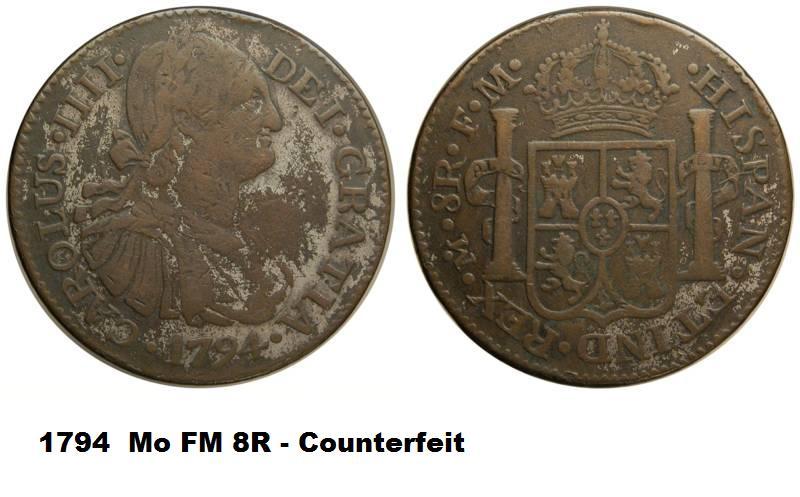
In the debate, both sides will acknowledge that there were very well executed NON SILVER forgeries made using technologies available only after 1850. We both agree that these NON-silver strikes are COUNTERFEIT. These HIGH quality non-silver strikes are made from dies that in some cases are identical with what I have been referring to for years as the "Boston" type forgery.

As I indicated, both sides of the dispute classify the non-silver coins as counterfeits. But I classify the silver examples as Counterfeits as well if the edge is improperly applied OR if the edge design is INCORRECT. The opposition thinks the silver coins are all RESTRIKES.

Where and when this debate will be settled is uncertain. But now, that the term RESTRIKE has been introduced, the status of the class as simple counterfeits is less certain.

I contend that the Mexico City RESTRIKES may simply be indistinguishable from the original Mexico City issue. It may have been done intentionally. But I ask if it is even plausible to think that the restrikes would use an altered design for the edge?

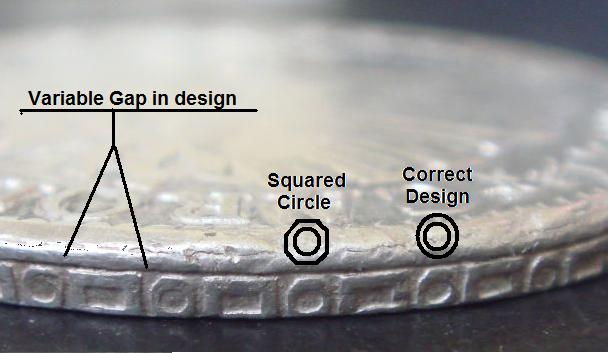
Your edge falls into this latter category. The circles in the design on your coin are NOT circles inside and out. The insides are fairly circular (you need to allow for a bit of strike distortion making them slightly ovoid) but in any event the distortion of the outside of the circle should mimic the distortion of the inside of the circle. Yours are two different shapes.

Look closely at your edge design::


1-St-Spanish/Mexican-8-Reales-1797-Carolus-IIIi

If you notice the centers of the circles are well rounded but the outer edges are NOT. The corners are squared off. This is an edge I have never associated with Mexico City. However, perhaps they did alter the edge to identify the "Restrikes". That is the contention of the other side. These are RESTRIKES.

The middle ground of the debate centers on UNDERWEIGHT and INCORRECT ASSAY coins that share similar edge traits. There are underweight coins that exhibit the traits - is a 25 gram 8R a "FRAUD" - we all agree YES but is it a Counterfeit draws a less clear answer. When it comes to incorrect alloys I get the same reply - it could happen even with an original. But I also have some other "ODD" examples of coins I classify as "Boston" types. How about a Charles IIII 8R dated 1817. That's nine years after Ferdinand VII took over. Would Mexico City make that error? How about assayer initials FM on a Ferdinand VII 8R from the teens - would Mexico City have made that error?

I would be very interested in the SG of your coin. Is it 10.31 as it should be?
Valued Member
RealPeso's Avatar
United States
426 Posts
 Posted 04/26/2011  12:00 am  Show Profile   Bookmark this reply Add RealPeso to your friends list Get a Link to this Reply
Hey swamperbob and everyone else reading this!

First off THANK YOU for welcoming me into the world of Portrait 8R's! I got a feeling that I am on course for another addicting neverending qwest as I am with the Cap & Rays. Thank you for your comprehensive response, I will definitely be copying it into my personal files for reference as I am sure that this knowledge will come in handy as I pursue more of these coins.

Also thanks for the comment on the pictures, after reading a lot of your previus postings I realized that accurate pictures were crucial whenever requesting opinions on this type of coin and the cap & rays for that matter.

I am glad to know that your opinion regarding weight and the circular chop matches what I thought but I NEVER expected to be thrown into the mysteries of the "Boston Forgeries" so soon!

My heart dropped when I read that there is reason to believe this might be another die variety of these copies because I have always tended to shy away from any counterfeits being contermporary or modern but from what it looks like these "Boston Forgeries" are a whole different situation because it appears they were the same as originals just not minted in the same time frame and definitely NOT a counterfeit in the traditional sense.

Sorry swamperbob but I am intrigued now and it has brought on a whole slew of questions to mind.

1). Is there any chance that my coin is still a original Spanish 1797 or are we definitely looking at a coin minted after 1797 be it classified a restrike or counterfeit?

2). Was the premium for Portrait 8R's really so great in China that it could trigger the restrikes to be minted? I mean I've read that some of the merchants were already paying up to 15% for Mexican Cap & Rays, how much more were they willing to pay for the portrait dollars? Why not just mint some Cap & Ray restrikes?

3). How did the "counterfeiters" get the stamps and edges so accurate on the restrikes? I doubt it if original dies were stil available because it had already been at least 50+ years since the last Spanish 8R's were minted and those were the Ferdinand style. Why not restrike those instead of going back to the Carolus IIII design?

4). What would the purpose be of minting restrikes in different dates if at this point in time they were just bullion?

4). If the restrikes/counterfeits were made possibly by different people in different nations wouldnt the coins show more pronounced differences than just minute edge style differences and woldnt modern technology and minting techquines show some way like steam presses vs screw and in collar press vs open. Even the die rotation would be different in the late 1800's but on this piece it is still the colonial medal die alignment?

I guess in short, how did these guys get everything SO right? It boggles my mind.

Sorry for so many questions swamperbob, this is truly interesting and I coulnt wait to get back from work to spill it all out here!

As far as the SG is concerned I am going to have to get back with you because I have never done it before (severe lack of science/math skills) but I dug up some of your old postings regarding how to do it and I might have to give it a try as soon as I have some time to figure out how to do it.

Thanks and I appreciate any opinions or comments that anyone might have!!
Pillar of the Community
swamperbob's Avatar
United States
5362 Posts
 Posted 04/26/2011  12:59 pm  Show Profile   Bookmark this reply Add swamperbob to your friends list Get a Link to this Reply
RealPeso To answer all of your questions might take a book.

I will attempt to answer briefly - not quite in your order.

1.
Quote:
Is there any chance that my coin is still a original Spanish 1797
Yes it could be, but I doubt it. I have learned that there are cases too close to call. For your coin to be real (read to mean original 1797) would require an odd edge die - but so many were made that nothing is impossible. I use a preponderance of clues basis when I review any coin.

Then again, your coin could also be Mexican Government restrike made using original techniques and materials. But either way it is worth the effort to study it.

1A.
Quote:
How did these guys get everything SO right?
I moved this from last to second because it ties in with number 1. One of the problems is that Mexico still (TODAY) has some of the original dies, punch sets, casting blocks and striking apparatus to make coins just as they were made in 1797. I know a man who has seen them in the vault. He was not even allowed to make a list of the dies he saw. So theoretically at least, Mexico is/was capable of making very well executed restrikes in the 1880 era and TOMORROW. Remember that Mexico was also looking for ways to profitably sell silver bullion in the 1880's and 1890's on a falling world market.

2).
Quote:
Was the premium for Portrait 8R's really so great in China that it could trigger the restrikes to be minted? I mean I've read that some of the merchants were already paying up to 15% for Mexican Cap & Rays, how much more were they willing to pay for the portrait dollars? Why not just mint some Cap & Ray restrikes?

The easiest answer to this last comment about making C&R coins is "perhaps they did". But I see no reason for them to have done so. From my reading, it was the Portrait coin that commanded the premium in the form of a credit on merchandise purchased and not so much the Cap and Ray coin. Granted both coins were preferable to the US Trade dollar or Balance Scale Peso, but Mexico pumped out such huge numbers of C&R coins that the demand could be met by normal production. The Portrait coins filled a different niche. Some Chinese merchants preferred the older trusted "Bustman coins" to the very variable and plentiful C&R versions. So demand for lightly circulated Portrait dollars existed. The RESTRIKES - Mexican or otherwise fit the bill.

Regarding the first part - was the premium so great etc. Well, at this same time in history people were wearing original coins down by shaking them in canvas bags of sand to remove 5% of the silver content. They could refine the sand and return the worn coins at face value. Gaining 5% in the process. It that a lot of work? So I guess it is one's perspective that matters how much profit is enough. In times of economic hardship when money is hard to come by a 5% advantage is enormous and a 15% advantage unheard of.

3).
Quote:
How did the "counterfeiters" get the stamps and edges so accurate on the restrikes? I doubt it if original dies were still available because it had already been at least 50+ years since the last Spanish 8R's were minted and those were the Ferdinand style. Why not restrike those instead of going back to the Carolus IIII design?


As noted above, Mexico still has some of them and more importantly the master casting blocks from which the original die punches were made. Mexico could re-tool from scratch at any time and make PERFECT copies. In the 1880's various technologies had been introduced that allowed an accurate image to be transferred to a die. The group I am most familiar with (which gave rise to the Boston reference in my categorization) used a one to one panto-graphic lathe to make accurate dies that were retouched.

But you also ask why not make Ferdinand VII coins? Well they did! One of the most common Boston types is the 1821 Zs RG copy. I own 49 counterfeit Portrait 8Rs dated 1821 - it is the most commonly forged year. But again, I would point to familiarity being the prime mover for RESTRIKES. A forger making coins for circulation always makes common coins - the types that the mark never looks twice at. The RESTRIKE makers I submit used the same guiding principle. If you recall Mexico was at war with Spain in most of the Ferdinand era so that could have effected the number of 8Rs exported to China at that time. Charles IIII 8Rs were made in a more stable era and were/are very well known in China. So I see no real issue in the fact that most restrikes would have been made of the most familiar type coin namely the Charles IIII type.


4).
Quote:
What would the purpose be of minting restrikes in different dates if at this point in time they were just bullion?


I think it is because of several very different reasons. If you were Mexico you likely had different date dies on hand already so why make new ones. If you were making new dies you could date them with whatever date you wanted. Perhaps the die sinker's anniversary? This RESTRIKE business was one of those "open secrets". The origin of the coins and the fact that they were really RESTRIKES was not a big topic of discussion. If the Chinese heard about it they might baulk at paying a premium. So while it was not against the laws at the time and while they passed easily no one went around advertising that they made RESTRIKES on the Internet.

In addition, unscrupulous makers of these Restrikes almost immediately start shortchanging the amount of silver to increase their own profit margin.

Some of the high quality SUPER COUNTERFEITS that I hear about coming from China today could simply be old "Boston" coins coming back at us. Payback is a .

The fact that there are many oddball dates in silver and in off metals is beyond dispute. I own several examples, but why they were made is unknown. Remember when dealing with numerous unrelated groups there are different motivations present. Perhaps the forgers were doing it to see if anyone noticed. You see too many very common 8R types with fantasy elements for me to believe they were all mint errors.

They are also too common for me to believe that they are all MODERN NUMISMATIC forgeries either. How many 1817 Charles IIII 8R can you sell as mint errors before the word spreads and they are identified as fakes. The cost today makes no sense versus the market. They could get away with ONE - not dozens, hundreds or thousands. But as a Restrike going to China - who would notice the date of 1817 or even an 1870 Charles IIII?

4).
Quote:
If the restrikes/counterfeits were made possibly by different people in different nations wouldn't the coins show more pronounced differences than just minute edge style differences and wouldn't modern technology and minting techniques show some way like steam presses vs screw and in collar press vs open. Even the die rotation would be different in the late 1800's but on this piece it is still the colonial medal die alignment?


I said up above that I use a preponderance of clues. Die rotation is easy because everyone knows the Spanish Standard rotation. A coin rotation draws suspicion and is usually only seen with reeded edge fakes.

But there are in fact many other clues that point to methodologies which I use to distinguish the various types of forgeries. I have been hunting for these forgeries (Portraits I call Boston) since I first heard of their existence back in about 1959. I had the distinct advantage of having spoken personally to a man who was involved in the Restrike production before it ceased about 1930. His group fabricated 900 fine silver Portrait 8Rs for a Boston broker who dealt with China. They were a large producer making tens of thousands a month. He was a tool and die man like my uncle which is how I got to meet him. He told me over time, a lot about what he did and how it was done. He was old and liked the attention. I was 10-13 and ate it up.

Some of the clues to Boston RESTRIKES and later forgeries like the closed collar strike are published and well known. The same can be said for most materials and methods used. You can't for example use electroplating to coat copper strikes BEFORE the technology was employed. So all of those clues (many of which I have spoken about repeatedly) are open season so to speak. We know about them and so do the forgers. But other clues, those that have never been published but which I have picked up by experience and a lot of reading will remain secrets. I am concerned that modern forgers especially will correct their work. Many forgers still continue to make the same errors over and over again and if I pointed them out they could correct what they are doing wrong. I do not and never will disclose all of my clues.

Edited by swamperbob
04/26/2011 1:29 pm
Pillar of the Community
MathieuMa's Avatar
France
1591 Posts
 Posted 04/27/2011  04:45 am  Show Profile   Bookmark this reply Add MathieuMa to your friends list Get a Link to this Reply
Thanks again for this overly interesting thread :)
Valued Member
ram96's Avatar
United States
417 Posts
 Posted 04/27/2011  06:07 am  Show Profile   Bookmark this reply Add ram96 to your friends list Get a Link to this Reply
The history of these and pillar coins is fascinating and just adds to the appeal. swamperbob are you doing a book on these coins?
Valued Member
RealPeso's Avatar
United States
426 Posts
 Posted 04/28/2011  01:47 am  Show Profile   Bookmark this reply Add RealPeso to your friends list Get a Link to this Reply
Hi swamperbob!

Sorry to throw so many questions at you, I just kept thinking of so many things. Thank you for taking the time to look at this coin and comment.

I did have one more by the way.

Is there any estimate or guesses regarding mintage of the full weight "restrikes" that were minted in the late 1800's to early 1900's?

I know there probably isn't a way to tell for sure but if you are running across them sporadically then this means the survival rate is high which could indicate that a large number were minted?

I guess I consider myself lucky that my first "portrait" 8R is a possible "boston type" because it does add much more appeal to this kind of coin as a previous person mentioned. I just wish there was more mainstream exposure on the subject in the way of articles, research, books, websites etc.

I will be looking forward to any of your publications in the future that you are working on. They will be a tremendous help and the knowledge that youve gathered up cannot be lost.

Hopefully this weekend I'll rig something up to do that SG test and I can post the results.
Pillar of the Community
swamperbob's Avatar
United States
5362 Posts
 Posted 04/28/2011  12:30 pm  Show Profile   Bookmark this reply Add swamperbob to your friends list Get a Link to this Reply
ram96 I thought I had answered yesterday, but I guess not, I am in the process of co-authoring a book on counterfeit Portrait 8Rs. I can not discuss any specifics but anyone who knows me also knows that a book up dating Riddell's work has been my objective for many years. It will be in two parts - first this collaborative effort involving the Portrait coins and then a more voluminous book on the Cap and Ray forgeries. I am alone on that second effort so far.

RealPeso You ask "How many Boston types were made?" That is the $64,000 question there. (Boy am I dating myself with that one.) Most of you young guys will have to google that reference.

But the number of "Boston types" produced is a question I have been pondering for years. Millions is a virtual certainty given the production rates and duration of the New Bedford operation alone. I was informed that they supposedly delivered nearly 300,000 coins over a period of several years and it was one of the smaller operations. Because of the nature of this work, documentation is exceptionally sparse. I have heard from a researcher at Stanford University that a contract was actually discovered in the Harvard Library archives that provided for a monthly delivery of 10,000 silver Portrait coins to a Salem merchant in the 1870's. The duration was not specified but it matches the NB monthly output in 1930. All of the manufacturers of this type must now be dead (the work ended by 1933 - 78 years ago - when the Bustman was demonetized in China in favor of the Fatman.) So talking to those involved like I did as a kid is likely impossible. How many facilities were making the fakes is also unknown. I am fairly certain that there were rings in Mass, Southern Maine, California, Birmingham, England, France and Mexico. The Mexico output was likely sanctioned by the Mexican Government to sell silver so those are technically RESTRIKES. There may have been many other locayions involved.

I have been struggling with how to make an estimate for Bostons for years but I think I can get a feeling for the magnitudes by comparing the survival rates of the three main counterfeit groups - the Birminghams - the Riddles and the Bostons. The number we see today on a relative basis should point to original numbers with some tweaking for age and survival rates.

For the Birmingham emission, we do have some old projections that were published in 1903 (Bordeaux) and that article reports other data from 1797 written by the Spanish authorities who discovered the plot originally. I can also look at the other known period estimates available like the work of J.L. Riddell.

In the period 1839 to 1844, Riddell reports that 90% of the circulating coinage in the US was Spanish American or Mexican in origin. The scope of the estimate is not specifically given. Riddell was a mint employee at New Orleans but did research for his book in Philadelphia as well. Riddell records NO BIRMINGHAM forgeries in his book so they were already going out of (or actually out of) circulation by 1839. At least Riddell found none of the type between 1839 and 1844. So I would expect to find far fewer Birmingham forgeries than other contemporary forgeries.

Riddell also says that 1 in ten coins in circulation was counterfeit - that means (if he is accurate) that 9% of all circulating coins in the entire US were circulating COUNTERFEITS of Spanish American or Mexican types. That is MILLIONS of dollars.

So there were millions of fakes made and in circulation in 1844. That is a huge number but believable. Riddell lists 292 counterfeit coins but only 33 (11%) were Portrait types. He lists 8 from other countries (2%). That leaves 250 Cap and Ray Mexican 8Rs as the primary form of forgery seen (87%). The end result is that of the 9% of all coins that were forgeries in circulation in 1844 about 1 percent of all coinage was Portrait type COUNTERFEITS. I need to find out the total amount of money (specie) in circulation in the US in 1844 - but 1 percent of that amount was counterfeit portraits and 8% counterfeit Cap and Ray types.

Those are the facts about the original populations of Birmingham and Riddell forgeries. You can reasonably conclude from the facts that - both were produced in the Millions of copies.

There is one special circumstance in relation to the Boston types that makes them different. They sneak by as REAL!

So if you compare the numbers of Bostons versus Riddells and Birmingham types based on current survival - you can demonstrate that it is logical to think in terms of MILLIONS of copies.

Another way to think about it, is that a direct comparison between surviving REAL portrait coins and Bostons should be about equal to the original production amounts. This simplified approach results as an outgrowth of the last conclusion above, that Bostons are still hiding out as real.

The first estimate treats Bostons as counterfeits that would have been REMOVED as they were found (hence it would theoretically provide a low estimate). But the second method would produce a high estimate because it assumes NONE were removed from circulation disproportionately to the originals.

I really favor the second approach - or lean towards it. I have such a hard time getting some experts convinced that the Bostons still exist that I believe they survived at rates very similar to originals because no one ever noticed them. We should be able to estimate how many real Portrait coins were made by researching Spanish records - (100's of millions I expect) so if we compare present discovery rates we should learn something about production magnitudes.

So what I have been working for three years is a correlation of data on survivors. I do so in a couple ways, one is by tracking the auctions appearing on ebay. I have detailed records for 3 years. I know several Birmingham die types very well and can pick them out instantly. They are the MOST common of the Portrait forgeries. They are rarer than the Riddell types and the Riddell types are rarer than the Boston types. Part of that obviously is survival time. But, as noted above, in addition the Boston types are actually silver and still pass unnoticed so survival is likely higher.

I can compare my theories to my ebay statistics for the past three years. That covers some 450,000 auctions (Mexico only). In that time period about 2700 Portrait 8Rs have appeared and less than 3% of those (85) were Contemporary Circulating Counterfeit Portraits of the early type. In that same period, I have only see 5 Riddell portrait counterfeit coins posted on ebay. That is 2/10ths of a percent. But that fact supports the Riddell data that most Birmingham forgeries were removed from circulation quickly. In that same period I have spotted over 200 coins with characteristics of Bostons that are visible on the auction photos (usually because an edge picture is included) - so about 200 out of 2700 were Bostons (7.4%). This would lead to the conclusion that 7.4% of the total Portrait issue could be Bostons - that is 10's of millions.

When I check Portrait 8Rs in large groups at shows - I find 1 Birmingham per show if I am very lucky but I find that 1 in 10 Portrait coins in general has some of the Boston Characteristics. This is a close correlation with the 7.4% of ebay because not all Bostons show clues on their faces and many ebay auctions show only the faces of the coins.

So there you have my present thinking about macro-populations. Figure out how many 8Rs were made and multiply that by 7 to 10 percent and you have the best estimate of Boston forgeries I can come up with.

It is HUGE but fewer than the originals - so Bostons are scarcer than originals by a factor of 10.

Are they worth 10x as much as originals? - NO WAY!

Why? Because there are far fewer people interested in collecting Counterfeit 8Rs than originals. Most collectors avoid them and do not know the history anyway. But in terms of rarity ONLY, the counterfeits in general are scarcer than the originals.

For anyone interested - the statistics on C&R forgeries are as follows (limited to the Riddell period of dates before 1845):

Total C&R 8 Reales - 2058 coins of which 158 were contemporary circulating types - 7.6% of the Cap and Ray population on ebay. Of these only 25 were properly identified as Contemporary Counterfeits.
Edited by swamperbob
04/28/2011 12:33 pm
Pillar of the Community
MathieuMa's Avatar
France
1591 Posts
 Posted 04/29/2011  04:26 am  Show Profile   Bookmark this reply Add MathieuMa to your friends list Get a Link to this Reply
Wow, those numbers are impressive ! 10% of all circulating US money counterfeit by then ...
Thanks again for sharing your knowledge :)
Pillar of the Community
swamperbob's Avatar
United States
5362 Posts
 Posted 04/29/2011  10:56 am  Show Profile   Bookmark this reply Add swamperbob to your friends list Get a Link to this Reply
MathieuMa The situation (the large number of foreign coins and forgeries of those coins) makes perfect sense if you place it in historical context. While the US was a British Colony it was treated unfairly "by law" in monetary matters. Counterfeit coins were effectively dumped in the colony because the colonists had few options. To support commerce "local replicas" were made and foreign made forgeries were imported. This lack of good hard money is one reason so many "counterfeits" of the period show extensive wear. Many (the majority) are in fact well past the point where the forgery was obvious, but the wear continued until the thin silver plates were virtually gone in many instances. Here is Birmingham variety rather well worn.


1-St-Spanish/Mexican-8-Reales-1797-Carolus-IIIi

The situation was actually worse in Canada where there was a government study done as late as the 1870s that reported that thousands of different counterfeit types were taken from circulation. (That study unfortunately lacks pictures of the coins.) As I recall the estimates of the percentage of counterfeit coinage in circulation in Canada was far higher than the US. One factor of course is that Canada remained a colony until the 1850's so the report in the 1870's might mimic the picture of coinage in the US in the first decade of the 1800's (20 years after independence more or less).

Haiti was another colony where the substitution of "token" base metal coinage by the "mother country" (read Bad Mother) for silver was extremely common. Most Haitian counterfeits were French in origin. Krause only recently reclassified the "silver plated copper" versions of the coinages of Petion and Boyer as counterfeits and removed them from their Guide Books.

Real silver was HOARDED in times of economic difficulty pure and simple. Much like Today. It is a fact that has repeated itself over and over through history.

But it was not just the silver coins that were forged. Copper coins were made by the State Governments and many private interests. Non-Regal issues some made very crudely by "Blacksmiths" also proliferated. The fact that these did circulation is beyond dispute. They are now an important sub-set of the Colonial Numismatic scene and one of the few counterfeit classifications that ebay recognizes as a legitimate collectible.

So the colonial period of restricted access to stable Hard Money led to the first instance of high rates of forgery.

There was a second period of History equally as important to US coinage and which was the direct cause of a period of increased forgery. That period was the Hard Times of the 1830's. The situation then actually may have been worse than in colonial times. US silver coinage - what little existed - disappeared from circulation entirely. It was hoarded by the people who had money and didn't trust Banks or Paper money. It became so bad that an entire series of base metal tokens sprang up minted by everyone and their brother so to speak. These underweight copper and brass tokens substituted for US copper coinage which was disappearing too. At the same time, a second wave of forgery of silver coins arose. That the Mexican C&R coinage was the target of this second period of forgery is beyond dispute. It is well documented in J.L. Riddell's ground breaking work "Monograph of the Silver Dollar, Good and Bad" (1845). The Cap and Ray 8 Reale series is THE PRIMARY FORGERY OF SILVER COINAGE made in the Hard Times period.

But in both these two early historical situations, the colonial US and the Hard Times, forgery was rampant. Silver dollars as tokens for real money were far less acceptable in commerce than underweight coppers. So we tend to think of the Dollar coins as true Counterfeits and relegate them to the trash bin, while we refer to the base metal copies as Non-Regals or Evasion Tokens. The two classes are both the same thing. The Evasion Coppers and Hard Times Tokens have always been recognized as a US monetary item and have had collector interest for many years. They have their own set of collectors and they are treated as a distinct form of US currency.

But what about the silver coinage? Why avoid it?

My thesis is that the foreign silver Dollar forgeries that circulated in both eras (the Colonial Period and the Hard Times) were also a definite part of US commerce (albeit a fraudulent part) and that they both legitimately belong in a classification of US Numismatics.

The majority of the Spanish American Colonial and Mexican forgeries were NOT made in their ostensible "countries" of origin. The counterfeit Portrait Dollars were primarily made in England (Birmingham) and a smaller number in the US. The Mexican counterfeit Cap and Ray 8Rs were produced primarily in the US but also in England (Birmingham) and France.

So the fact is that counterfeits did circulate in some form of "acceptable arrangement" of token trade. The US had no source of raw silver other than commercial sources, so the wholesale replacement of the monetary base was impossible. The government could not buy silver at a premium cost and then make full weight coins - it would be a big loser - a financial disaster for the struggling new nation.

In this situation, US coinage was NOT the primary medium of commerce in the new Republic. Foreign silver - especially Spanish American was the currency behind commerce in the US. That fact while well known is ignored by some Colonial coin collectors and virtually all collectors of early US coins. The coins of the common man were WORN Spanish American and Mexican coins - not the coins made at the US mint in Philadelphia. It is simply a pro-US mint prejudice that keeps us from seeing that.

So if you like I, am really interested in collecting what the average man on the street - or even the average man in commerce used for money on a day-to-day basis say in 1810 or 1839 - do not look to the US mint products but rather to the worn foreign coins that substituted for hard money under protection of law until 1857.

In direct contradiction to Keith Davignon's contention about the Bust Half being the work horse of US monetary system - I submit that the coin most often used in commerce and most often forged in periods of crisis was NOT the US Bust Half but first the Portrait 8R and then the Cap and Ray 8R of Mexico. Those are truly the coins that the US economy was based on for the first 5 plus decades of the United States existence as an independent country.

But the second part, the Hard Times, is a different story that I plan to cover in my second book. My dream book - the update of the work of Dr. John Leonard Riddell.
Edited by swamperbob
04/29/2011 11:22 am
Valued Member
RealPeso's Avatar
United States
426 Posts
 Posted 05/01/2011  5:16 pm  Show Profile   Bookmark this reply Add RealPeso to your friends list Get a Link to this Reply
Hello guys! Hi swamperbob!

Wow, that's some very impressive info swamperbob. Many thanks!

I FINALLY got done doing my SG test on this piece and I'll get to that in just a second.
Lemme catch up with the previous postings first.


Quote:
But other clues, those that have never been published but which I have picked up by experience and a lot of reading will remain secrets.

I am glad for this swamperbob and I understand completely, I have often wondered myself how much of this knowledge is falling into the wrong hands and put to the wrong use.

Quote:
Millions is a virtual certainty given the production rates and duration of the New Bedford operation alone.

Looks like the probability of this is very good considering the records youve kept on how many you run into.

Quote:
In the period 1839 to 1844, Riddell reports that 90% of the circulating coinage in the US was Spanish American or Mexican in origin.


Quote:
In direct contradiction to Keith Davignon's contention about the Bust Half being the work horse of US monetary system - I submit that the coin most often used in commerce and most often forged in periods of crisis was NOT the US Bust Half but first the Portrait 8R and then the Cap and Ray 8R of Mexico

It really is a shame that most people don't even realize this, from the bits and pieces that I've studied and researched I believe it 100%. As a matter of fact I have belonged to other sites dedicated to metal detecting, treasure hunting and such and many many times people have unearthed caches from the early 1800's with CAP & RAYS. Some people don't understand why or think that that their going to find US coinage but the reality is that the 8R's were circulating everywhere back then.

I guess I shouldn't say it's a shame though, because if they were more popular I wouldn't be getting the deals I'm getting now on 8R's.

Considering the fact that most of the 8R's were exported out of Mexico and never went back means that they are practically American coins too and shouldn't be viewed as just "foreign". And when I look at super expensive bust half dollars and early date Seated Liberty halves I think to myself "there's a very good chance that was made from a melted down 8R", especially the ones from the New Orleans mint.


Quote:
But the second part, the Hard Times, is a different story that I plan to cover in my second book. My dream book - the update of the work of Dr. John Leonard Riddell.


To tell you the truth swamperbob, this is the badboy I am crossing my fingers for! Since the majority of my 8R's are all Cap & Ray this update would be the best thing since "resplandores" in the world of Mexican 8R Cap & Rays.


SG

Well now to the SG result on this 1797 8R.

At first I kept getting everything from 10.35 down to 10.12 but after fine tuning everything and getting the hang of it more or less I got a SG of 10.20

My result probably isn't 100% accurate but for a newbie I am pretty content that I got the hang of it "somewhat".

What I learned is that it is a very delicate process because anything can give you a different result like bubbles, temperature, impurities, wind, movement but I believe the 10.20 is pretty close.

What do you think swamperbob is this a pretty good result?


Edited by RealPeso
05/01/2011 5:20 pm
Pillar of the Community
swamperbob's Avatar
United States
5362 Posts
 Posted 05/01/2011  8:33 pm  Show Profile   Bookmark this reply Add swamperbob to your friends list Get a Link to this Reply
RealPeso Given the range of results - you do need to practice to get the technique down. It is good as a starting point but you should be able to get results that can be replicated over and over. I personally try to weigh each coin three times to make sure it reads the same. But overall you are shooting to get the volume of the coin to be accurate to within 1%.

You mentioned several things that are critical. I agree. Air bubbles in the water that form quickly on the coin is a very bad sign. It means you have a poor batch of water. Too much air dissolved in the water. Something is wrong. Try boiling the water and then cooling it off in a refrigerator. Keep it in a full container as well. DO NOT SHAKE IT OR POUR IT VIOLENTLY. There should be no added air in the water. Normal room temperature is fine. The coin and the water should be exactly the same temperature. NEVER USE TAP WATER OUT OF THE FAUCET. It is too cold and contains a lot of air in solution. If you want to use tap water, it has to sit so the air comes out. Distilled water is the best. I always boil it and let it cool. Always add a drop or two of detergent to the water to act to break surface tension. DO NOT RAPIDLY MIX IN THE DETERGENT. Make sure there are no large blobs of dirt on the coin or anything else NOT silver. Oil and grease are very light and grease will give you a false reading every time. IT DOES NOT TAKE MUCH. I often use an acetone bath first on counterfeit coins to remove any dirt and grease. You have to adjust your numbers for the effect of the buoyancy of the wire (hangar) as well. Make sure the weight in air uses a DRY hangar with no water trapped by the twist. Never use a porous material to make a hangar. Make sure there is NO AIR FLOW in the room. NO FAN. NO AC or OPEN WINDOWS etc. Let things get still when you do the test and do not breathe on the apparatus. Remember that 0.01 gram is not much weight. Check that out sometime by seeing what it takes to make your scale read 1/100th gram more.

I kept practicing with US Silver Dollars until I could get repeated test results that did not vary by more than 1/100 gram. Always weigh each step 3 times and make sure you get repeated results.

When you change the DELTA (the volume of the coin) by 0.01 you create a range of 0.04 +/- in the SG for a dollar sized coin. A range of 0.04 +/- equates to 20 points of fineness. So repeatable results accurate to 0.01 MINIMUM are essential and even then 900 fine silver could show a range from 880 to 920 fine. That level of accuracy is THE BEST you can hope for unless you get a labratory analytical balance.

Test results that are accurate to only 0.10 gram (for the delta) are essentially worthless. The range of SG would actually run 0.35+/-. Or for a sample of 900 fine silver you could get SG's ranging from 9.96 to 10.46 which tells you nothing because that silver range is 700 to 960 fine.

The SG of 10.20 you measured would equate to 840 fine silver according to my chart. IF that is an accurate result, that means the coin is certainly NOT a contemporary circulating counterfeit from the Riddell period. They never used silver over 70% pure and that was exceptional when it got that high. But it could be a Boston forgery however. Most Boston type counterfeits I have measured fall between 800 fine and 925 fine. That is the range where most standard tests (and scales) used in the 1880's would fail to disclose the fraud.

Good luck with your practicing - after you get used to it - it is not a pain in the neck anymore.
Rest in Peace
pls's Avatar
United States
1729 Posts
 Posted 05/01/2011  10:46 pm  Show Profile   Bookmark this reply Add pls to your friends list Get a Link to this Reply
Best thread EVER, guys. Thanks!
Pillar of the Community
MathieuMa's Avatar
France
1591 Posts
 Posted 05/02/2011  6:58 pm  Show Profile   Bookmark this reply Add MathieuMa to your friends list Get a Link to this Reply
Yes, I second that, best thread since a long time.
And maybe a new discovery as well, which is quite exciting :D

Thanks again swamperbob for sharing your knowledge, that piece of history is amazing - I'm learning a lot :)
I'll chat about that soon with a us coin dealer I know since ages and which does only US coins ... will be fun :D

Hope to read both of your books soon ;) (with at least a signed copy :D )
Valued Member
RealPeso's Avatar
United States
426 Posts
 Posted 05/04/2011  01:36 am  Show Profile   Bookmark this reply Add RealPeso to your friends list Get a Link to this Reply
Thanks guys!

It was extremely interesting to say the least. I learned a great deal! I am glad I didn't just stick the coin in a 2x2 and put it away in my collection.

Thanks for the tips swamperbob! I'll keep practicing those SG tests and hopefully I'll get better more consistent results with time. I guess ultimately with this coin the mystery will remain whether it was minted in 1797 or later and if it is was minted later I hope there is some type of agreement in the future on what to call them as far as restrikes or counterfeits.


New Member
United States
9 Posts
 Posted 10/23/2011  8:42 pm  Show Profile   Bookmark this reply Add fuze to your friends list Get a Link to this Reply
This is a very interesting thread! There's so much to learn, wow...

Any opinions on this one? It has all these strange markings all over it. Anyone have any ideas what they are?

1-St-Spanish/Mexican-8-Reales-1797-Carolus-IIIi
  Previous TopicReplies: 31 / Views: 21,176Next Topic
Page: of 3

To participate in the forum you must log in or register.


Disclaimer: While a tremendous amount of effort goes into ensuring the accuracy of the information contained in this site, Coin Community assumes no liability for errors. Copyright 2005 - 2026 Coin Community Family- all rights reserved worldwide. Use of any images or content on this website without prior written permission of Coin Community or the original lender is strictly prohibited.
Contact Us  |  Advertise Here  |  Privacy Policy / Terms of Use

Coin Community Forum © 2005 - 2026 Coin Community Forums
It took 0.58 seconds to rattle this change. Forums