| Author |
 Replies: 14 / Views: 3,936 Replies: 14 / Views: 3,936 |
|
|
Pillar of the Community
Australia
877 Posts |
This was in a tin of assorted UK older silver coins I just bought. It is a New Zealand half crown; probably 1933 or 1934 (maybe 1935, but that was a rather low mintage year). The lettering and date on the reverse have been scraped off and the following inscribed "DX536 Yates.DW". Obviously hand done. Also a pit -possibly start of making a hole to be able to wear on a chain or cord. 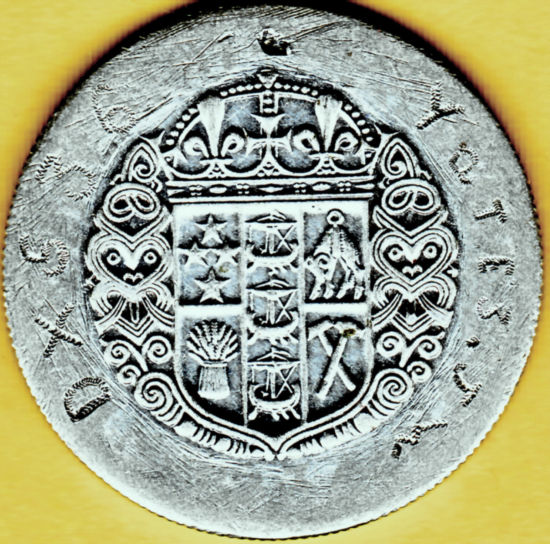 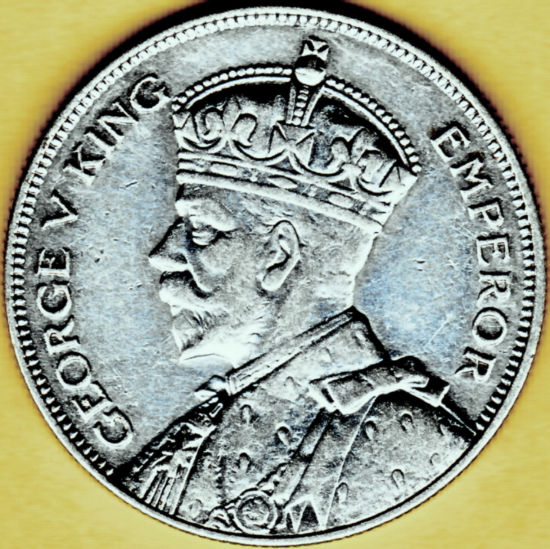 My guess is a serviceman's name and service number but the number doesn't seem long enough. My guess is a serviceman's name and service number but the number doesn't seem long enough.
Any suggestions?Apart from the deliberate modification it is quite high grade. Catalogue value of a normal coin like this, in this condition would be around $100. Jeff |
|
|
|
Moderator
 Australia
17031 Posts |
A "DX" prefix to their service number indicates this particular soldier signed up in Darwin, Northern Territory; given the low population of the Territory at the time, low numbers are to be expected. According to this website, John William Yates, DX536 was born in Melbourne in 1911, signed up with the Australian Army on 4th June 1940 and was discharged on 23 March 1944 with the rank of Gunner with the 6th Field Regiment Artillery. As to why an Aussie digger would choose a NZ halfcrown for his piece of trenchart... you'd have to ask him.  Don't say "infinitely" when you mean "very"; otherwise, you'll have no word left when you want to talk about something really infinite. - C. S. Lewis
|
|
Pillar of the Community
 Australia
877 Posts |
Sap,
What a surprise! Almost instant answer; I expected a long, drawn out process to establish the details.
Now the challenge is to see if I can find any family -they might appreciate to get it.
And, next question; why a New Zealand ½ crown?
Sap, I appreciate your information -PM me and I have a nice little token of appreciation to send you.
Thanks again,
Jeff
You can't best CCF for best information
|
|
Pillar of the Community
United Kingdom
2943 Posts |
Now that is proper numismatic history - what a great story.
|
|
Pillar of the Community
Australia
2830 Posts |
NAA Item barcode 5896678 refers.
The NT Pioneers index goes upto 1939.
I'll check whether Gunner YATES gets a mention when I get into the Library ...
One possibility is that he was a local (albeit born in Melbourne);
or he was here with the Regular Army, which had a large and growing garrison after 1938, and he "transferred" to the A.I.F. in 1940. The "X" in the service number indicates that he was in the AIF.
I won't go into the subtle significance of this at the moment ...
|
|
Bedrock of the Community
United States
10045 Posts |
Wow--I wouldn't have imagined you could research trench art so well--excellent!  |
|
Pillar of the Community
United States
1512 Posts |
I am sorry to resurrect this thread, but I wonder if Jeff ever found the family of the service man? That would be very cool if he did!
|
|
Moderator
Australia
17031 Posts |
Sadly, in many cases such as this one, it is likely that it is the family that has sold the pieces in the first place.
I recently was given a collection of coins and memorabilia by a friend of the family to sell on their behalf; their father had been a commando in WWII and had a collection of interesting military badges from his service, but nobody in the family wanted to keep them after he passed away.
Don't say "infinitely" when you mean "very"; otherwise, you'll have no word left when you want to talk about something really infinite. - C. S. Lewis
|
|
Pillar of the Community
Canada
5423 Posts |
"AS History fades away so do the people who Care for it". So sad but true. That is a reason my entire collection will be sold off whilst I am alive and sitting in the auction room with a jug of cold beer in my hand. Then with great pleasure off to the SPCA with a huge cheque. Then I can die in peace!
Back to the topic great research on this piece! I wonder if the reason he used the New Zealand piece was because it was a foreign coin and a large one at that. Made a great canvas for his artwork!
|
|
Pillar of the Community
United States
883 Posts |
Australia, after all, did not coin halfcrowns. Aside from a single experiment with the crown, the largest piece was the florin.
|
|
Pillar of the Community
Australia
539 Posts |
actually we had 2 crowns the 37 and 38
|
|
Pillar of the Community
United States
883 Posts |
I consider the two-year type crown of 1937-8 a single issue. You are free to differ.
|
|
Pillar of the Community
Hong Kong
1270 Posts |
Publius, I feel you know the fact behind why the 2-years crowns were issued. Were they struck for some other purpose than for circulation? Most of the 37 and 37 Crowns are not likely to be circulated in my opinion, I suspect they were issued not for circulation. Do any one know more about my concern?
|
|
Moderator
Australia
17031 Posts |
The 1937 crown was intended as a coronation commemorative. The reason behind the 1938 crown issue is more obscure, and the result of a thorough mis-interpretation of the mood of the coin-using population of Australia.
The 1937 crown was originally conceived as a one-off commemorative coin for the coronation of Edward VIII; coin collectors had successfully lobbied the government to issue crowns, and federal Treasurer Richard Casey pushed the concept through parliament. Edward's abdication caused the original coronation to be replaced with that of his brother George VI, but the commemorative crown went ahead.
Basically, the 1937 crown was kept in large numbers as souvenirs of the coronation (and perhaps as a reminder of the whole Edward VIII abdication thing as well); very few of them were being returned to the banks. The government interpreted this statistic as actual use in circulation, so they concluded that there must be a high enough demand for the crown denomination to continue issuing them for circulation. It possibly isn't also a coincidence that striking a single crown is more profitable for the government than striking five one-shilling coins, adding to the attraction of continuing the crown issue.
The people, particularly the media (which lampooned the coins as "Casey's cartwheels") quickly set about correcting the government's mis-interpretation, which was confirmed by the resultant very low demand (and high return rate) of 1938 crowns. The issue was therefore discontinued partway through 1938, leaving a much smaller mintage in the second year (and, ironically, making that year much more desirable today).
Don't say "infinitely" when you mean "very"; otherwise, you'll have no word left when you want to talk about something really infinite. - C. S. Lewis
|
|
Pillar of the Community
Hong Kong
1270 Posts |
Great story behind the Australian crown 1937 and 38! Thank you Sap.
|
| |
Replies: 14 / Views: 3,936 |
|







 Posted 05/27/2011 05:42 am


