











 Posted 07/25/2011 11:55 am


PS first!... The Rooswijk has produced some really nice specimens that while still "salvage", have little-to-no corrosion and good eye appeal...
-------
I don't know exactly why they did what during that transition period of 1732-34, based on what needs/shortages... In 1733, they made cobs, klippes, a klippe/cob hybrid AND milled Pillar 8R (and even a few trial round klippes!).
The klippes were made using new style dies, but on still hand cut often-squarish planchets. They weren't "technically" the same as cob planchets, however. The klippe planchets were chopped from relatively flat/even sheets of silver, which made for much more level striking surfaces than seen on cobs, and thus the rather even imparting of detail normally seen on these. Of course, the sheets didn't always come out perfectly similar, so you get some variation in thickness vs. diameter and how level the striking surface turned out.
The caveat to this is that there do exist pieces that are COB planchets but struck with KLIPPE dies. It can be a bit difficult to distinguish, as it seems from amateur observation that some of the known cob planchets in that last year (1733) were rather broad/level, as if they were incorporating part of the klippe planchet technique into how they produced them.
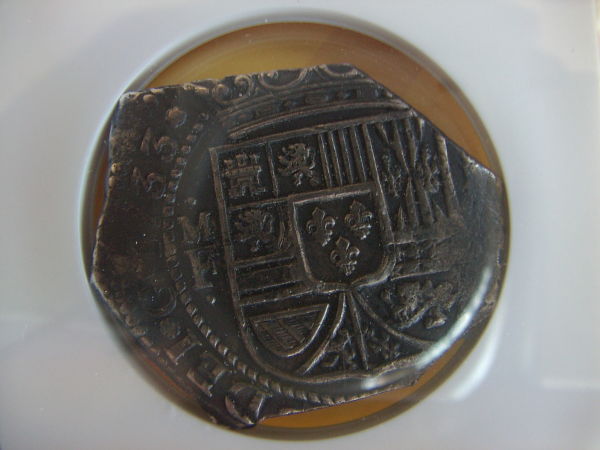
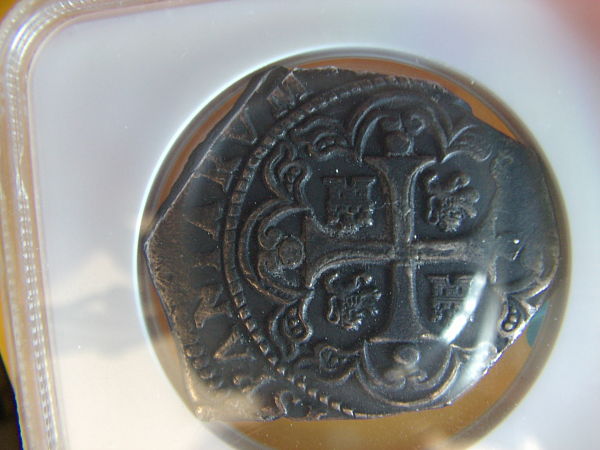
Your piece is absolutely genuine and is nicely toned... I think there's a possibility, however, that it could be klippe dies on a really nice cob planchet. The planchet seems a bit more compact than most klippes, and there is a slight flat spot (corresponding on the shield and cross sides)... The strike overall, however, IS quite even overall... I really can't say for sure, I just don't know them well enough. I'd run it by Sedwick or Ponterio.
Here's a photo of the three different types from a Sedwick auction (off the Rooswijk... they included a 1733 Pillar 8R to complete the variety set). The one on the L is obviously cob, on the are obviously klippe, and they attribute the center piece as klippe dies on a cob:

-------
I don't know exactly why they did what during that transition period of 1732-34, based on what needs/shortages... In 1733, they made cobs, klippes, a klippe/cob hybrid AND milled Pillar 8R (and even a few trial round klippes!).
The klippes were made using new style dies, but on still hand cut often-squarish planchets. They weren't "technically" the same as cob planchets, however. The klippe planchets were chopped from relatively flat/even sheets of silver, which made for much more level striking surfaces than seen on cobs, and thus the rather even imparting of detail normally seen on these. Of course, the sheets didn't always come out perfectly similar, so you get some variation in thickness vs. diameter and how level the striking surface turned out.
The caveat to this is that there do exist pieces that are COB planchets but struck with KLIPPE dies. It can be a bit difficult to distinguish, as it seems from amateur observation that some of the known cob planchets in that last year (1733) were rather broad/level, as if they were incorporating part of the klippe planchet technique into how they produced them.
Your piece is absolutely genuine and is nicely toned... I think there's a possibility, however, that it could be klippe dies on a really nice cob planchet. The planchet seems a bit more compact than most klippes, and there is a slight flat spot (corresponding on the shield and cross sides)... The strike overall, however, IS quite even overall... I really can't say for sure, I just don't know them well enough. I'd run it by Sedwick or Ponterio.
Here's a photo of the three different types from a Sedwick auction (off the Rooswijk... they included a 1733 Pillar 8R to complete the variety set). The one on the L is obviously cob, on the are obviously klippe, and they attribute the center piece as klippe dies on a cob:


